

Sex after prostate cancer
Sex after prostate cancer is an online training program built to help clinicians care for the sexual health of people affected by prostate cancer, and of their partners.
It draws on the world's first Clinical Guidelines for Sexual Health Care for Prostate Cancer Patients. It also draws on the lived experience of patients and partners, and on clinicians who've already built this work into their everyday care.
Attention to diversity, inclusion and cultural appropriateness runs throughout.

This course encourages you to:
- Examine the ways your own and society's attitudes, values and biases shape your beliefs about sexual health, and where they narrow the care you offer
- Understand how patients and their partners struggle to maintain a sexual life after prostate cancer, and what they say they need
- Develop the knowledge and skill to assess sexual health concerns, work out what is happening, and provide resources and interventions for the problems that commonly arise in prostate cancer care
- Work effectively with the team around you: to receive referrals well, to refer on when something sits beyond your scope, and to make sexual health care a routine part of your service
Before you begin
How to navigate this course
Click each section below to see the button it refers to light up. Give it a try.
Before you begin
Frequently Asked Questions (FAQs)
Select any question to expand the answer.
There are four modules, and they'll take around 13 and a half hours in total. Each one breaks into lessons of 15 to 50 minutes, and most are 30 minutes or under. You can finish something meaningful between clinics. Your progress saves automatically, so you can stop part-way through a lesson and pick up where you left off.
Yes. The four modules run in sequence, because each one assumes the one before it. You'll need to finish all four to complete the course.
The lessons and the practice activities are what the course asks of you, and you'll need to work through those. Anything marked as an optional reading or a full-length film is there if you want it, and you can skip all of it and still complete the module.
Headphones, if you'd like to listen with sound. Every film is captioned and has a full transcript, and the course works on a laptop, a desktop or a phone.
This module is designed to work with standard screen readers, including JAWS, NVDA and VoiceOver. Interactive elements are keyboard navigable, films have transcripts, and you can adjust the text size, switch to night mode or turn on reduced motion using the settings button.
We think so. Clinicians often tell us the hardest part of these conversations is finding the words and using them with ease. The course models that, using direct anatomical and sexual language and showing real consultations about sex. It can feel confronting at first, and it's worth knowing before you start rather than it be a surprise in Module 3.
This course covers sexual health after prostate cancer: erections, desire, intimacy, body image, and the emotional side of those changes. Some of it may feel personal. Go at your own pace, take a break when you need to, and come back when you're ready. If anything brings up more than you expected, please seek supports available within your organisation.
Acknowledgement of Country
This course was created in Melbourne, on the lands of the Wurundjeri Woi Wurrung people of the Kulin Nation, with input from clinicians, researchers and people with lived experience across the world.
Movember acknowledges the Traditional Custodians of Country throughout Australia and the many Countries on which this work was shaped. We recognise the continuing connection to land, waters, community and culture, and the enduring knowledge systems of health, healing and care. We pay our respect to Elders past and present, and extend that respect to all Aboriginal and Torres Strait Islander peoples today.
This course is taken on many lands around the world, and we acknowledge the Traditional Owners and Indigenous peoples of each of them.
How this course works
A few things about how this course runs, because it asks something slightly different of you than most.
You'll practise, not just read. Thirteen times across the four modules you'll rehearse the conversation itself.
Sometimes a real consultation stops part-way through, and you choose what to say next, then see what the clinician said. Sometimes you'll be asked to say a difficult question out loud, in whatever room you're in, before you see how experienced clinicians put it.
You're building a toolkit. Assessment prompts, phrasings for difficult subjects, patient handouts and your own referral map. It travels with you, and you can email or print it at any point.
Your reflections are private. They're saved to your own device, never uploaded, and yours to export.

What this course covers
Module 1
Foundations
The conversation that's not always had, getting ready to ask, how sex works and how cancer changes it, what each treatment does, and what partners carry.
Module 2
Assessment and Models of Care
The integrated model, PLISSIT and PRISM, taking a sexual history in depth, the words for the difficult parts, and turning what you've heard into a plan.
Module 3
Intervention
Working with couples, intimacy, sensate focus, erectile and penile rehabilitation, pro-erectile therapies, and androgen deprivation therapy.
Module 4
Inclusive care and your professional practice
Gay and bisexual men, trans women and gender non-conforming people, boundaries and ethics, and becoming the referral destination where you work.
Ready? Let's start with Module 1: Foundations.
Module 1: Foundations
1.1 The conversation that's not always had
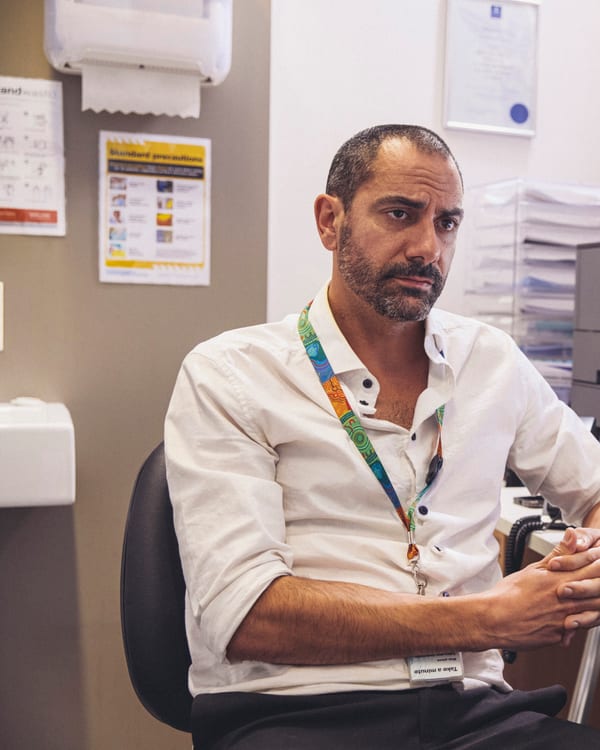








Learning outcomes
This module builds on your existing clinical skill and experience and helps you apply them in an area most clinical training leaves out.
By the end of this module you'll be able to:
- Explain why sexual health care belongs as part of prostate cancer care and what the silence costs patients and their partners.
- Recognise how your own assumptions, values and comfort shape the care you offer, and what to do about it.
- Describe sexual function and the models of sexual response used in this field, including why a linear model fails many couples after treatment.
- Describe the effects of surgery, radiation, androgen deprivation therapy and chemotherapy on sexual function, beyond erectile function alone.
- Recognise what partners experience, and why they are so rarely asked about it.
Let's start with Anthony
Anthony is 62 and starts radiation therapy for prostate cancer in a month. He's recently divorced and was dating before his diagnosis.
Press play to hear his clinician introduce the case. The clinician sets out three challenges that men in Anthony's position often face: not knowing what to expect from treatment, deciding what to tell someone new, and beliefs about masculinity that can stop men from asking for help.
You'll follow Anthony through the course, from his first appointment at the sexual health clinic to a year after treatment. You'll sit in on that appointment later in this module.
The clinician and the interviewer
0:00So, uh, Dr. Matthew, thank you for joining us. Would you like to let us know a little bit about the case that you're going to present today? Absolutely. He's a, uh, 62-year-old man, um, who is going to undergo radiation therapy in about a month's time.
0:15And, uh, he single, uh, actually recently divorced and has been on the dating scene for a period of time prior to being diagnosed.
0:27Uh, and so now he's just, uh, learned about his diagnosis. He's consented for treatment with radiation therapy and, uh, I will be carrying him through, uh, what often occurs with single men under these conditions. And what are some of those challenges that men might face, men Might face? So first of all, it's, it's, uh, it's the many times these men will not know what to expect over time, uh, with the radiation treatment.
0:57So we'll talk about what is the direct impact of the radiation therapy on erectile functioning so that it helps with them in terms of, uh, uh, expectation and uncertainty. So the more they know, the less uncertain they are. Also, we talk to 'em about the use of, uh, pro-erectile aids and devices, uh, to encourage, um, penile rehabilitation in some ways, but also to encourage ongoing sexual activity over time.
1:24Another big issue, uh, as you can imagine, which differs from couples is disclosure. Mm-hmm. Right? So you start dating, uh, how do you go about, um, telling the, the person you're dating, um, or how do you, uh, respond to the fact that you may not be functioning as well as you had previously done? Right. And how do you deal with that, uh, under new dating circumstances? That's also quite common.
1:50Absolutely. I can imagine it might be challenging to disclose all that kind of information in a new relationship. Absolutely. Absolutely. And the other is that, um, we have to think about there gonna be the masculine belief system. Right. So, and it's influence on this. And generally, um, if men carry these relatively strong masculine beliefs, then they'll have the belief that, uh, that they don't wanna show vulnerability or weakness, for instance. They also, uh, they'll feel that they could fix it themselves, and so they don't embark on social support or even our services. Um, and, um, and that, uh, if it's difficult or it becomes difficult and they're unable to fix it on their own, then the tendency is to withdraw. Now we'll have to see whether, uh, Anthony mm-hmm. Uh, carries some of those beliefs and if so, we'll discuss them. Okay. And why do you think a program like the Sexual Rehabilitation Clinic is important for these kinds of men?
2:54I think, um, I mean, we know that, uh, in investigating, uh, the quality of life of men who have been, uh, diagnosed and treated for prostate cancer, that it does affect several domains, uh, in their quality of life. One and one most affected, uh, is their sexual functioning.
3:14Mm-hmm. And more to that, um, bother associated with that. So it's not only that they have a reduction in sexual functioning, but they're distress related to that sexual dysfunction Okay. Is highest amongst all the domains of quality of life.
3:29So the sexual health programming, um, helps them so that they can understand what lies ahead of them that they have, uh, support as they go through it, both biomedical support and psychosocial support so that they can adapt and accept the situation most successfully. Great. Well, thanks. Thank you very much.
1.1 The conversation that's not always had
The moment that mattered had already passed

For most men you'll meet in this course, one appointment decides everything: the one where the treatment is chosen.
The man is told he has cancer. He is told his options. He is asked to choose and often that decision is made within the hour.
The appointment is also usually the only time anyone mentions what treatment will do to sexual function, if it is mentioned at all.
A study following 211 men with urological cancers found that only 23.2% said sexuality was addressed by their clinician at diagnosis1.
It's worth slowing down on this moment, because it's what the whole course is built around, and it's missed far more often than it's caught.
What Anthony heard
Anthony's doctor did mention sex when they talked through radiation therapy. Ask Anthony what he was told, and he'll say there probably wouldn't be much impact and that he should recover fully.
Picture the appointment. He's just been told he has prostate cancer. There's a lot to take in – survival rates, surgery or radiation, recovery times and what any of it means for his life. Sexual function got a sentence, and the part he kept was the reassuring one.
He left with a treatment chosen and an expectation that wouldn't survive the next eight months.
Now picture a couple
Same news, same room, but this time a partner is beside him.
Prostate cancer. Treatment options. Recovery times. Part-way through the doctor mentions briefly, and only once, that treatment can affect sexual function.
Nobody picks it up. Not the man who is still processing the word cancer. Not his partner, who hesitates: it doesn't feel like their place, and it feels small next to survival. Not the doctor, who said the words and moved on.
This time the silence lands on two people. In one survey of physicians treating cancer patients, 44.4% said they never or rarely include the patient's partner as standard practice when sexual health is discussed at all2.
The point: In both rooms, sexual health was technically covered and functionally absent. That gap is where the decisional regret begins3.
1.1 The conversation that's not always had
Eight months later
Anthony is cancer-free.
But he can't get an erection, he's leaking urine during sex, and his sex drive is gone. It's been 8 months since he completed his last radiation treatment. He didn't think he'd be having these problems so many months after treatment had finished. He has many anxious thoughts:
- Are these issues permanent?
- Can they be fixed?
- And where does he go for help?
And there's something else. Anthony has just started a new relationship. They don't know he was treated for prostate cancer.
Should he tell them? How much? How do you raise erectile dysfunction with someone new? Should he be dating at all like this?
Some days he doesn't feel like much of a man.
Anthony doesn't feel adequately prepared for this. So when it came, he had no framework for it and nowhere to take it, and he's treating it as a private failure, rather than a known and expected consequence of his treatment.
For a couple, the same symptoms play out differently
The changes are the same. What happens next isn't.
He ties erectile function to being a man and a husband, so the loss reads as a loss of himself. He withdraws. He hasn't touched his partner in months. In turn, the partner reads withdrawal as rejection.
He can't find the words to explain that it isn't. Neither of them can find a way to say they still want closeness. The silence that started in the consulting room has now moved into their home, and it's costing them intimacy and closeness.
You would normally come home and probably be a little bit frisky with the missus or things like that. It just disappears, and you don't know why. And you can't explain it, but she feels it.
I completely shut my wife out of the process, completely. I didn't allow her to fulfil the role I know she wanted to.
He beat cancer. Nobody prepared him for what he'd lose along the way.
1.1 The conversation that's not always had
This isn't a niche problem
Between 81 and 93 per cent of people treated for prostate cancer report that it affected their sex life4. The range depends on the treatment and the measure used.
What share were offered no support for it at all?
Drag the slider to your best guess, then lock it in.
56% were offered no support for it at all.
That second figure comes from Life After Prostate Cancer Diagnosis, a study of nearly 36,000 men across the UK. It remains the largest dataset we have on what happens after treatment5.
Almost everyone is affected, and more than half of them get no help.
1.1 The conversation that's not always had
Why one mention is never enough
Four reasons this keeps happening, none of them is about clinicians not caring:
- A man at diagnosis cannot always hear it. Information about sexual function is competing with mortality, and it loses every time. Saying it once, at a catastrophic point, is not the same as telling him.
- He can't imagine it until he's living it. Erectile function, ejaculation, sensation, desire, continence, body image – abstract in a consulting room but a reality eight months later. He can't weigh what he can't picture, and that's precisely what produces regret.
- Partners are rarely spoken to directly. Nearly half of clinicians never or rarely include partners in the conversation2. Addressing only the patient means the partner doesn't get permission to enter the conversation and no support when the changes arrive.
- We don't feel equipped. The most commonly cited barriers clinicians face in this area are lack of training, lack of time and discomfort with the topic.
The take home point:
- Raise it before treatment is chosen.
- Raise it again after treatment ends.
- Describe what will actually change, not just that something might.
- When there's a partner in the room, speak to them too.
- And leave the door open, every time, so he knows where to come back to.
1.1 The conversation that's not always had
Every treatment, not only surgery
Surgery, radiation, hormone therapy and chemotherapy all affect sexual function to some extent. The effects of these reach beyond erections and include:
Before you look: which effects beyond erections can you name?
- loss of desire and libido
- dry orgasm
- perceived changes in penile length
- leaking urine during sex
- pain
- fatigue
- altered or absent orgasm
Sexual dysfunction is the most frequently reported unmanaged side effect of prostate cancer therapy.
We'll come back to each treatment in detail in Lesson 1.4.
1.1 The conversation that's not always had
Quality of life understates it
Sexual dysfunction gets filed under altered quality of life and set aside, which is broadly what has happened for thirty years. The consequences are more serious than that framing suggests.
Open each marker to see what that consequence looks like.
Mental health
Sexual dysfunction after prostate cancer is associated with higher rates of depression, anxiety and suicidality.
Relationships
People withdraw, and partners read that withdrawal as rejection. Neither of them has the language to correct it. Relationships that survived the cancer don't always survive the silence.
Decisional regret
Someone who doesn't know what a treatment will do to their sex life can't make a real choice between the options.
Equity
Outcomes are consistently worse for men in rural and remote areas, men who don't speak the dominant language, gay and bisexual men, trans people, Black men, Indigenous men, and men without reliable internet access.
Open each one to read what the study found.
Lehto and colleagues surveyed 1,239 men five years after prostate cancer diagnosis, across surgery, both radiotherapies, hormone therapy and surveillance, and found that between 81 and 93 per cent reported that treatment had negatively affected their sex lives. The range reflects the treatment4.
Access the paperThe Life After Prostate Cancer Diagnosis study surveyed 35,823 men across the UK between 18 and 42 months after diagnosis. It remains the largest study of post-treatment quality of life in this population, and it's the source of the finding that 56 per cent were offered no support for sexual difficulties5.
Access the study
It affected our sexual activity, but living was more important.
CM, diagnosed at 56, treated with surgery

1.1 The conversation that's not always had
Nobody had written it down
The knowledge already existed. It was scattered across urology, nursing, psychology and physiotherapy, and nobody had ever pulled it together into something a clinician could use in a consultation.
In 2015 Movember convened a global working group, chaired by Dr. Daniela Wittmann (University of Michigan) and co-chaired by Professor Eilis McCaughan (Ulster University) and a decision was made to synthesise what all the disciplines already knew separately. Professor McCaughan died in 2020, before the work was published but much of what follows exist because of her.
Between 2017-2021, the team grew to include oncologists, sexual medicine urologists, primary care physicians, psychologists, social workers, nurses, physiotherapists and the men and their partners who had gone through the treatment.
In 2022, the group published the world’s first Clinical Guidelines for Sexual Health Care for Prostate Cancer Patients: 47 statements and recommendations, and the first time anyone anywhere had done this.
1.1 The conversation that's not always had
The biopsychosocial model of sexual health care
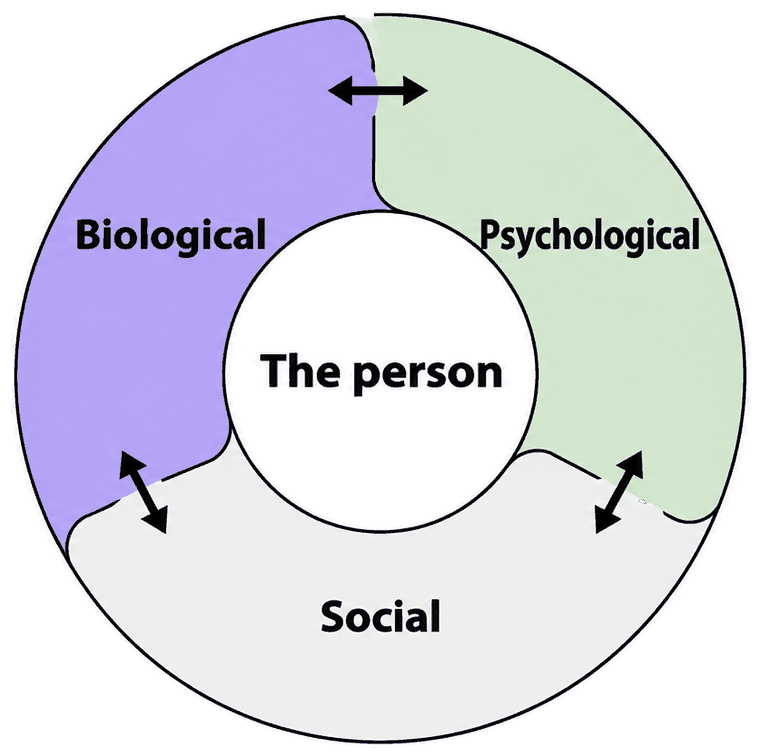
The Guidelines view sex through a biopsychosocial lens, and recommend caring for men and their partners holistically which includes the biological, psychological and social impacts together.
Using that lens matters for the whole person and the world they live in. Someone whose erectile function has been restored by medication, but who hasn't spoken to their partner about any of this in eight months, hasn't really been helped. A couple who have quietly redefined intimacy without erections may need nothing further from you at all.
This course is built on that principle. You'll meet it again in Module 2 as the integrated model of sexual health, and you'll use it every time you formulate: every time you draw the three together into one working explanation of what's happening for the person in front of you.
1.1 The conversation that's not always had
The first guideline is the one nobody does

Of the 47 recommendations in the Guidelines, the first is the simplest: ask. Raise sexual health before a man chooses his treatment, and keep raising it afterwards.
Not asking the question closes the door on understanding one's health. This is what it costs:
Looking back, I would have asked my doctor what my options are. Because I now have erectile dysfunction, urinary incontinence, and all the doctor said was I'm living. I'm alive, but I'm not living.
The knowledge exists and the guidelines exist. What's missing is the conversation, and that's what this course is about: the first guideline, and what to do once someone has been referred to you.
1.1 The conversation that's not always had
Before we go on, think about the last man you treated for prostate cancer.
Do you know whether anyone discussed the sexual consequences with him before he chose his treatment? Not whether it was in the consent form, but whether a conversation happened.
If you don't know, that's an answer worth sitting with.
References
- Barros, R., Fosse, A. M., Jr., Schul, A., Mangas, G., Teixeira, C. H. da S., Ninis, T., Carvalho, J. P. M., & Favorito, L. A. (2025). Impact of diagnosis of urologic cancer on male sexuality and patients' perceptions of health professional's approach. International Brazilian Journal of Urology, 51(4), Article e20259910.
- Camejo, N., Montenegro, C., Amarillo, D., Castillo, C., & Krygier, G. (2024). Addressing sexual health in oncology: Perspectives and challenges for better care at a national level. ecancermedicalscience, 18, 1765. https://doi.org/10.3332/ecancer.2024.1765
- Fanshawe, J. B., Chan, V. W.-S., Asif, A., Ng, A., Van Hemelrijck, M., Cathcart, P., Challacombe, B., Brown, C., Popert, R., Elhage, O., Ahmed, K., Brunckhorst, O., & Dasgupta, P. (2023). Decisional regret in patients with localised prostate cancer: A systematic review and meta-analysis. European Urology Oncology, 6(5), 456–466.
- Lehto, U.-S., Tenhola, H., Taari, K., & Aromaa, A. (2017). Patients' perceptions of the negative effects following different prostate cancer treatments and the impact on psychological well-being: A nationwide survey. British Journal of Cancer, 116(7), 864-873. https://doi.org/10.1038/bjc.2017.30
- Downing, A., Wright, P., Hounsome, L., et al. (2019). Quality of life in men living with advanced and localised prostate cancer in the UK: A population-based study. The Lancet Oncology, 20(3), 436-447. https://doi.org/10.1016/S1470-2045(18)30780-0
Module 1: Foundations
1.2 Getting ready to ask
Recommended: the next 3 lessons in one sitting
Lessons 1.2, 1.3 and 1.4 each end in a rehearsal, and each rehearsal builds on the one before it. Together they run to about 2 hours, which we know is a long stretch to find in a working week. You can stop anywhere and the course will hold your place, though you'll get more from these three if you can take them close together.
A note before we begin
It starts with you
When clinicians are asked what stops the sexual wellbeing conversation happening, the answer is rarely about the patient. Research across the field points to the same place: the clinician's own comfort, confidence and preparation1.
Practitioners have their own internal hangups and biases, difficulties, religious beliefs … that are creating sort of a barrier and that generates discomfort in them and anxiety in them to even broach the topic.2
Patient factors are hard to shift. Comfort and confidence are learnable, and they're built through language you've practised and a structure you trust. They also come from knowing what to do with the answer once you get it, which is what this course sets out to give you.
You may also be the last person in the pathway who can ask, which makes your version of this conversation matter more than most.
1.2 Getting ready to ask
Assumptions that quietly close a door
These examples came up unprompted when clinicians were asked what gets in the way, and none of them involves anyone behaving badly.
Before you look: what have you heard yourself or a colleague assume about a patient’s sex life?
Open any of them for what that one looks like in practice.
The assumption tends to arrive once a patient is in their sixties or seventies, and it's rarely tested.
The type of sex that you think they should be having because that's the type of sex that you want to have.
A clinician described an oncology consultant who said he'd never had a gay patient. The reply: So what you're actually telling me is you've never asked a question in 20 years.
Each of these looked reasonable to the person making it. That's what makes them hard to spot in your own practice.
1.2 Getting ready to ask
Open each one to read what the study found.
Seymour-Smith, Wetherell and Phoenix analysed the way doctors and nurses talk about the men in their care, and found that clinicians' accounts consistently served to 'indulge and protect' stereotyped ideas of masculinity, treating men's reluctance, stoicism or bravado as simply how men are, rather than as behaviour shaped by socialisation3.
Access the paperSamulowitz and colleagues reviewed 77 studies on gender bias in pain treatment4. Where men minimised their pain, clinicians tended to accept the account at face value, even when it may have been masking significant suffering. The response in both directions was shaped by gendered assumptions about how people experience and express pain.
Access the paper
1.2 Getting ready to ask
A more useful question than bias
Bias is an uncomfortable word, and not a very useful one. It invites you to work out whether you're a good person, which is hard to answer and harder to act on.
More specific questions you can ask yourself:
- What do I not ask about?
- Whose sex life do I assume I already understand?
- Which patient makes me move faster through the sexual history?
Each of those has an answer, and an answer you can name is something you can change on Monday morning.
Take those three questions one at a time, and answer them about your own clinic rather than in general.
- What do you not ask about?
- Whose sex life do you assume you already understand?
- Which patient makes you move faster through the sexual history?
Be specific. A named patient will be far more useful to you here than a category.
1.2 Getting ready to ask
The fixing instinct
There's a second thing in your way, and it happens to be the thing you were trained to do.
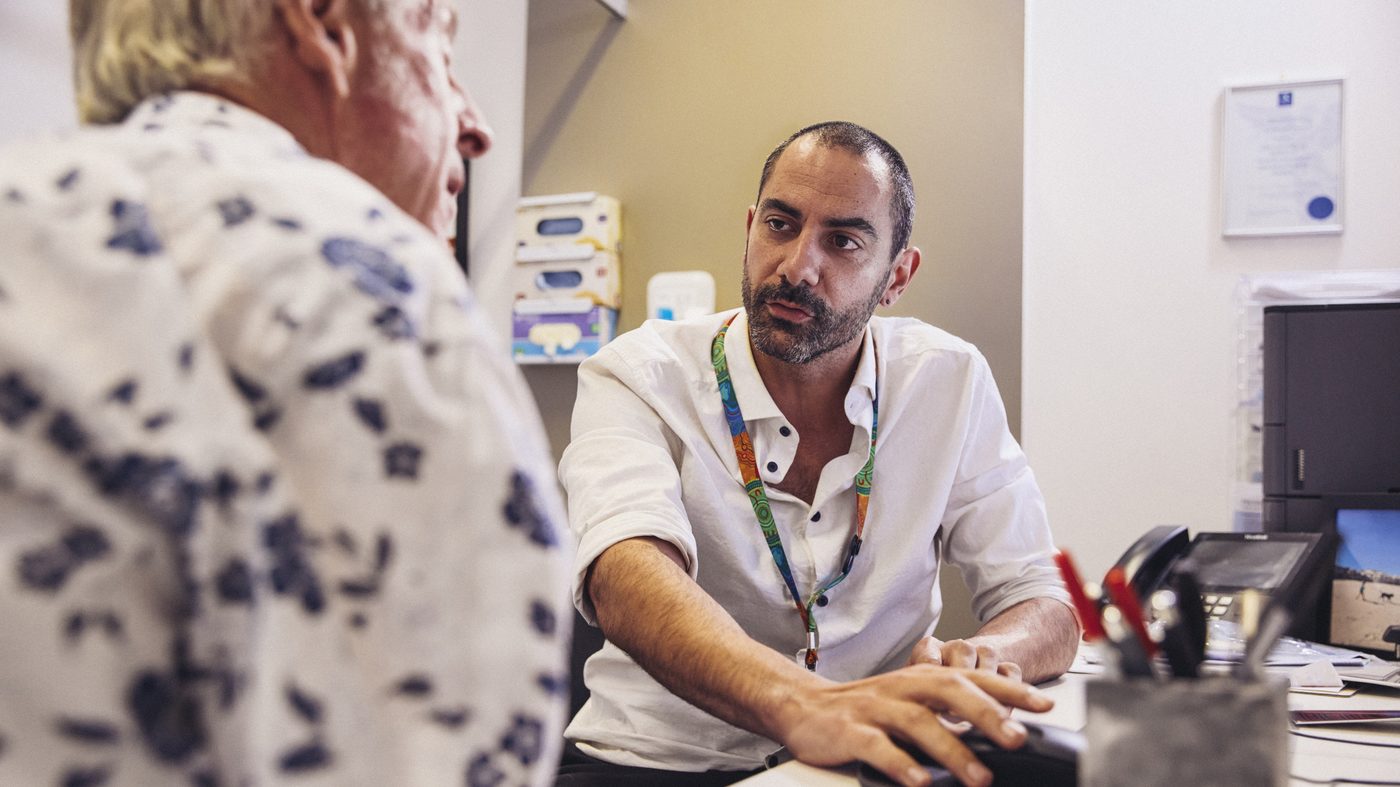
One clinician put it this way:
The ability to listen and not jump in and fix. The confidence to allow people to be uncomfortable and not be scared that you can't fix them.
This urge to fix is a good instinct, built by years of clinical training, and it's frequently what the person came for. It just isn't always what's needed. Sometimes being heard is the help, and the conversation is the fix.
1.2 Getting ready to ask
When to fix, and when not to
You'll fix a great deal in this course: erectile rehabilitation, pro-erectile therapies, sensate focus, symptom management. That's the job.
The skill lies in recognising which of three situations you're actually in.
- Fix it when there's a treatable mechanism and the person wants it treated.
- Don't fix it yet when they're still describing the problem. A solution offered at minute two ends the history at minute two, and you'll spend the rest of the consultation treating something they hadn't finished explaining.
- Don't fix it at all when the loss is real and permanent, and what's needed is for someone competent to sit with that without flinching. Someone whose erections won't return doesn't need a fifth device. They need a clinician who can say so and stay in the room.
1.2 Getting ready to ask
Say it out loud
This is the first of 13 rehearsals in the course, and they work considerably better if you do them rather than reading past them.
You're with a patient three months after a radical prostatectomy, and you need to ask whether they're leaking urine during sex.
Say the question out loud, now, in whatever room you happen to be in.
Some phrasings that work
Some people find they leak a little urine during sex, or when they orgasm. Has that happened to you?
One thing I ask everyone after this surgery: any leaking during sex?
Climacturia is leaking urine at orgasm. It's common after this operation and there are things that help. Is it something you've noticed?
Notice what they have in common. Each one names the thing plainly, signals that it's ordinary rather than shameful, and makes it easy to say yes.
Every phrasing in this module is collected in a conversation guide on the Resources screen.
1.2 Getting ready to ask
Why saying it aloud matters
Research into sexual health conversations has shown that awkwardness is audible.

If you sound awkward, it becomes awkward, and then the person doesn't engage as well in the conversation.
Talking around the subject broadcasts the same discomfort.
If we overly talk around it, we are saying, I'm not really comfortable talking about that.
Clinical education reaches for more knowledge when a clinician sounds uncomfortable. What settles a voice is having said the words often enough that they stop arriving with a wince attached. Which is why this course will keep asking you to speak them aloud.
1.2 Getting ready to ask
Your own history with this
Every clinician arrives carrying a sexual history of their own. What they were taught, what was never mentioned at home, and what they find easy to say now.
You won't be asked to share any of it. It's in the room whether you've reflected on it or not. The clinicians who have reflected on their own understanding of sexuality are consistently the ones who find the conversation easiest.
What follows is a values exercise originally developed for men and partners affected by prostate cancer. We're using it on you first, before you ever use it with anyone else.
Work through these in order. Nothing here is shared or uploaded.
- Where did you learn what sex is for? Name the sources rather than the values.
- Which of those did you keep, and which did you discard?
- What is sex for, in your view, at seventy? At eighty-five?
- Which sexual practice would you find hardest to discuss without any reaction showing on your face?
- What would a patient have to say for you to feel out of your depth?
Question four is the one that changes practice. Answer it honestly and you'll know exactly where you need to rehearse.
References
- Dyer, K., & das Nair, R. (2013). Why don't healthcare professionals talk about sex? A systematic review of recent qualitative studies conducted in the United Kingdom. The Journal of Sexual Medicine, 10(11), 2658-2670.
- Charlick, M., Tiruye, T., Ettridge, K., O'Callaghan, M., Sara, S., Jay, A., & Beckmann, K. (2024). Prostate cancer related sexual dysfunction and barriers to help seeking: A scoping review. Psycho-Oncology, 33(8), e9303. https://doi.org/10.1002/pon.9303
- Seymour-Smith, S., Wetherell, M., & Phoenix, A. (2002). 'My wife ordered me to come!': A discursive analysis of doctors' and nurses' accounts of men's use of general practitioners. Journal of Health Psychology, 7(3), 253-267. https://doi.org/10.1177/1359105302007003220
- Samulowitz, A., Gremyr, I., Eriksson, E., & Hensing, G. (2018). 'Brave men' and 'emotional women': A theory-guided literature review on gender bias in health care and gendered norms towards patients with chronic pain. Pain Research and Management, 2018, 6358624. https://doi.org/10.1155/2018/6358624

They’ll feel that they could fix it themselves, and so they don’t embark on social support or even our services.
A clinician working in prostate cancer care
Module 1: Foundations
1.3 How sex works, and how cancer changes it
1.3 How sex works, and how cancer changes it
Why this lesson exists
You already know the anatomy. This lesson is about the model of sexual response you carry in your head, because that model decides what you ask about and what you count as a problem.
Two clinicians can see the same patient on the same afternoon and take completely different histories, one working from a linear model and one from a circular one. They'll reach different conclusions about what's wrong.
So this lesson is about the map rather than the parts.
1.3 How sex works, and how cancer changes it
The structures involved
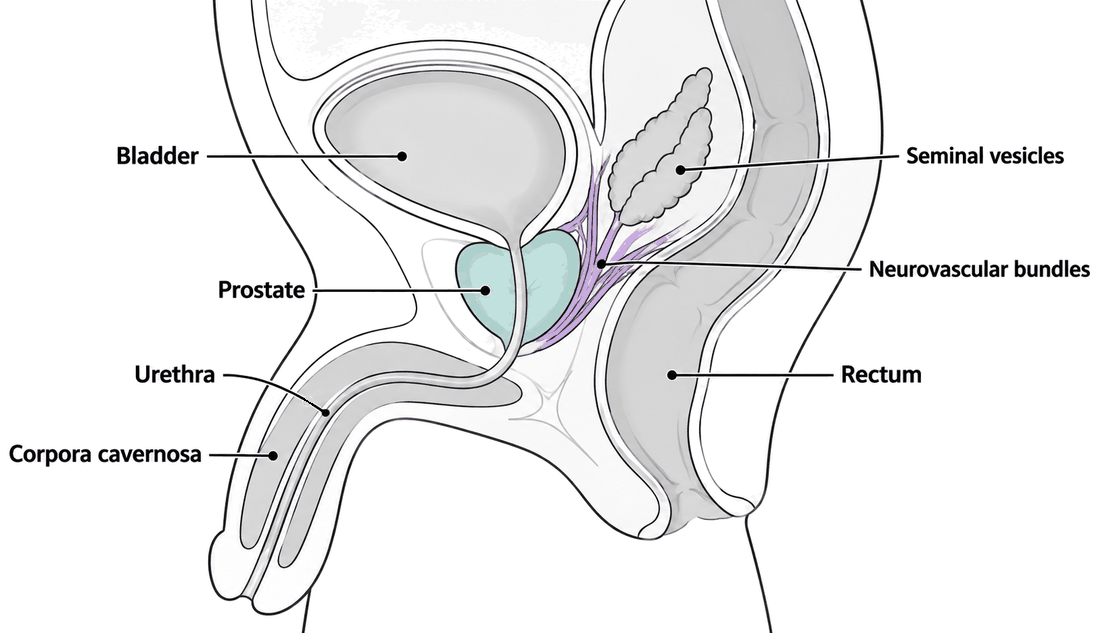
The prostate sits below the bladder, surrounding the urethra, and the neurovascular bundles carrying the nerves responsible for erection run along either side of it. They're close enough to the gland that surgery in this area puts them at risk even in expert hands.
Erection itself is neurovascular. Arousal signals cause smooth muscle in the corpora cavernosa to relax, blood fills the sinusoids, and the expanding tissue compresses the veins that would otherwise drain it. Damage the nerves and the signal doesn't arrive; damage the vessels and the tissue doesn't fill.
Emission and ejaculation are separate processes again, and separately vulnerable, which is why someone can have an orgasm without producing any semen at all.
1.3 How sex works, and how cancer changes it
Three things that get conflated
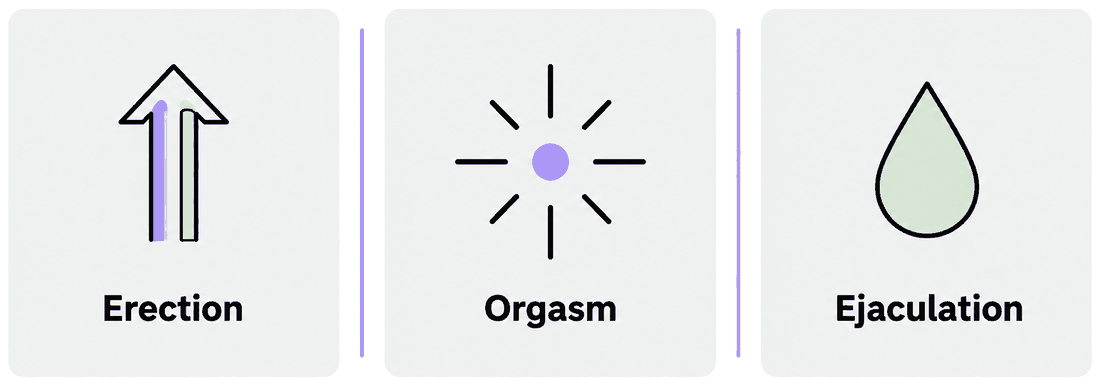
Erection, orgasm and ejaculation are separate processes with separate mechanisms, and prostate cancer treatment can affect any or all of them.
Someone can have an orgasm with no erection, or an erection with no orgasm. Almost everyone who has had a radical prostatectomy will have orgasms with no ejaculate at all, because the structures that produce it have been removed.
A man eight months after a radical prostatectomy tells you his sex life is ruined. From that sentence alone, which of the three has he lost?
Nothing in that sentence tells you which one he means — and the three have different mechanisms, different prognoses and different answers.
If you don't separate these three when you take a history, you'll hear my sex life is ruined without knowing which of them they mean. Separating them tells you what has actually been lost, and what might be recoverable.
1.3 How sex works, and how cancer changes it
The linear model of sex – the script we first learned

Masters and Johnson described sexual response as a linear sequence: excitement, plateau, orgasm and resolution, to which Kaplan later added desire at the front.
Desire, then arousal, orgasm and then it's over. One direction, one destination.
As a description of a young man having sex he already wanted to have, in a body with no pathology and no ageing changes, it holds up reasonably well. And that's exactly what most of us learned.
This is where sexual scripts get written. Desire shows up unbidden. Erections arrive without being asked. Orgasm is reliable, and it's the point to sex.
The script is invisible precisely because it works.
Where the script breaks:
Then the body changes, through ageing, illness and treatment and the script doesn't.
Look at what prostate cancer treatment can actually change: erections, desire, orgasm, ejaculation, body image, incontinence and libido. If you run that list against the linear script, almost every stage of it is affected – but the script only has one obvious failure point, and that's the erection.
So that's where the man's attention goes. It can leave men or couples feeling frightened, out of practice and quietly grieving the sex they used to have all while measuring themselves against a sequence their bodies can no longer perform in that order.
Before the next screen. A man no longer gets spontaneous erections, but he still wants sex with his partner. Against the script above, what has he actually lost?
Desire may be entirely intact, and so may his capacity for arousal. What he has lost is the thing that used to open the sequence — which is not the problem the linear script would have you treat. The next screen is the model that describes it.
1.3 How sex works, and how cancer changes it
Basson's circular model
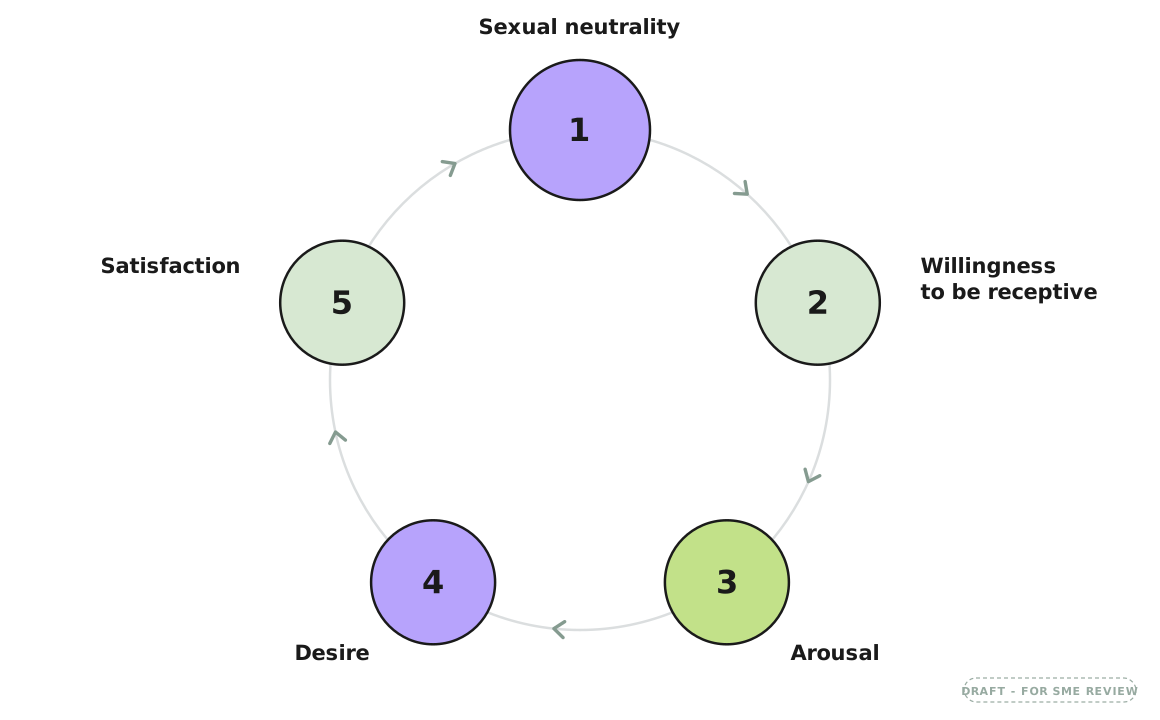
Rosemary Basson proposed something different, initially describing women's experience, and it has since been applied a good deal more widely – including to men after prostate cancer.
In her model many people begin from sexual neutrality rather than from desire. They choose to be receptive for reasons that are often relational rather than physical: closeness, reassurance, the wish to give something to a partner.
Arousal follows that choice, and desire, if it arrives at all, arrives after arousal rather than before it, and satisfaction may or may not involve orgasm.
Here is what it changes in practice. If desire follows arousal rather than arriving before it, then someone who no longer gets spontaneous erections has lost the thing that used to start the whole sequence. The desire may still be there. What's gone is the entry point, and that's a different problem with different answers.
1.3 How sex works, and how cancer changes it
Why the model you hold changes the history you take
The model in your head decides the questions you ask. It's rarely a conscious choice, and it shapes everything that follows.
A linear model asks what has stopped working
Has desire dropped? Are erections happening? Is orgasm still possible?
These are necessary questions. They're also, on their own, a checklist of loss, and if you only ask the ones that linear script makes obvious, you will ask about erections and stop.
That misses the altered or absent orgasm, the dry ejaculation, the leakage during sex, the pain, the loss of desire and the couple who simply stopped touching each other months ago.
A circular model asks what could work
What would make them receptive? What does closeness look like between them now? What is sex actually for in this relationship?
These questions can't be answered with yes or no, and that's the point. They tell you what this man or a couple are working towards, rather than only what they've lost.
The first set gives you a list of what has stopped working. The second gives you something you can build a plan on.
So even inside the linear model, ask about the whole sequence, not just the erection.
1.3 How sex works, and how cancer changes it
Put the history in order
A 63-year-old man is eight months on from a radical prostatectomy, and he tells you his sex life is ruined.
Six questions are worth asking. Which one do you ask first?
Select the six questions in the order you would ask them. Each one takes its number as you select it.
Correct: C. Start with his own word. He said his sex life is ruined, and you don't yet know what that means to him. This open question lets him tell you before you ask anything specific.
A. Second. Once he has told you what is wrong, ask about erections. He expects this question, and answering something familiar helps him settle.
F. Third. Ask about orgasm next, while you are both already talking about his body.
B. Fourth. Ask about his partner once you have covered his body. You need to know who else is involved before you talk about goals.
E. Fifth. Ask what he wants sex to look like. His goals make sense only once you know about his body and his relationship.
D. Last. Ask whether there is anything he hasn't told anyone. It is the most personal question, so save it for the end, when he trusts you most.
The order is C, A, F, B, E, D. Start open and in his words, cover his body, then his relationship, then his goals, and ask the most personal question last.
1.3 How sex works, and how cancer changes it
Sexual values, and why they matter more than function
Beck, Robinson and Carlson proposed a way of thinking about sexual motivation that turns out to be particularly useful in this population: the physical pleasure and relational intimacy model1.
Some people are motivated principally by physical pleasure, others by relational intimacy, and most by some combination of the two. The ratio is stable for them, and largely invisible to everyone else.
When prostate cancer treatment removes reliable erections, the person motivated mainly by relational intimacy will often adapt. The person motivated mainly by physical pleasure frequently doesn't and encouraging them to focus on closeness will land as a consolation prize rather than a plan.
Same diagnosis, same operation, two entirely different problems.
Open each one to read what the study found.
Basson revised and expanded the definitions of women's sexual dysfunction, setting out the circular, responsive model of sexual response that has since reshaped how sexual difficulty is understood well beyond women's health2.
Access the paperBeck, Robinson and Carlson developed the physical pleasure and relational intimacy model of sexual motivation, and showed that sexual values predict adjustment after prostate cancer treatment more usefully than measures of function alone1.
Access the paperMorck, McLeod and Robinson wrote the sexual function primer prepared for the IPODE project, which remains the clearest short account of sexual function written for an interprofessional audience3.
Access the module
1.3 How sex works, and how cancer changes it
Think of two patients you've treated who had the same procedure and adjusted to it completely differently.
What was different about what sex was for, for each of them?
And if you don't know, what would you have had to ask to find out?
References
- Beck, A.M., Robinson, J.W., & Carlson, L.E. (2013). Sexual values as the key to maintaining satisfying sex after prostate cancer treatment: The physical pleasure and relational intimacy model of sexual motivation. Archives of Sexual Behavior, 42(8), 1637-1647. https://doi.org/10.1007/s10508-013-0168-z
- Basson, R. (2005). Women's sexual dysfunction: Revised and expanded definitions. CMAJ, 172(10), 1327-1333. https://doi.org/10.1503/cmaj.1020174
- Morck, A.C., McLeod, D.L., & Robinson, J.W. (2011). Sexual function primer. Module prepared for the IPODE project.
- Masters, W.H., & Johnson, V.E. (1966). Human sexual response. Little, Brown and Company.
- Kaplan, H.S. (1979). Disorders of sexual desire and other new concepts and techniques in sex therapy. Brunner/Mazel.
Module 1: Foundations
1.4 What each treatment does
1.4 What each treatment does
Each treatment, and a different effect in each case
People are routinely told that treatment may affect sexual function.
Here are the four this lesson covers. What follows over the next few screens is what each one does, in the terms someone will experience it.
- Radical prostatectomy
- Radiation therapy
- Androgen deprivation therapy
- Chemotherapy, and active surveillance
1.4 What each treatment does
Radical prostatectomy
Turn each card to see what radical prostatectomy does to it.
 ErectionsTurn
Some degree of nerve injury is close to universal, even with nerve-sparing technique, because the bundles run across the surface of the gland. Where recovery happens it occurs over 12 to 24 months, and it isn't guaranteed.
 EjaculationTurn
Gone, permanently. The prostate and seminal vesicles produce almost all of the ejaculate and both are removed, though orgasm remains possible and people describe it as dry.
 Penile lengthTurn
Shortening is common and consistently under-discussed. People who aren't warned tend to experience it as a further loss inflicted without their consent.
 ClimacturiaTurn
Leaking urine at orgasm. Common early on, improving for most people, and almost never mentioned in advance.
 OrgasmTurn
May be altered in intensity, delayed, or occasionally painful.
1.4 What each treatment does
Radiation therapy
Radiation does not take erections away at once, the way surgery does. The chart below sets the two side by side across five years.
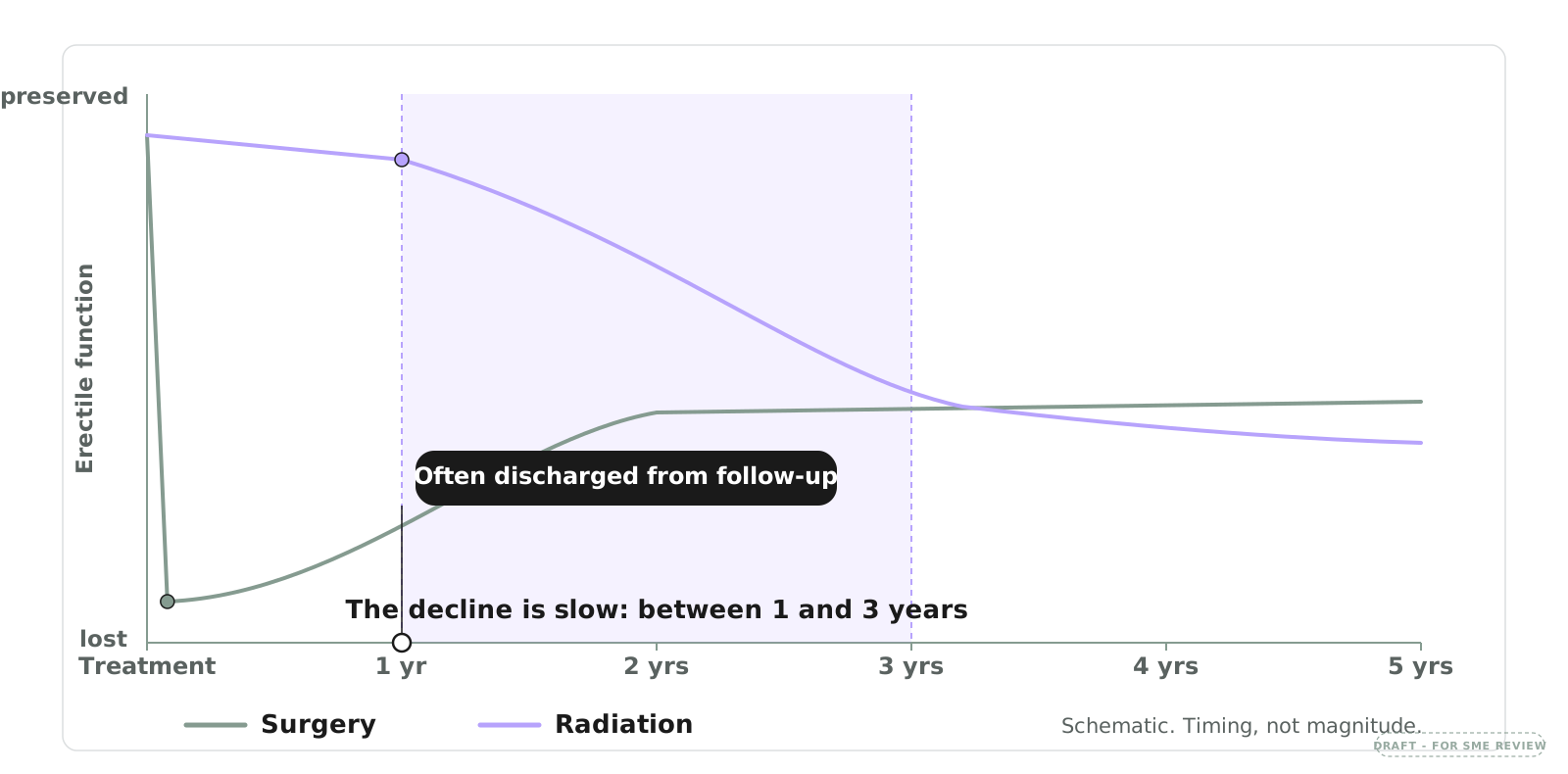
Here are the three changes followed by the reason they are so often missed.
- Erections. The decline is gradual rather than immediate, arriving over the years after treatment as radiation damages nerves, blood vessels and the smooth muscle that holds an erection. People are often reassured in the first year and then caught out later.
- Ejaculation. Volume declines gradually and variably, and may cease altogether. Orgasm can be painful, for some people.
- Bowel and urinary symptoms. Both bear directly on sexual confidence, and people very rarely volunteer either of them in a conversation framed as being about sex.
- The timing problem. Because the decline is slow (between 1 and 3 years)1, people are frequently discharged from follow-up before the sexual consequences arrive, so by the time they notice, nobody is still asking. That gap between treatment and consequence is where most of them are lost.
1.4 What each treatment does
Androgen deprivation therapy
ADT does something categorically different from the other treatments. Surgery and radiation damage the machinery; ADT removes the drive.
Open each marker to see what androgen deprivation therapy does to it.
Desire
Around 90 per cent of men on ADT report reduced libido, and for many it goes altogether2. This is the effect people find hardest to describe, because they aren't distressed about sex so much as no longer interested in it, and that in itself is distressing.
Erections
Reduced independently of desire.
Body and self
Weight gain, muscle loss, breast tenderness or growth, hot flushes, fatigue, mood change, and frequently a felt loss of masculinity that men rarely name directly.
Partners
ADT changes the relationship more than any other treatment, precisely because the person's interest in sex has gone rather than their ability to perform it. Partners routinely interpret this as rejection, and nobody has explained to them what the drug does3.
1.4 What each treatment does
Chemotherapy, and active surveillance
Chemotherapy is used in advanced disease, where fatigue, nausea and altered body image typically dominate. Sexual concerns are frequently deprioritised by everyone involved, including the patient, and that's a decision worth making explicitly rather than by default.
Active surveillance involves no treatment, and therefore, in principle, no sexual side effects. In practice people on surveillance report erectile difficulty at higher rates than age-matched men without cancer, driven by anxiety, by repeated biopsy, and by the experience of carrying an untreated cancer.
Someone on active surveillance who develops erectile difficulty has a sexual problem caused by their cancer without ever having been treated for it. They usually won't connect the two, and neither, in our experience, will their clinician.
1.4 What each treatment does
Back to Anthony

You met Anthony at the start of this module, a month before his radiation therapy begins. What follows is his first proper conversation about sex with a clinician.
Everything you've just read about what each treatment does is about to arrive in the room as Anthony's question.
1.4 What each treatment does
Pause and choose · Anthony
This is Anthony's first conversation about sex with a clinician. You'll watch a short clip from it and decide what the clinician should say next.
How it works
- Press play. The clip runs for about 20 seconds, then stops.
- Choose what you would say next.
- Read the feedback on your choice. Then press play to see what the clinician actually said.
You can replay the clip as many times as you need, before or after you choose.
What you'll see
Anthony is 62 and starts radiation therapy in a month. The clinician has been asking about his desire, and now asks about his erections. Anthony says his interest in sex rises and falls with how well he feels, and that his erections are fine. The clinician reminds him that treatment starts in a month, and the clip stops.
Anthony and the clinician
3:44through this in terms of how it might affect your libido. How about, um, erectile functioning? Have you noticed any, uh,
3:52difficulties in achieving full erections or No, everything's Fine. Yeah. Okay. Alright. Um, so, uh, as you know, you've chosen obviously radiation therapy
4:03and I think you're gonna initiate that therapy in a month's time. Um, what is, what is your understanding of the impact
4:10of radiation therapy on, on your sexual function or erectile functioning? I think that the doctor said there wouldn't probably be
4:20that much impact. I mean, uh, I understand that I'm gonna get very sore perhaps. Mm-hmm. Um, he said I wouldn't be glowing in the dark.
4:33Alright. And that I should recover fully from. Okay. Yeah. Alright. So we do know, I mean, with the prostate, uh, um,
What do you say next? Choose one. There is a best answer here, and it's what the clinician actually said. The feedback explains what each of the other three would do.
Choose one option.
The consultation carries on from where it stopped.
1.4 What each treatment does
What that rehearsal was doing
Option B isn't better because it's softer, but because of what it buys you.
Most people hold a private model of what's going to happen to them. It gets assembled from a rushed sentence in an oncology appointment, something they read at two in the morning, and a friend's experience of an entirely different treatment.
Until you've heard that model, everything you tell them lands on top of it rather than replacing it. That's why people so often appear not to have absorbed information they were definitely given.
Elicit before you inform. It costs a sentence, and you'll use it in every consultation for the rest of this course.
1.4 What each treatment does
What people are not told
The 2022 guidelines say patients and partners should be counselled about every one of the following. These are the ones that most often go unsaid.
- That ejaculation ends permanently after surgery, and that this is a different thing from erectile difficulty
- That the penis may be shorter afterwards
- That they may leak urine at orgasm
- That desire itself can disappear on ADT, rather than simply performance
- That radiation effects arrive years later, long after discharge
- That partners are affected too, and can be seen
Each of these is easy to say in advance and distressing to discover alone.
Someone else treated most of the people you'll meet, so none of these omissions are yours. You may still be the first person willing to name them.
1.4 What each treatment does
Knowledge check
A 66-year-old man had external beam radiotherapy three years ago. He reports that his erections have become unreliable over the past year, and he was told at the time of treatment that his sexual function should be fine.
What is the most likely reason his erections have become unreliable?
References
- Incrocci, L. (2015). Radiotherapy for prostate cancer and sexual health. Translational Andrology and Urology, 4(2), 124–130.
- Wassersug, R.J., Walker, L.M., & Robinson, J.W. (2018). Androgen deprivation therapy: An essential guide for prostate cancer patients and their loved ones (2nd ed.). Demos Health.
- Clinical Guidelines for Sexual Health Care in Prostate Cancer (2022), p. 55.
Module 1: Foundations
1.5 What partners carry
1.5 What partners carry
The person nobody asks
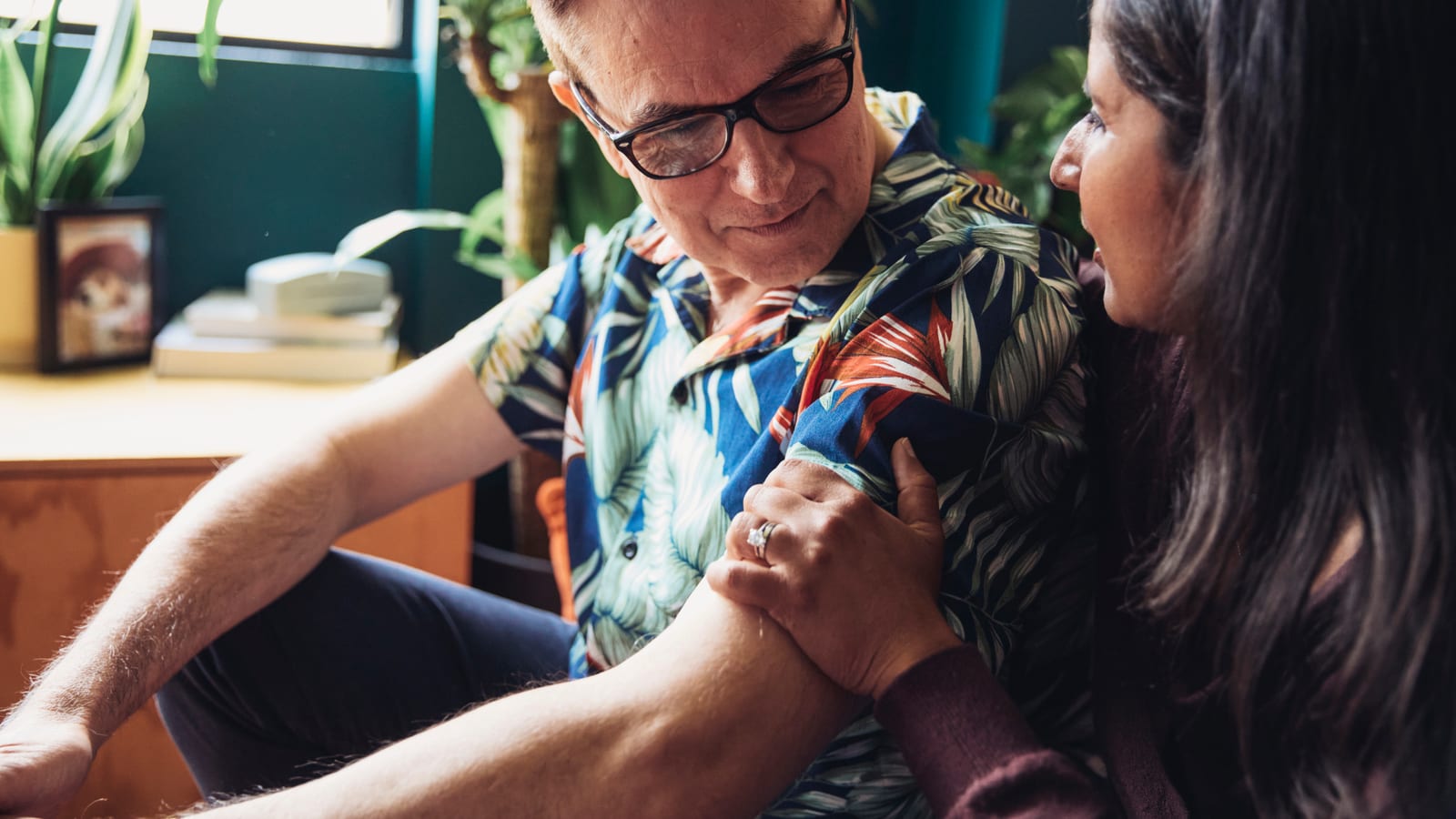
Partners are affected by every one of the changes in the last lesson, and they're almost never included in the conversation about any of them.
Research on partners' experiences finds their own needs for intimacy are overlooked when couples approach services, and that partners are routinely left out of discussions about sexual side effects. The Guidelines are explicit that sexual health care in prostate cancer is dyadic, and clinical practice, overwhelmingly, isn't.
This lesson is short. It's here because the most common gap in otherwise competent care is that only one of the two people was ever asked anything.
Back in lesson 1.2 there were three situations, and the skill was telling them apart: fix it, don't fix it yet, and one more. What was the third?
Don't fix it at all — when the loss is real and permanent, and what’s needed is for someone competent to sit with that without flinching.
This lesson is about the third one.
1.5 What partners carry
What partners report
- Being read as the problem.
When desire disappears on ADT, partners routinely interpret it as rejection, or as a signal that the relationship is ending, because nobody has told them what the drug does.
- Intimacy, not just sex.
Many partners describe the loss of everyday closeness as the bigger loss. Holding hands and cuddling stop as well, and that's a loss of sexual wellbeing beyond the act itself.
- Silence mistaken for coping.
People withdraw to protect their partner, and the partner reads that withdrawal as rejection.
- Their own sexual health, unexamined.
Partners have bodies too. A partner in their sixties may have pain or dryness that predates the cancer entirely and that nobody has ever asked about, because they've been categorised as the well one.
- Guilt about wanting sex.
Partners frequently describe a sense that raising it at all would be selfish while their partner has cancer.
- No standing.
Many report having no legitimate place from which to ask a question, because the appointment belongs to the patient.
Sexual wellbeing is more than penetration. Many female partners report the loss of intimacy as being the major loss. Not holding hands or cuddling anymore results in a loss of sexual wellbeing that is beyond the physical act of sex.
Relationships that survived the cancer don't always survive the silence.
1.5 What partners carry
What this means for your practice
Three things, and none of them requires a service redesign.
Select each card to see what it sounds like in the room.
One sentence will do it: Is there a partner in this, and how are they finding it?
Partners rarely assume they'd be welcome. If your partner wants to come to the next one, they're very welcome changes what's possible in the following appointment.
Invite them to raise their own sexual health, if that feels appropriate.
Pick one of the three and commit to it.
You'll practise all three in Module 3 with Chris and Patti.
Every phrasing in this module is collected in a conversation guide on the Resources screen.
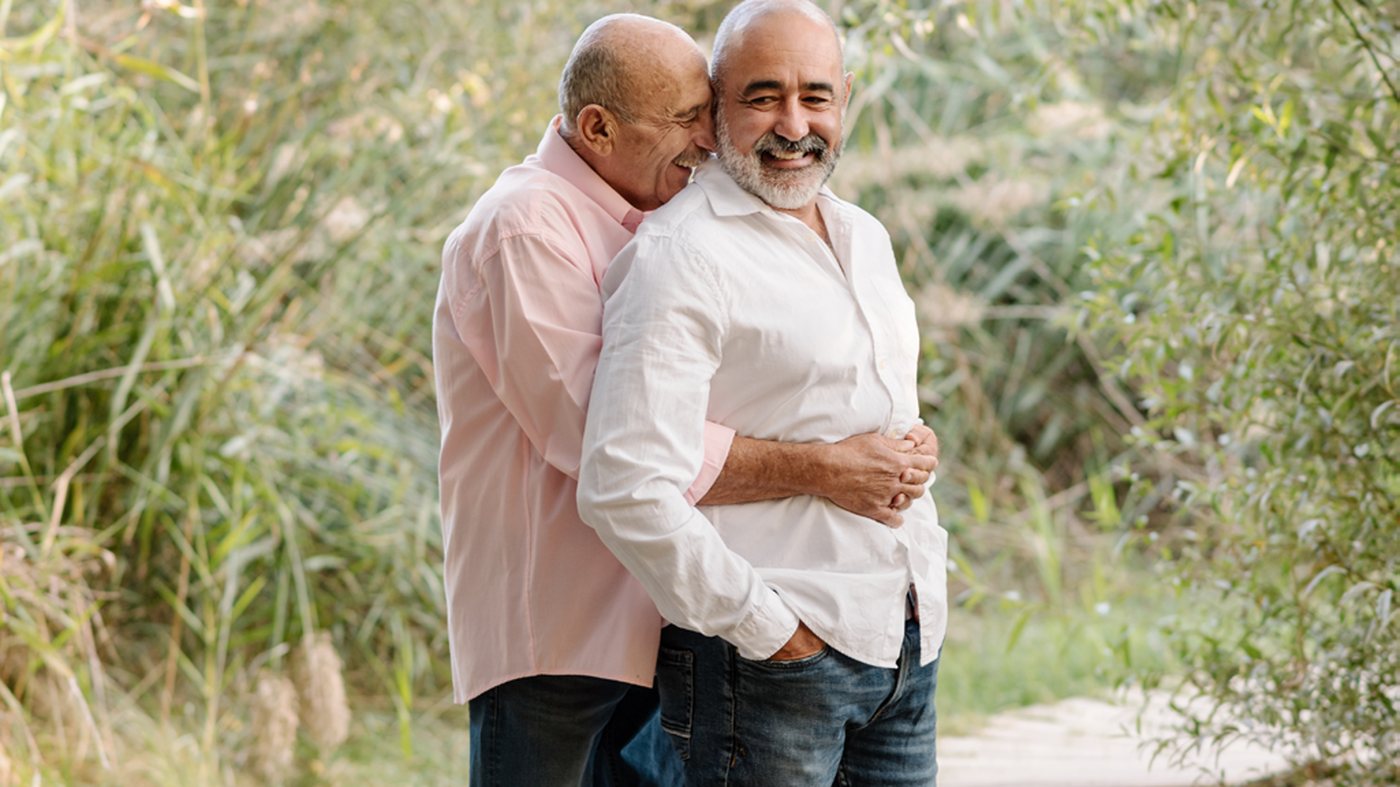
The most common gap in otherwise competent care is that only one of the two people was ever asked anything.
1.5 What partners carry
Think back over your last ten prostate cancer patients.
How many partners did you speak to?
And how many did you ask a question about their own sexual health?
What now?
You've reached the end of Module 1.
You've looked at what the silence costs and at getting ready to ask. You've looked at how sexual response works, at what each treatment does in the terms someone experiences it, and at the person sitting beside them who nobody asks.
In Module 2: Assessment and models of care, you'll take a full sexual history, learn the words for the parts most people avoid, and turn what you've heard into a plan.
Your toolkit so far
- Conversation guide: Modules 1 and 2, with every phrasing and the pre-treatment discussion prompt
Your reflections
Review everything you wrote during this module, and email or print a copy to keep for your own records.
Resources from this module
Tick the resources you'd like to keep, then email them to yourself. The conversation guide is ticked for you.
Your reflections
Everything you wrote in this module is saved on this device. You can read it back, print it or email it to yourself.
Changelog
Current version: v0.48
- Batch 2: screens 14–66, the rest of Lesson 1.1 — prevalence, the four reasons one mention is never enough, every treatment, what quality of life understates, the evidence accordion, the two lived-experience quotes, the Guidelines and the biopsychosocial model, and the reflection that closes the lesson.
TOTAL13 → 62. - These ten screens are GENERATED, not patched. They come from
build_module.py, which reads the samedata_a|b|c.pythe storyboard .docx is generated from, so the copy is verbatim by construction rather than by transcription. Batch 1 lifted its screens out of the v5.0 build because v5.0 was already word-for-word v6.0 on most of them; that stopped being true here. The two pipelines meet at the data document — the generator’s sections are parsed back into the recordsmodule-extractproduces, so numbering, the design edits andmodule-generateare all unchanged. Screens 1–13 stay on the extract. - The deck’s bullets become the purple arrow list on three screens — four reasons, the seven effects (two columns, per the brief’s own “purple-arrow bullet list”), four consequences. They were middot characters inside body paragraphs, which is a list drawn as prose: no list semantics for a screen reader, and no marker.
- 56% is set large beside its own line. Unlike screen 11’s figure it is not
aria-hidden: there the big number restates what its sentence already says, so hiding it stops a screen reader hearing it twice; here the deck made the figure the subject of its sentence, and hiding it would leave “were offered no support for it at all” with nothing to say how many. The closing line takes the plain editorial beat, not--pull—.mo-statalready carries a purple rule on that screen. - The generated evidence accordion is brought to the engine’s own shape:
data-evidence, which is whatmodule-components.jsparses the block back out by, the moustache on the row, and each citation with its link as one.evidence__paper. Every citation link is now live except one, and the reasoning that kept them plain has expired: Anu verified the URLs on 30 September and asked for them to go live. The bmjopen link that was here — bmjopen.bmj.com/content/6/12/e013555, approved by the project lead on 17 August — was the wrong paper: it is the LAPCD study protocol, while the paragraph beside it names Downing et al. 2019 and quotes the 35,823 sample and the 56 per cent, neither of which a protocol contains. It now points at Downing itself. Lehto, Seymour-Smith, Samulowitz, Basson and Beck each take their DOI. The exception is the Morck IPODE primer, which has no public URL and cannot get one, so its “Access the module” stays as the deck’s words. Anu, 30 September 2026. - Both lived-experience quotes become figures, attribution inside, the same device screen 12 uses. Generated, they were a blockquote followed by an orphaned paragraph that read as body copy.
- Three fixes in
build_module.pyitself, so batches 3–7 inherit them. The reflection’sdata-qidnow comes from the deck’s own build note (m1-r1) rather than from the screen number — derived, it would move the moment a screen was inserted ahead of it and orphan every response a learner had saved. The disclosure toggle no longer reads “Save response”: the engine rewrites that button on every click, so the label changed the first time it was pressed and never came back, and the screen carried two “Save response” controls. And.reflect__savedis authored, which is the elementsaveReflectionEntrylooks for to confirm the write — without it the button did its work and said nothing. - The reflection is the first
.reflectin the module, soqa-reduced-motion.jshas something to inspect from here on. Before this batch it reported that it had checked nothing, which is not a pass.
- Screen 13’s black plate was the image.
PLACEHOLDER-5was a JPEG of a transparent mark, and JPEG has no alpha channel, so the transparency had been flattened to black andmix-blend-mode: screenwas dropping that black back out. It is now the kit’s own PNG with its alpha intact — and painted behind the line, which is where the storyboard briefs it. The figure above the title was the compromise the flattened JPEG forced: a blended plate greys any type laid over it. The title is BLACK on the mark, not the white the engine gives a dark screen: white on the brand lavender is 2.2:1 and fails AA outright, black on it is 9.7:1. That is the module’s own convention too —.mo-hlsets no colour because every other screen using the mark already has dark type. Anu, 29 September 2026. - The arrow list had no space above it.
.mo-arrowssetmargin: 0, a shorthand, so it also zeroed the top — and the engine’s stacking rhythm for blocks inside.screen-inneris amargin-topat the same specificity in an earlier file, which the shorthand silently won. The list sat flush against the paragraph introducing it. - Screen 12’s beat carries.
.mo-beat--pull: 26px with a purple rule down its left edge. The plain beat stays as it is for screen 11, where.mo-statand.keypoint-wrapalready carry a purple rule each and a third would flatten all three; screen 12 has neither. The words stay--fg— a full sentence in purple at that size reads as a system message rather than as Anthony. - The two quotes are one per row again, with the quotation mark hanging in the left margin. Abreast, each had half a measure to sit in and the pair read as a comparison table.
- The eyebrow is purple on screens 3, 10, 11 and 12 — one rule, not a mark per screen. Anu, 29 September 2026: one purple element on every screen. Screen 1 was the only one with none of its own, so it takes screen 7’s purple rule under the title, aligned left. Eyebrows on dark surfaces stay white: the kit’s
.screen--dark .eyebrowis two classes deep and still wins. - “Eight months later” has three design elements. Anthony's three anxious thoughts become an arrow list — they were loose paragraphs, reading as prose rather than as the questions going round in his head. “Some days he doesn’t feel like much of a man.” becomes the editorial beat, the same device screen 11 uses for its pivot line. And the two quotes become figures, each with its attribution inside it and the kit's quotation mark opening it, side by side on a wide screen. No word is added, removed or reworded. ID call, Anu, 29 September 2026.
.mo-outcomesis now.mo-arrows, single column by default and two with--split. Naming it for the arrow rather than for one screen is what stops the next list minting a third class for the same marker..mo-listremoved: nothing had used it since the landing became a hero and the course-covers screen became tiles.- The outcomes band cycles, and is taller. Five panels, nine portraits each, cross-fading eight seconds a picture on a 72-second turn — MIM Pro's band as built. The height is theirs too,
clamp(240px, 40vh, 420px): at the previous height the 600x750 portraits were cropped through the chest and, before that, through the top of a head. - The stagger is what keeps a face off the strip twice at once — panel i reaches picture j at
8j + 1.6i— and the delays are NEGATIVE so every panel is already mid-cycle at load. Tom's note records what a positive stagger did: three panels blank for their first seconds. - Reduced motion stops the reel and leaves the first portrait in each panel showing. Without that it would leave all forty-five at
opacity: 0, which is where the cycle starts. - The outcomes band is five portraits again, each panel its own photograph — MIM Pro's band as built. The single image could not be either thing: slicing one photograph gave five copies of the same face, and cropping a portrait to the band's ratio put the crop through the top of a head. These are MIM Pro's own band portraits, cut at 600x750 with headroom, framed at
center 22%so none of the five clips. - The 1.1 divider is a photograph rather than the lavender texture — a man looking away, which is the unasked question the screen is named for. The storyboard briefs a brand texture here, so this is a deviation on the record.
- “How to navigate this course” is on the white photocopy grain. Light, with a paper texture rather than a colour — field mean 252, standard deviation about 4. Third attempt at this surface: black was too dark, the purple separated it from the FAQ but the lavender was too much. This separates them less, so what distinguishes the two screens now is their cards rather than their grounds.
“How to navigate this course” is on the light PURPLE photocopy texture.Reverted at v0.41. Black read as too dark. The purple keeps it light while still separating it from the FAQ — sampled mean (188,170,252) against the white texture's (247,247,247), which would have been the FAQ again. No.screen--darknow, so the type stays its default dark.“How to navigate this course” is on a dark textured surface.Reverted at v0.40.- “How to navigate this course” is on a dark textured surface. It and the FAQ are the same shape — a heading and a column of light cards — and on a white ground they read as the same screen twice. The cards stay light, because that contrast is the point.
.screen--darkcomes with it, which is what turns the eyebrow, title and lead white; the engine already carries those rules and writing them by hand is how one gets forgotten. - The objectives banner is back to the clinic scene, purple squiggle and all — it suits the screen better — and the circle round “encourages” comes off. The image carries the purple now, so the word does not need to.
.mo-circledis removed with it rather than left as a rule nothing uses. The objectives banner is a clean photograph.Reverted at v0.39.- The objectives banner is a clean photograph. It held a MIM Pro scene with their purple brand squiggle burnt into the image, which put a third source of purple on a screen that already carries the circled word and the arrow marks. Now a studio portrait with no overlay — and one that reads as a whole figure in a 21:6 band rather than a face cropped through the forehead.
- A short purple rule under the “What this course covers” title. Drawn rather than borrowed: the highlighter mark and the circle are both used elsewhere, and a third word-level mark would start to read as a tic. The rule echoes the purple top edge on the four tiles below it and the rule under the outcomes band. The kit’s own purple, not the AA-dark recolour, because it sits on the scrim.
- Every placeholder now holds a real image, from ADAM by way of the MIM Pro set: the landing hero, the divider texture, the consulting room on screen 11, the highlighter mark on screen 13, the outcomes band, the objectives banner and the background on screen 7. Still stand-ins rather than chosen assets, and each brief stays in its alt.
- The outcomes band is one image, not five slices. Five only works when the source is wide with different content across its width; with a single subject every slice held the same face and it read as five copies of one man. The slicing rule is kept in the CSS for the day a five-face photograph exists.
- The video poster is a black screen. Every frame available is of another man and the copy beside the tile names Anthony, so a picture there misidentifies a person, which is worse than no picture. The 16:9 window stays, so a real frame from Vimeo 1053246446 drops straight back in.
- “It’s worth slowing down on this moment” is set as an editorial beat — display face, a size up from body, air either side, with the highlighter mark behind “slowing down”. No left rule:
.mo-statand.keypoint-wrapboth carry one, and a third on the same screen would stop any of them meaning anything. Smaller than the key point, so the screen’s conclusion still outranks it. .works-hlis now.mo-hl. Two screens want the highlighter mark and a third would have minted another class for the same rule.- “The moment that mattered had already passed” has three design elements. The 23.2% figure is pulled out large beside its own sentence; “The point:” becomes the engine's key-point pull-out; and the two citations move into the engine's evidence accordion. No words are added, removed or reworded — three passages are re-presented. ID call, Anu, 29 September 2026.
- The accordion is labelled “THE EVIDENCE” rather than MIM Pro's “MOUSTACHES LOVE RESEARCH”. The same phrase is set in
build_module.py'sUI_STRINGS, so batch 2 onwards generates it too. - The big figure is
aria-hidden: it restates what the sentence already says, so it is decoration for the eye and a screen reader hears the claim once. Pulling the number out and shortening the sentence round it would read better and would be a rewrite, so it is not done. - The Anthony video screen is on MIM Pro's video tile — Tom's “LE Tiles” design of 20 September: a 16:9 still with a purple rule round it and a white light travelling that rule, then a solid caption strip beneath carrying the instruction and a filled purple play disc with a ring pulsing out of it. One still rather than MIM Pro's cross-fading reel, which is the case Tom describes as “just use this static image”.
- “Press play to meet him.” moves out of the body onto the caption strip, which is the control it instructs. The words are unchanged; one sentence is relocated. ID call, Anu, 29 September 2026, since it splits an authored paragraph.
- The poster still is PLACEHOLDER-40, and its brief is ours. The transcript is still not built: MIM Pro's tile carries a transcript toggle and panel, and this film has no corrected transcript yet, so the toggle is left off rather than pointing at an empty panel.
- The outcomes intro reads “This module builds on” rather than “This course”. They are the module's outcomes, the lead-in already says so, and the screen sits after the Module 1 divider. Authorised deviation from the signed-off storyboard, Anu as ID, 29 September 2026. The copy deck in
_storyboard-source/data_a.pywas changed to match, so a regeneration no longer reverts it — the storyboard .docx is now one word behind its own source until it is rebuilt. - “How this course works” has some purple and a composition. After the trim it was a narrow column of black text hanging off the top of a wide white screen. The heading takes the highlighter mark on “works”, the three lead sentences take the AA-dark purple, and the block is centred on a slightly wider measure. The purple is attached to content rather than floated as decoration, because every mark in the kit is attached to something.
- “How this course works” is down to three bullets. “The readings are optional” and “You can stop anywhere” come out: the FAQ states both facts two screens earlier, and states them better, as the answer to the question a learner actually has. What stays is what a learner could not look up because they would not know to ask — that the course is built on rehearsal, that there is a toolkit, and that reflections never leave their device. Authorised deviation from the signed-off storyboard, Anu as ID, 29 September 2026, since VERBATIM says not to drop bullets.
- “How this course works” moved ahead of “What this course covers”. Both screens are
data-type="content", so verify-module's type-mismatch check cannot catch a half-done reorder here the way it did for the outcomes move — the types still line up while the menu names the wrong screens. TheSCREENS[]entry moves in the same pass and the order is read back off the built page. - Learning outcomes moved to sit after the Module 1 divider. They are the module's outcomes rather than the course's — “By the end of this module you'll be able to” — so they belong with the module instead of in the front matter next to “What this course covers”. The screen is found by content when it is moved, not by index, because the build has already reordered things above it.
- “Module 1: Foundations” on the divider is now MiM purple. The kit's own
--mim-purplerather than the AA-dark recolour, because it sits on the dark hero where the darker purple would disappear. - The objective tiles are gone. Four boxed screens had stacked up across the front matter and the boxes had stopped carrying meaning, so the two-column arrangement and the arrows stay and the cards go. A hand-drawn purple circle from the kit sits round “encourages” in the heading, for some variety on a screen that is otherwise all type.
- Learning outcomes rebuilt on MIM Pro's layout — the
.screen--loscreen: dark photocopy surface, portrait band across the top, the purple highlighter mark behind “outcomes”, arrow bullets in two columns. The copy maps across unchanged and the five outcomes split 3 + 2, which is MIM Pro's own split. - The band is five panels showing five slices of PLACEHOLDER-16, so the divided strip is MIM Pro's while the storyboard's single brief stays a single file. MIM Pro cycles nine separate photographs through each panel; those do not exist for this course.
- The header logo's alt text was still “Men in Mind”. It now names this course.
- “What this course covers” is now a full-screen photograph with the four module tiles over it. The highlighter-line figure comes off; PLACEHOLDER-15 is no longer referenced, though the file stays since the storyboard still briefs it. The new background is PLACEHOLDER-39, and its brief is ours rather than the storyboard's.
- The screen fits one view at the default text size — centred, tighter tiles, no
overflow: hidden, so it reflows and scrolls again if a learner turns the text up. Title and closing line go white, because the screen is a dark surface now and the engine colours both fromvar(--fg). - Acknowledgement of Country rebuilt on MIM Pro's layout — the
.aocblock on flat black with the photocopy texture off, purple title, 60ch measure, no figure. The copy is this course's own three paragraphs, which differ from MIM Pro's two deliberately because this course is global. PLACEHOLDER-2 comes off: MIM Pro's screen carries no artwork. - The FAQ shadow band is gone. The engine gives every pressable thing depth at
.screen button(0,1,1), which outranks its own.accordion__summary { box-shadow: none }(0,1,0); the summary is a button inside a card withoverflow: hidden, so its shadow was clipped into a grey band lying across the answer whenever a question was expanded. Fixed by specificity rather than!important, as MIM Pro does, in both light and night mode. - Every accordion carries the purple moustache — Tom's round of 15 September, the
--img-mo-marktoken used as a mask with purple painted through it. The toggle widens to 44px to match, because the engine's 22px left spacer exists to mirror it and centre the question on the card. - Night-mode card background added. The engine's card stays
var(--bg)— white — while its own night rule turns the question text white, which is what made the FAQ headings invisible in night mode. So that resolves here rather than waiting on the engine. - “How to navigate this course” now has its seven steps, verbatim from MIM Pro for GPs Part 1 screen 2, which is what the storyboard asks for. The screen previously carried its heading and instruction and nothing else — the engine does not build these boxes, it only drives the pulse, so “Click each section below to see the button it refers to light up” pointed at nothing.
- Each icon is a replica of the control its row describes, per Tom's round of 15 September: the black Continue pill, the grey Back pill, and the four header buttons on their own dark plates. The seventh step describes a gesture rather than a button, carries
data-target="none"and is inert by design. - Night-mode rules added for these boxes. The engine has none, so the card would have stayed light on a dark screen; darkening it means the title and body come too, since the engine sets them from
var(--fg)andvar(--fg-muted)and night mode redefines neither. - The banner grows into the space above the heading instead of that space sitting there as white. Centring the text block left equal room above the heading and below the tiles, and the room above read as a gap between two things rather than as breathing space. The text stays where centring put it; the band above it is now photograph. The gap is 22–32px across 1280x720 to 1920x1080, down from as much as 160px.
- The figure uses
flex: 1 1 0. Withflex-basis: autoits base size is the image's own height at full width — 411px for a 21:6 crop on a 1440px screen — and grow then adds the leftover on top of that, which overflowed the screen and brought the scrollbar back. It keeps amin-heightand yields space back as the text grows, so a larger text size costs banner rather than costing tiles. - Heading and tiles were centred vertically in the height the banner leaves, and the gap between the heading and the tiles is wider. Measured at 1280x720 through 1920x1080, the space above the heading and below the tiles now match to within a few pixels.
- The screen is a flex column for that, with
displayon.screen--objectives.activerather than the class alone — the same cascade trap that left the old.screen--lorendering while inactive..screen-innerusesflex: 1 1 autoso it grows past the container at larger text sizes instead of squeezing the tiles. - Banner cap down to
clamp(140px, 24vh, 320px), paying for the wider gap. 26vh left 7px of scroll at 1280x720. - The objectives heading is back to the engine's standard
--fs-h1and centred over the two columns. It sets on one line down to 1280px wide. - The banner's cap is
clamp(150px, 26vh, 320px), which absorbs the taller heading and still clears the footer on a 720px-tall screen. At 28vh it left 2px of scroll there. - The four tiles sit in two columns, marked with the MiM arrow instead of a number. The arrow is the kit's own mark recoloured to
--mim-purple-aa-dark; the kit's#C2A4FFwas drawn for dark screens and washes out to about 2:1 on a light tile. Night mode swaps back to the original. - The screen now fits one view at the default text size — shorter banner, smaller title, tighter padding, and a wider measure for the two columns. Not done with
overflow: hidden: the engine's text-size control scales every size here through--fs-scale, and a learner who turns it up still has to reach the last tile, so it scrolls again once the text outgrows the screen. - The banner runs the full width of the screen. It sits outside
.screen-innerin the markup, which is where the 820px measure and the side padding live;.screenitself has neither. No negative margins and no100vw, either of which would add a horizontal scrollbar as wide as the vertical one. Height is capped at 340px so it does not eat a wide monitor, and the corners are square. - The objectives screen is a banner plus four numbered tiles. One banner image instead of the five-panel portrait strip, and the bullets become tiles in the style of the engine's
.tutorial-stepboxes on MIM Pro's “How to navigate this course” screen. - The tiles are their own
.mo-stepclasses rather than a reuse of.tutorial-step, which carriescursor: pointer, a hover lift and a transition. An objective is not clickable and should not be dressed as though it were. - They also carry their own night-mode rules. The engine styles
.tutorial-step__titlewithvar(--fg)and.tutorial-step__textwithvar(--fg-muted), and night mode redefines neither. - The dark
.screen--lotreatment is gone, along with the four spare band placeholders. Both are in git history at v0.14. - A portrait band added to the objectives screen, the still version of MIM Pro's: five panels, one image each, rather than nine photographs cycling through every panel. Panels fade in staggered on entry and the purple rule draws in under them. The screen reverts to top-aligned flow, since the band now fills the space that centring was compensating for.
- Band images are placeholders at PLACEHOLDER-34 to 38 — clear of 1–11, 15–29 and 31–33, which the storyboard already names, so they cannot collide with a later screen's brief. The image brief is mine, not the storyboard's, and needs sign-off.
- Below 680px the band drops to three panels. Five at phone width gives slivers.
- The four modules on “What this course covers” are now rectangular tiles, two up, stacking to one column below 680px. The copy is unchanged except that “Module 1 · Foundations” splits across two lines — the number becomes the tile's label, the name its title — so the middot separator is no longer needed.
- The objectives screen now uses the MIM Pro outcomes layout (
.screen--lo): dark photocopy surface, display title with the purple highlighter mark behind one word, arrow bullets in two columns. Taken from MIM Pro for GPs Part 1 screen 6. No portrait band — that band is briefed for this course's own Learning outcomes screen and would need its own images here. - The staggered reveal is written for any list length. MIM Pro's targets its 3 + 2 split by
nth-child, which would have left a fifth bullet unanimated, or stranded atopacity: 0. - Course objectives moved to their own screen, now screen 2, directly after the landing. The landing keeps the MIM Pro shape the storyboard asks for: what the program is, what it draws on, then the closing line.
TOTAL12 → 62. - The heading on the new screen is the storyboard's own lead-in, “This course encourages you to:”. No new copy was written for it.
- Title set in sentence case — “Sex after prostate cancer” — matching the naming decision of 21 September.
- The insert renumbered every screen after the landing.
NAV_TUTORIAL_SCREENis now 3 and the film is now screen 10, with itsvideo-frameanddata-screenids moved to match. Both are computed from array position in the build script rather than typed, so the next insert cannot strand them.
- Course renamed from the SHAReT working title. Applied to the landing, the page title, the header, the module menu, the reflections export and
imsmanifest.xml.MODULE_IDstayssharet-module-1, because it keys analytics and the learner's saved reflections. - Landing rebuilt as a cinematic screen on the MIM Pro for GPs Part 1 pattern: full-bleed image, scrim, photocopy texture, copy stacked bottom-left. Scoped to
.screen--cinematic, because the part-divider screens share.screen--heroand.mo-heroand keep their own treatment. imsmanifest.xmlrepointed to the v6 filename, which the folder rename had broken.- Changelog reset. The entries here were Welcome to Movember's, inherited when this module was first copied.
- Rebuild against storyboard v6.0 (sign-off, 22 September 2026) on the 28 September engine. Front matter and the opening of Lesson 1.1; the remaining screens follow in later batches.
- Built through
module-extract→module-generate, so every screen number derives from its position in the data document. - Copy to v6.0: new final FAQ; “self-care” dropped from the Module 4 line; rehearsal count Fourteen → Thirteen; Anthony now pre-treatment and recently divorced; the omission located at diagnosis rather than before treatment.
mim-design-system.cssandfonts/refreshed fromdesign-systems/men-in-mind. The v5 copy had drifted from the master.