Sex after prostate cancer · Module 2
1 / 79
SCREEN 1 · landing

Module 2

Assessment and models of care

3 hours 20 minutes · six lessons

Where we have got to

Module 1 made the case for having this conversation and the importance of this being clinician-led.

You looked at what the silence costs and at where your own practice may quietly narrow. You looked at the sexual script most of us learn, where it breaks, and at what each treatment does. You met Anthony, and you met the partner who has their own sexual health at stake.

Module 2 gives you the method.

By the end of it you will know how to look at the whole problem, from a biopsychosocial lens, and you will have a framework for how to have the conversation. You will be able to take a full sexual history and turn what you have heard into a plan for your patient and their partner.

SCREEN 2 · content

Learning outcomes

By the end of this module you will be able to:

  • Apply the integrated model of sexual health to a presenting problem, distinguishing biological, psychological and social contributions
  • Select and use PLISSIT, Ex-PLISSIT or the 5A's appropriately for a given presentation
  • Sequence a full sexual history so that it maximises disclosure
  • Use direct, specific language for dry orgasm, penile shortening, climacturia, anal sex and disclosure to a new partner
  • Turn what you have heard into a plan, and decide what to address first
  • Identify what sits beyond your scope, and refer so the patient stays in the conversation
  • Use the Clinical Guidelines for Sexual Health Care in Prostate Cancer as a working reference

You will practise four times in this module. Once with a consultation that stops part-way and asks you what you would say, once out loud in whatever room you are in, and twice in shorter drills.

SCREEN 3 · part-divider

Module 2: Assessment and models of care

2.1 A model to work from

SCREEN 4 · content

2.1 A model to work from

Good care that answers one question

A man finishes treatment for prostate cancer. At a follow-up appointment he says his sex life has changed, and he is offered a pro-erectile therapy.

That is good care. The clinician made it safe enough for him to say it and had something useful to offer.

Psychological and social problems also come through the same clinic: the man who has stopped initiating because he cannot predict what his body will do, the couple who last touched each other eight months ago after one attempt went badly, and the man whose sense of himself as a sexual person changed between diagnosis and the end of treatment.

Each of those needs to be treated, and Guideline statements 22 to 27 set out the psychosexual and couple interventions that treat them.

Where sexual function is written into routine assessment, what proportion of patients do you think report a problem?

Drag the slider, then lock it in. Nothing is scored.

50%
SCREEN 5 · content

2.1 A model to work from

Doug and Jean

A couple sitting together at home, hands held across a knee.

Doug is in his late sixties, and in a few weeks, he is having a radical prostatectomy. Today he is in a clinic room with Jean, who is in her late sixties, to talk about what the surgery will do to their sex life.

Both are retired and their children have grown up and left. Sex has mattered to them, and they have come to find out how to keep it.

Jean does much of the asking. How long does the catheter stay in? Does robotic surgery make a difference, and what does nerve sparing change? Part-way through she mentions, unprompted, that she has had vaginal dryness since menopause and manages it with creams and a lubricant.

Doug says less. What he has heard is that some men never have an erection again, and that they cannot have penetrative sex in the same ways.

Doug and Jean are the main characters in this module. You will watch the start of their session in a moment, you will sit in at the point where it turns.

They are here before treatment. Module 1 identified this appointment as the one most often missed in the pathway.

SCREEN 6 · video

Watch the first session

Doug and Jean, part 1

This is the first four minutes of their session. Watch what the clinician does before she gives them any information. She asks what they are worried about, what they have already heard, and what they think is going to happen to them.

Press play to sit in with them.

Doug, Jean and the clinician

0:00So Doug and Jean, um, I understand that you're getting ready for surgery for your prostate cancer. That, that's right. Yeah.

0:09How are you feeling about that? Well, I haven't really had surgery and this is, um, this is pretty unique, pretty personal.

0:20Mm-hmm. So are you, do you have particular concerns about preparing for this? Well, We've heard a lot about, uh, the effects of

0:31prostate surgery, and we're just kind of wondering what it's going to be like after surgery. Mm-hmm. So you're thinking about side effects in particular

0:41and how to cope with that after treatment? Yes. And some people I don't think are, are intimate at all after surgery.

0:49Okay. The other concern is we've been told that it's going to be robotic as opposed to a surgeon going in.

0:55Then we wanna make sure that the, that they, we've heard about the nerve sparing. Mm-hmm. You know, is that gonna make a difference? Okay.

1:02And will that make a difference later? Right. So, so you're concerned about sexual function, you've heard about the nerve sparing procedure.

1:11Mm-hmm. Mm-hmm. Uh, and of course, everyone goes in hoping that, uh, nerve sparing is a possibility. Exactly. Right. Exactly.

1:18But then we have to consider our ages and, uh, may, maybe it's not going to be that important to us.

1:26Okay. So you're how old Doug? Well, I am over 60. Okay. Yeah. So you're, um, late sixties, is that right? Mm-hmm.

1:35Yeah. Okay. And yourself? Yeah. About 64 6, Yeah. Okay. So you've heard that some, some people are maybe not intimate

1:44after treatment, but some people are. Mm-hmm. Is that something important to you that you wanna maintain? Well, yeah, I guess,

1:51Yeah. It is. Mm-hmm. And for yourself as well? Mm-hmm. Mm-hmm. Okay. Yeah. So sexual intimacy can be a really important

1:58part of a relationship, keeping people feeling connected Exactly. And having pleasure and that vitality. Mm-hmm. And so sex has been, uh, an important part

2:08of your relationship in the past? Mm-hmm. Uh, yes, it has. And you wanna maintain that coming through treatment? Mm-hmm. Okay. Mm-hmm.

2:15So what's your understanding of, um, what might happen from this treatment? Well, um, it seems that some men are really

2:26able not to, um, not to ever have an erection again. Okay. And, uh, they, um, they just are not able to

2:35enjoy, uh, they can't satisfy their wife's desires and, um, they're, they're important. Okay. So you're certainly concerned about what your outcome might be. Mm-hmm.

2:48Yeah. Mm-hmm. And fearful that that might be the story for you. We don't know what's ahead. Yeah. You're absolutely right.

2:56We don't know what lies ahead. So it is important to be aware of the risks, what could potentially happen, as well as what are some

3:02of the treatment options for, uh, erectile difficulties. So that's what I'd like to do with you today is teach you a little bit

3:10about some of those options. What kinds of things might change because of the treatment, how erections work. I'll give you some information

3:18to take home with you today Okay. So that you can prepare a little bit more mm-hmm. About what might be

3:24Thank you. Yeah. Now, do you have any idea, I know he has to have a catheter in now, how long will

3:29that be in, you know? Mm-hmm. And I know I've heard of different problems with men having catheters for a longer period of time,

3:36and other men having a shorter period, shorter period of time. Is that a surgical question we should be asking,

3:42or, um, you know mm-hmm. Where, where's the answer there? Absolutely. So you'll also take part in some prep with your nurse Okay.

3:51About the procedure. Okay. So she'll be able to walk you through all those details around catheters and how to handle that.

You are watching a 4-minute extract. The full session runs 18 minutes and is available in the resources at the end of this module.

SCREEN 7 · content

2.1 A model to work from

One consultation, four problems

Doug has not had surgery yet, and this consultation already holds four separate problems.

Select each problem to see what it is.

One of the four is erectile function. The other three will shape how this couple comes through treatment, and each has an intervention behind it.

SCREEN 8 · content

2.1 A model to work from

The integrated model of sexual health

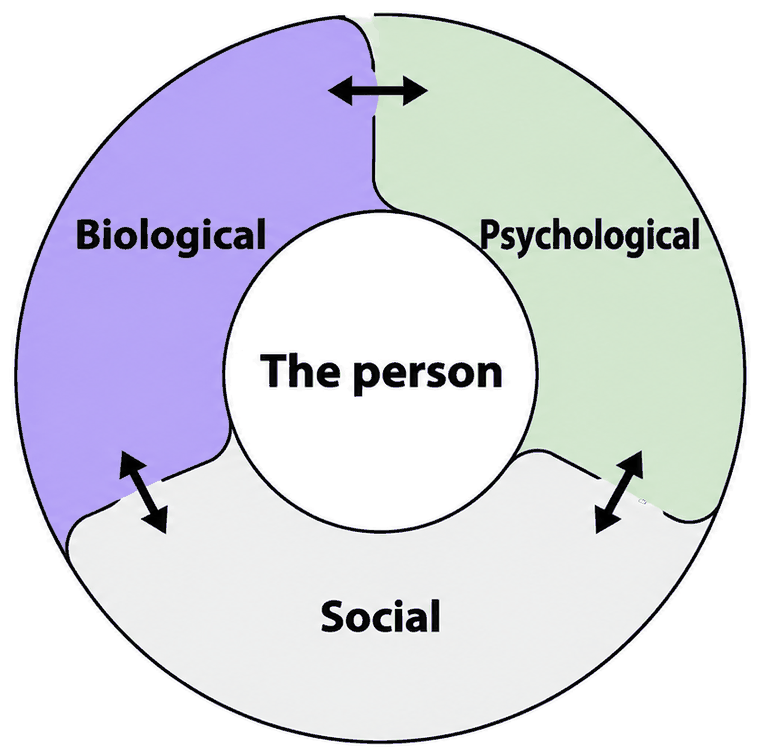
You met the biopsychosocial model in Module 1. It treats sexual health as three things happening at once, in different proportions for each person.

Select each domain to read what sits in it.

The biopsychosocial model drawn as a ring around the person. Biological fills the upper left of the ring, Psychological the upper right, and Social the lower half, with arrows between them showing that each one affects the others.

Biological

What the body does, and what has been done to it. Surgery, radiation and hormone therapy each leave their own mark on desire, arousal, erection, orgasm, ejaculation, continence during sex, pain, fatigue and medication. It is also where the familiar tools sit: PDE5 inhibitors, intracavernosal injections, vacuum erection devices, penile implants, pelvic floor rehabilitation.

Psychological

What someone believes has happened to them, what they expect, and what they are afraid of. Performance anxiety, low mood, body image, and what the loss has done to how they see themselves. It is also where grief sits, mourning the sex they used to have. The interventions here are psychiatric review, individual counselling and cognitive behavioural therapy.

Social

What happens between two people: who initiates, what has been said, what each believes the other thinks, and what sex means in this relationship. It also includes what surrounds them: what a man with prostate cancer was raised to believe sex is for, what he assumed a man his age should still want, and who, if anyone, he can talk to. Couples therapy and supportive group counselling sit here.

A problem in any one of them needs to be addressed. The model is dynamic, and a change in one moves the others.

Doug, and almost every patient you will see, arrives with something at stake in all three domains before treatment begins.

SCREEN 9 · content

2.1 A model to work from

Apply the biopsychosocial model to Doug and Jean

Doug and Jean have not had the operation yet. Everything below is already present at the pre-treatment appointment.

Select each domain to see the question and what it does.

Doug is weeks from a radical prostatectomy. Nerve sparing is planned but not guaranteed, continence and erectile function will both be affected, and he will not know the full picture until months after the operation. Jean has vaginal dryness she already manages.

ASK

  • "Most men want to know what happens to erections and continence after the surgery, has anyone talked you through what to expect in the first few months, and what usually comes back?"

What it does: naming erections and continence out loud tells him that this appointment is where those questions belong, and it gets his expectations on record while there is still time to correct them.

Doug has heard that some men never have an erection again and cannot have penetrative sex in the same ways. He has not checked it with a clinician, and he is carrying it into a treatment decision.

ASK

  • "What have you heard about what this does to men, so I know what you're working from?"

What it does: it puts the belief on the record, and it surfaces what is actually driving his treatment decision rather than what he thinks he should say.

Jean is doing the asking and Doug is saying less. They want different things from sex, and today is the first time each has heard the other say so.

ASK

  • "What have the two of you been able to say to each other about this so far?"

What it does: it hands the question to the person who is quieter, so the imbalance in the room can be corrected. It also allows them to have an avenue to share their concerns.

Three questions, each one sentence long, covering all three domains.

SCREEN 10 · content

2.1 A model to work from

What the research says

What the research says

Open each one to read what the study found.

The 2022 Clinical Guidelines for Sexual Health Care in Prostate Cancer open with counselling patients and partners about the biopsychosocial effects of treatment. Statements 1 to 3 and 7 sit ahead of the biomedical statements, and this module follows that order.

Access the guidelines

Beck, Robinson and Carlson proposed the physical pleasure and relational intimacy model of sexual motivation, which you met in Module 12. It accounts for two men with identical surgical outcomes reporting different levels of distress.

Access the paper

The IPODE module sets out a 5-dimension version of the integrated model3. The two extra dimensions are information and meaning: what he was told about his treatment, and what he concluded from it. Ask about both at the first appointment after diagnosis.

Access the module
SCREEN 11 · content

2.1 A model to work from

The philosophy behind it

A model tells you what to look at. It doesn't tell you how to be in the room, and the second one matters as much as the first.

Three commitments run underneath everything this course teaches.

Select each commitment to see what it means in the room.

It belongs in the appointment on the same terms as continence and should be treated as standard clinical practice. A man whose sexual life changed at 62 following prostate cancer treatment has had something taken from him and treating that as clinical is the first thing that makes the conversation possible.

You'll have an informed view of what a good outcome looks like. His may be different but it's important to know what matters to him. That's where the plan should start, and through shared decision making you and your patient can land on the same target.

They have their own sexual health, their own losses, and sometimes untreated sexual health problems of their own.

SCREEN 12 · content

2.1 A model to work from

What a good outcome includes

Most men treated for prostate cancer want their erections back, and for many of them erectile recovery resolves the problem. Sexual dysfunction is the most commonly reported quality-of-life problem after treatment, and erectile dysfunction is the most recognised part of it. It is also the best evidenced: Guideline statements 28 to 42 cover penile rehabilitation, PDE5 inhibitors, intracavernosal injections, vacuum erection devices and implants.

Two further outcomes carry the same clinical weight.

Select each one to read it.

What you are measuring decides what you will offer. Guideline statement 20 sets the baseline: patient-reported sexual function, sexual distress and couple coping, recorded for the patient and the partner and repeated over time. Those three measures capture all three outcomes.

Ask him for his own target as well.

ASK HIM

  • "If this went as well as it realistically could, what would be different in six months?"

What this does: it records his target beside yours. Where the two match, that is your plan. Where they differ, you will know before you build one.

SCREEN 13 · image-quote
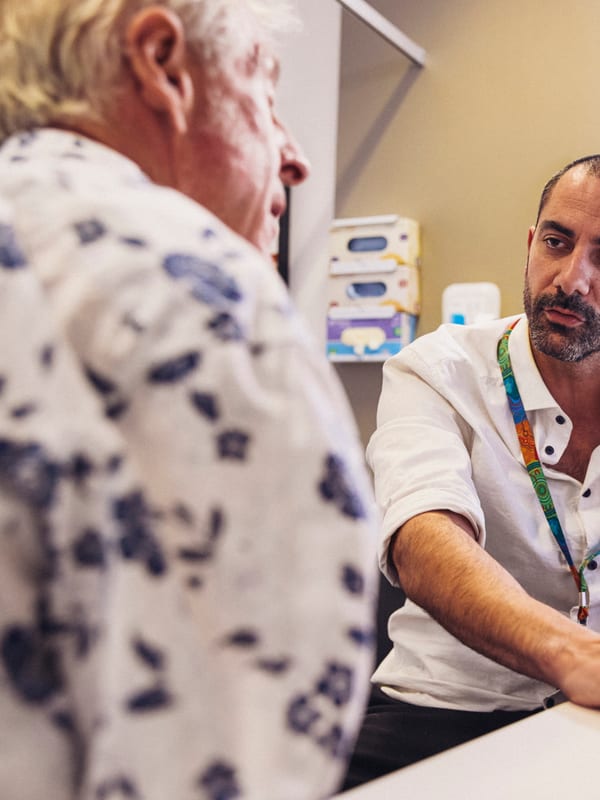
A clinician sitting forward in a consulting room, listening, seen past the shoulder of the person they are talking to.

It's…as normal as speaking about a headache. It should be no different.

A clinician working in prostate cancer care

SCREEN 14 · content
SCREEN 15 · part-divider

Module 2: Assessment and models of care

2.2 Frameworks for the conversation

SCREEN 16 · content

2.2 Frameworks for the conversation

Frameworks for sexual health conversations, and why they matter

The model in the last lesson tells you what is in scope. A framework tells you how far to go, and the numbers below show why that matters.

In one study, 96 per cent of health professionals said discussing sexuality was part of their role. What proportion do you think said they raised it regularly?

Drag the slider, then lock it in. Nothing is scored.

50%
SCREEN 17 · content

2.2 Frameworks for the conversation

PLISSIT

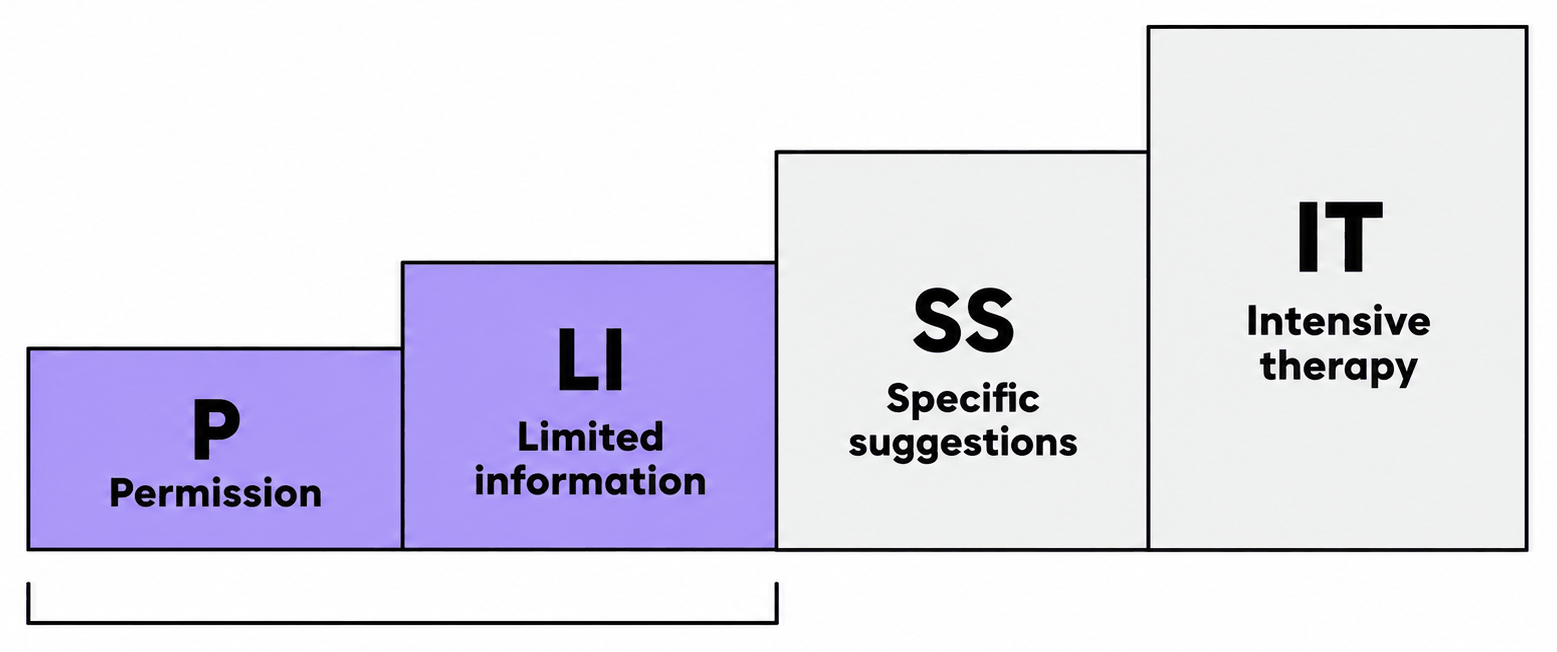
The four PLISSIT levels as a rising staircase. Permission and Limited information are the first two steps, filled purple. Specific suggestions and Intensive therapy are the taller third and fourth steps, in grey. A bracket under the first two marks where most clinicians in prostate cancer care work.

Annon proposed PLISSIT in 19762. It is rooted in behavioural sex therapy, and its core claim is that sexual concerns vary in complexity and most do not need a specialist.

The framework goes as below.

The levels are drawn as a hierarchy, and in practice they overlap. Most clinicians in prostate cancer care work at the first two and refer for the fourth. Across 384 consultations at a Cancer Centre, Schover and colleagues found 80 per cent of sexual concerns were managed at the first three levels3.

Select each level to read what it asks of you.

Give patients permission to raise sexual issues. Signal that sex is a subject that can be raised here. This can be done by normalising sex, asking the question, and giving the person the licence to raise it or not to.

Give patients limited information about the sexual side effects of treatment. This is the opportunity to correct any misconceptions they may have, or to prepare them for the real-life scenario they may face.

Make specific suggestions based on the problem. Give this person, with this problem, something to do about it: a pro-erectile therapy, a change to how and when they attempt sex, a sensate focus exercise.

Refer to intensive therapy to support the problem. This can be sex therapy, psychological care, or biomedical interventions for problems that need sustained support.

SCREEN 18 · content

2.2 Frameworks for the conversation

PLISSIT in action: Rakesh

Rakesh is 62. Localised prostate cancer, treated with robot-assisted radical prostatectomy five months ago, bilateral nerve sparing, PSA undetectable. He's at a routine follow-up with the specialist nurse, mainly about ongoing urinary leakage. He's been married to Maya for 30 years.

On his way out, putting his jacket back on, he says: "Well, the sex side of things is finished anyway, so."

  • What he hasn't said. His erections are unreliable and not sufficient for penetration. The incontinence has him worried about leaking during sex. He's noticed changes in orgasm, and in the length and curvature of his penis, and doesn't know how to raise any of it. He's stopped initiating any physical contact with Maya, including non-sexual affection, because he's worried about where it will lead. He doesn't know himself whether he's accepted this or is avoiding it.
A specialist nurse at a desk in a consulting room, looking into the room rather than at the camera.

Practical tools

Rakesh's consultation

SCREEN 19 · content

2.2 Frameworks for the conversation

Which level is this?

Each of these is something a clinician said. Select the PLISSIT level it belongs to.

For each one, choose: Permission · Limited information · Specific suggestions · Intensive therapy

1 of 6

"A lot of men notice this after surgery. Is it something you'd want to talk about?"

2 of 6

"Dry orgasm is expected after this operation, and it doesn't mean anything has gone wrong."

3 of 6

"Try emptying your bladder just before, and keep up the pelvic floor exercises."

4 of 6

"There's a psychosexual service I can refer you both to, and I think it would help."

5 of 6

"I ask everyone this after treatment, because it's one of the things most affected and one of the least discussed."

6 of 6

"Penile shortening is real, it's common, and it isn't something you're imagining."
SCREEN 20 · content

2.2 Frameworks for the conversation

Ex-PLISSIT

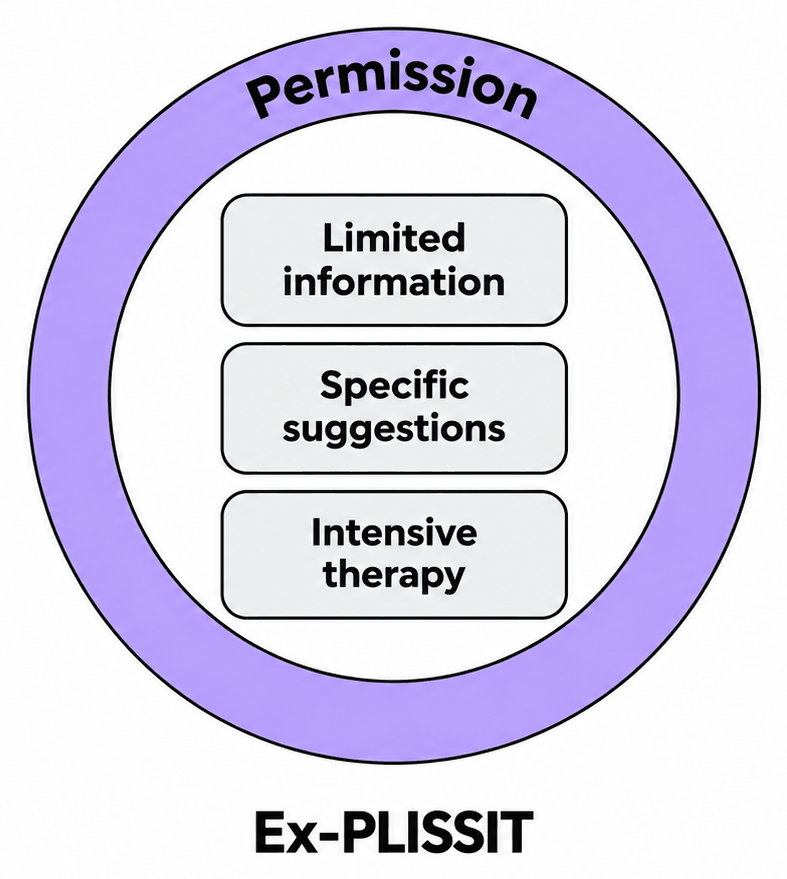
Ex-PLISSIT drawn as a thick purple ring labelled Permission, enclosing three stacked cards: Limited information, Specific suggestions, and Intensive therapy. Permission surrounds all three rather than coming before them.

You'll have seen in the previous example that permission isn't confined to the first step. It runs through every stage of the conversation with Rakesh.

In 2006, Taylor and Davis at the University of Bradford developed the Ex-PLISSIT model, which makes this explicit4. Rather than treating permission as a stand-alone first step to be completed and moved on from, Ex-PLISSIT places permission-giving around all three of the remaining levels. It's redrawn as a circle enclosing limited information, specific suggestions and intensive therapy.

Asking permission at every step creates a safe environment for patients to have ongoing, open conversations about sexual health. It also recognises that a patient's concerns change over time, so consent to discuss one thing is not consent to discuss everything.

Where permission appeared in Rakesh's consultation

  • At the opening "Would it be alright if we spent a few minutes on it?" The nurse asks rather than launches in, and leaves room for Rakesh to decline.
  • When he might decline "That's ok. We can pick this up at any of your appointments." This is permission-giving in its purest form. Nothing clinical has been delivered, but Rakesh now knows the topic is available to him whenever he wants it.
  • When he agrees to talk "What matters to you about sex, and how has that changed?" An open question that lets Rakesh define what sex means to him, rather than the nurse assuming it means penetrative intercourse with Maya.
  • At specific suggestions "There are a few things we could try." Framed as an offer. Rakesh keeps the choice about whether to pursue any of it, and permission is sought again before moving from talking to doing.
  • At intensive therapy "That's a normal next step." Permission to return to this in future, and permission to need more help than one appointment can give.

Each of these is a separate act of permission. Rakesh agreeing to talk about erections at the start doesn't mean he has agreed to talk about leaking during sex, about changes to his penis, or about what has happened between him and Maya. Each of those needs asking about in its own right.

SCREEN 21 · content

2.2 Frameworks for the conversation

Pause for a mo'

Ex-PLISSIT asks one more thing of you that the original model doesn't. It asks you to reflect on your own practice and your own assumptions.

The most common barrier to sexual health conversations isn't patient reluctance. It's practitioner discomfort.

After a consultation like Rakesh's, Ex-PLISSIT asks you to consider:

  • What did I assume about Rakesh's sexual life, his partner, or what sex means to him?
  • Did I avoid any topic because I found it uncomfortable rather than because it wasn't relevant?
  • Did Rakesh have room to raise something I didn't ask about?
  • What would I do differently next time?

Discomfort in these conversations is normal and expected. Ex-PLISSIT treats it as something to notice and work with.

✓ Saved
SCREEN 22 · content

2.2 Frameworks for the conversation

The 5A's

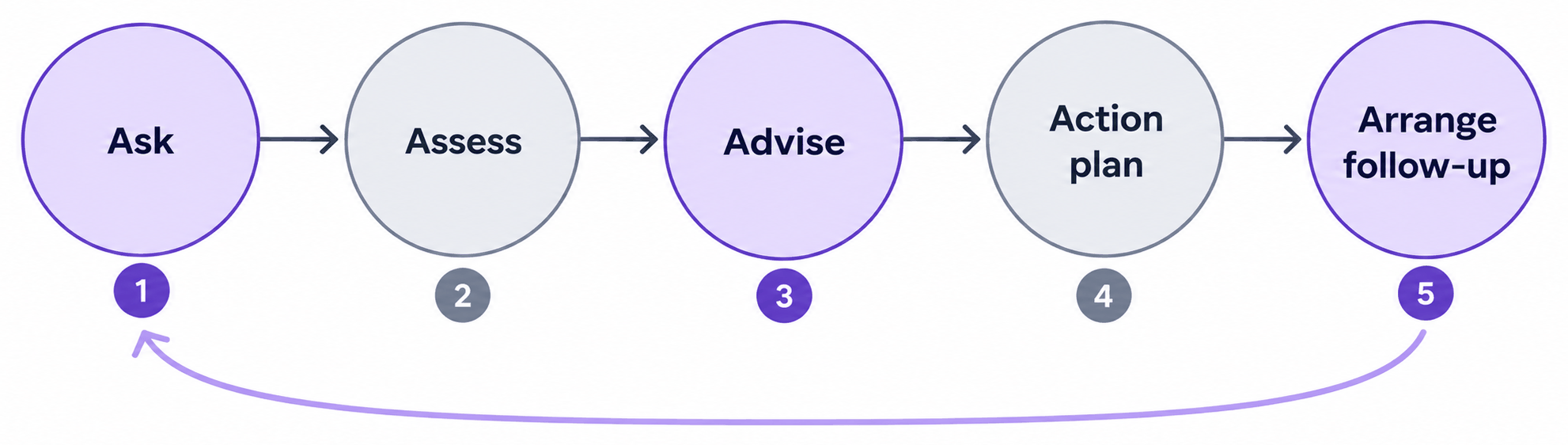
The 5A's drawn as five numbered circles left to right, joined by arrows: Ask, Assess, Advise, Action plan, Arrange follow-up. A curved arrow runs back underneath from Arrange follow-up to Ask, so the five are a loop rather than a line.

PLISSIT and Ex-PLISSIT tell you how far to take a conversation. The 5A's tells you how to run the one in front of you, start to finish, in a single appointment.

Bober and Reese set it out in Communicating about Sexuality in Cancer Care5.

Select each step to see how to run it.

A step

Pick a step

Select any of the five to see how to run it.
0 of 5 opened
SCREEN 23 · content

2.2 Frameworks for the conversation

Choosing between them

Each of these works in your head during the consultation, and gives you a sequence to fall back on when it gets away from you.

Select each one to see when to reach for it.

Reach for PLISSIT

when you want a quick read on how far this encounter needs to go, and whether the next step is yours or a referral.

Reach for Ex-PLISSIT

when you are seeing someone over time. Repeated permission gives him a fresh opening at every visit, and the reflection step puts your own assumptions under review.

Reach for the 5A's

when you have one appointment and a problem in front of you, and you want to get from opening the subject to a plan without losing the thread.

One clinician described the effect of the repeated invitation plainly.

"If they at least have a seed planted, then maybe on the second or fifth visit something might open up."
A clinician working in prostate cancer care

Name the framework when you are teaching a colleague, or explaining why you asked.

SCREEN 24 · content

2.2 Frameworks for the conversation

Knowledge check

You are a specialist nurse. A 71-year-old man, two years after brachytherapy, mentions at the end of a routine review that things haven't been the same with his wife. He does not elaborate, and there are four minutes left in the appointment.

What is the best next step?

Choose one option.

SCREEN 25 · content

2.2 Frameworks for the conversation

What the research says

What the research says

Open each one to read what the study found.

The paper PLISSIT comes from. Annon argued that sexual concerns vary in complexity, that most of them do not need a specialist, and that a clinician who can give permission and limited information is already answering the majority. That claim is what the first two levels of this lesson rest on.

Annon, J.S. (1976). The PLISSIT model: a proposed conceptual scheme for the behavioral treatment of sexual problems. Journal of Sex Education and Therapy, 2(1), 1-15.

Access the paper

Taylor and Davis argued that PLISSIT was being used as a staircase, with permission treated as a first step to get past. Their extension makes permission-giving explicit at every level and returns to it rather than moving on, which is the whole difference between PLISSIT and Ex-PLISSIT.

Taylor, B. and Davis, S. (2006). Using the extended PLISSIT model to address sexual healthcare needs. Nursing Standard, 21(11), 35-40.

Access the paper

The chapter sets out how to raise sexual concerns in cancer care, and what stops clinicians doing it.

Robinson, J.W. and Lounsberry, J.J. (2010). Communicating about sexuality in cancer care. In Kissane, D. et al. (eds), Handbook of Communication in Oncology and Palliative Care, chapter 35. A required reading in the source course, and the origin of the participation figures in this lesson.

Access the chapter

Where the 5A’s comes from: ask, assess, advise, action plan, arrange follow-up. It is a way of running one consultation start to finish, rather than a judgement about how far to take it.

Bober, S. and Reese, J. (2025). Communicating about sexuality in cancer care. In Gupta, Reese, Bober and Nelson. The 5A's model of inquiry.

Three hundred and eighty-four consultations at a cancer centre, recorded with what each patient presented with and how it was resolved. It is the source of the 80 per cent figure this module uses twice, and the earliest evidence here that most sexual concerns after cancer treatment are settled without a specialist referral.

Schover, L.R., Evans, R.B. and von Eschenbach, A.C. (1987). Sexual rehabilitation in a cancer center: diagnosis and outcome in 384 consultations. Archives of Sexual Behavior, 16(6), 445-461.

Access the paper

A 2024 systematic review and meta-analysis of counselling based on the PLISSIT models found improvements in sexual function and satisfaction across a range of clinical populations. That is the closest thing there is to evidence that the framework itself works.

SCREEN 26 · content

2.2 Frameworks for the conversation

Pause for a mo'

Think of a patient you referred on for a sexual difficulty.

  • Looking at the four levels: permission, limited information, specific suggestions, intensive therapy. Which one were you actually working at when you decided to refer?
  • Was the referral because the problem needed more than you could give, or because the conversation had gone further than you expected?

Both are legitimate, and they lead to different next steps.

✓ Saved
SCREEN 27 · content

2.2 Frameworks for the conversation

From framework to consultation

A framework tells you how far to go. The next lesson gives you the questions, the order to ask them in, and a rule for what to do with an unexpected answer.

You will build a full sexual history question by question. Then you will watch Doug and Jean's session and choose what you would say next, before you see what the clinician said.

SCREEN 28 · part-divider

Module 2: Assessment and models of care

2.3 Taking a sexual history

The longest lesson in the course, at about 55 minutes. Your progress saves automatically, so you can stop part-way and come back.

SCREEN 29 · content

2.3 Taking a sexual history

What a full history is for

Most patients arrive ready to describe a problem with function, because that is the problem they expect a clinician to treat. A full history takes longer and gives you the material a plan can be built from.

The order of the questions you ask and how you begin will help you get the full history.

Robinson and Lounsberry give the reason for taking the longer version1. A patient reporting lost desire may have dyspareunia behind it, and treating the desire works once the pain is found.

By the end of this lesson you will have a sequence you can run without notes.

SCREEN 30 · content

2.3 Taking a sexual history

How to set the appointment up before you ask the first question

A clinician and a patient seated at an angle to each other with no desk between them, in a small consulting room.
  • Set the room up. Chairs at an angle rather than across a desk, door closed and screen turned away, all of which tells the patient that the appointment is private.

What you do in the first minute sets the ceiling on everything that follows.

  • Say why you are asking.

TRY

  • I ask everyone this after treatment, because it's one of the things most affected and one of the least discussed. Saying why converts a personal question into a routine one.
  • Say who else hears it. Tell them what goes in the notes and who reads them.
  • Say how long you have got.

TRY

  • We've got about ten minutes today, so tell me what matters most and we'll book more time if we need it. Naming the limit at the start lets the patient choose what to spend it on.

Clinicians in this field describe rapport as the precondition for everything else.

"Trust and rapport is number one. You absolutely need that before you can do anything else."
A clinician working in prostate cancer care

Every phrasing in this module is collected in a conversation guide on the Resources screen.

SCREEN 31 · content

2.3 Taking a sexual history

How to give the patient permission to have a problem

The single most useful sentence in taking a sexual history is the one that gives the person permission to have a problem.

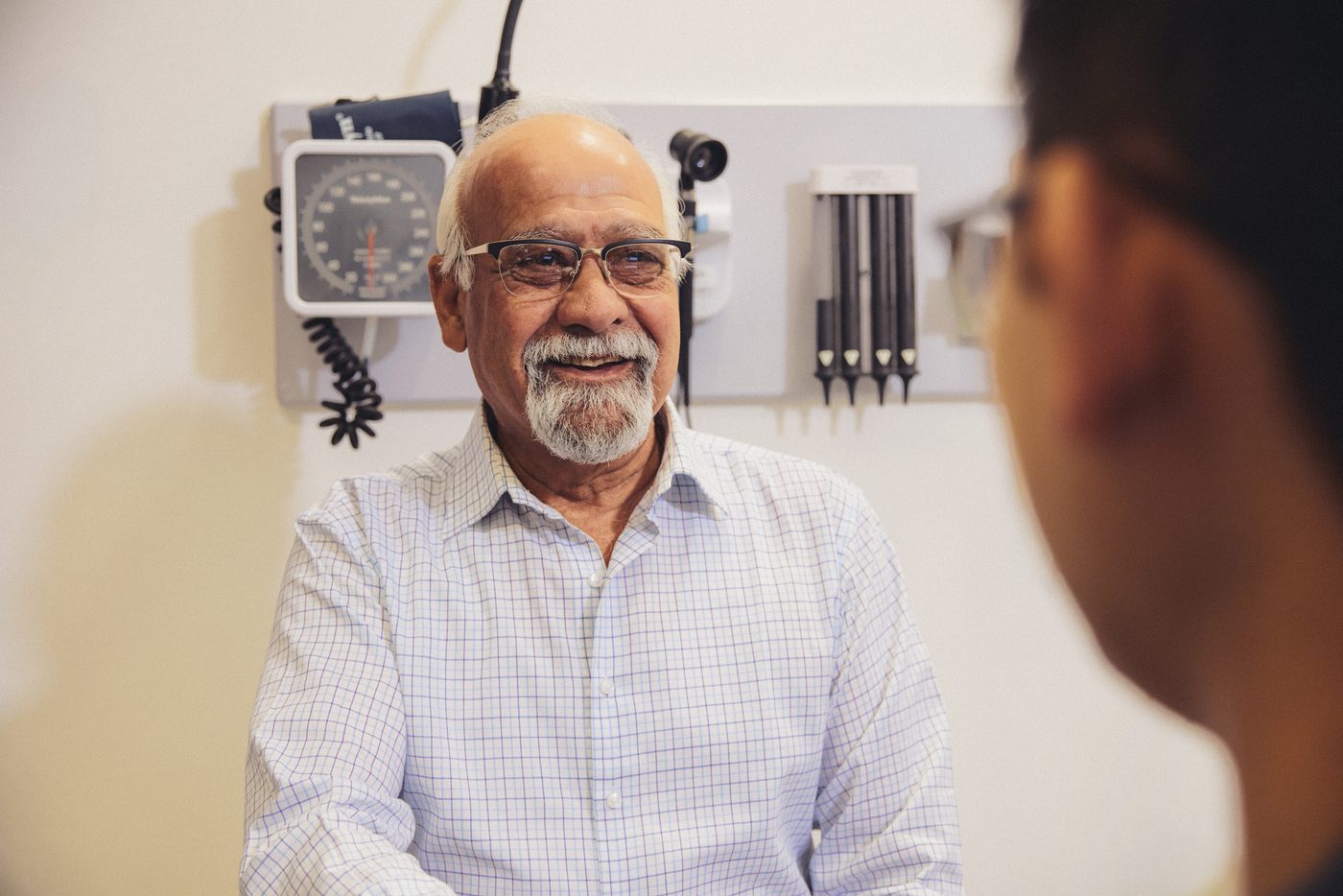
A clinician and an older patient sitting at the same height, turned towards each other, with no desk between them. The patient is talking and the clinician is listening.

Select each number to see what that part of the sentence is doing.

Say

A lot of men after this treatment find that sex has changed in ways they weren't warned about.Some of it is about erections and a lot of it isn't.How has it been for you?

  1. 1The sentence tells the patient that other men after this treatment have the same problem, so having it is ordinary.
  2. 2It widens the subject beyond erections before he has to find a word for what has changed.
  3. 3It ends on an open question, and he decides how much to say.

Then stop talking. The pause after this question is longer than is comfortable and clinicians routinely fill it, so leave it open.

If you are stuck for an opening, there is a three-step version.

SAY

  • Many people I talk with have questions or concerns about the sexual part of their life.
  • Have you thought about this at all?

If yes: Would you like to talk to me, or to someone else, about it? If no, tell them the door stays open and move on.

SCREEN 32 · content

2.3 Taking a sexual history

The order of the history

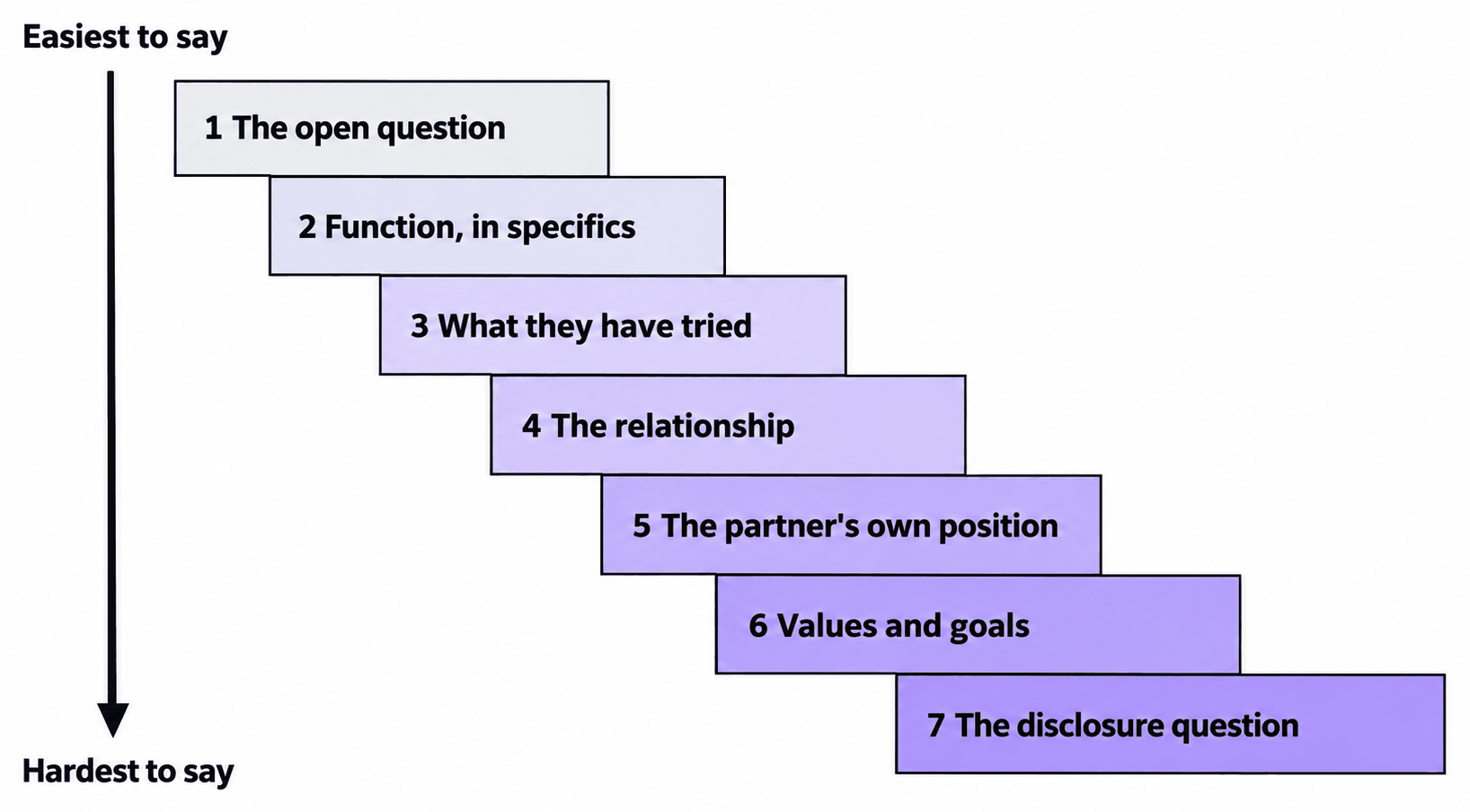
The seven stages of a sexual history as a descending staircase, from easiest to say at the top to hardest to say at the bottom: the open question, function in specifics, what they have tried, the relationship, the partner's own position, values and goals, and the disclosure question. Each step is a deeper purple than the one above.

The sequence that follows runs from what is easiest to say to what is hardest.

  1. The open question

    What has happened, in their words.

  2. Function, in specifics

    Erection, desire, orgasm, ejaculation, continence, pain.

  3. What they have tried

    Including what they tried and abandoned, and why.

  4. The relationship

    Who initiates now, what has been said, what has been avoided.

  5. The partner's own position

    The partner's own position,. if there is a partner.

  6. Values and goals

    What sex is for, in this relationship, and what a good outcome would look like.

  7. The disclosure question

    Anything they have not told anyone.

A person who has just answered six specific questions about their own body is in a different state from someone who has just sat down. The consultation builds disclosure.

SCREEN 33 · content

2.3 Taking a sexual history

How to ask the patient functional questions when taking a sexual history

Module 1 left you with an instruction: inside the linear model, ask about the whole sequence. Robinson and Lounsberry organise the functional questions by phase, with questions for desire, arousal, orgasm and resolution2. Here we will practise wording them.

Select each one to see how to ask it.

TRY

  • Are you getting erections? Then stop and wait.
  • When did you last feel like having sex? Then stop and wait.
  • Are you still reaching orgasm, and what happens when you do? Then stop and wait.
  • Is there any pain or discomfort for you during sex? Then stop and wait.

COMPARE

  • How are your erections, and your desire, and is orgasm still happening? gets you one answer covering whichever part the person is most comfortable with.

TRY

  • Are you getting erections at all, including on waking? This asks about an event and can be answered directly.

COMPARE

  • Are you having erectile problems? asks the person to judge themself, and it produces a yes or a no rather than a description.

TRY

  • When did you last try to have sex or masturbate? This produces a date.

COMPARE

  • How often are you managing to have sex or masturbate? This produces an estimate, and usually a generous one from the patient.

Most people have never been told these are connected to their treatment, so they don't report them.

This includes: dry orgasms, absent or painful orgasms, leaking urine during orgasm, changes in penile length, girth or curvature, pain during receptive anal sex, and whether they have simply stopped trying.

Working through the list covers the whole sequence, instead of it being fixed on erections only.

SCREEN 34 · content

2.3 Taking a sexual history

How to ask relationship questions when taking a sexual history

The functional questions tell you what is happening in the body of the man who has had prostate cancer treatment. This section allows you to understand what is happening socially in the sexual dynamic of the patient.

Select each one to see how to ask it.

SCREEN 35 · content

2.3 Taking a sexual history

How to ask the questions without assuming the answers

Don't fill in the blanks for them

Keep conversations about sexuality open, safe and free from bias. Do not assume sexuality or heterosexual penetrative sex. Take the words that patients use for their partner, their body and sex, and use those words back to them.

Ask patients who came alone about their situation

TRY

  • Are you seeing anyone at the moment?
  • Tell me about your partner.
  • What does sex look like for the two of you?
  • What matters to you about sex?
  • Is penetration part of sex for you, and if so, what are your preferences?
  • What do you call that? I'll use your word.
  • When you say "down there", do you mean your penis? Clarifying this will help make sure we are talking about the same thing.

Ask who is allowed to hear the answer

Not every couple discusses sex directly with each other. Some patients may not have told their family what the diagnosis involves. The person who came to the appointment may not be the partner. Gauge this before starting a sexual history.

TRY

  • I usually offer people some time together and some time on their own. Which would you like today?
  • Are you comfortable discussing sexual health today?
SCREEN 36 · content

2.3 Taking a sexual history

How to ask about values and goals when taking a sexual history

What they want from sex is a separate question from what has changed, so ask it separately.

An older man mid-answer in a consulting room, relaxed in his chair, the clinician out of focus in the foreground.

Select each question to see how to ask it.

Ask what a good outcome would look like to them.

The answer becomes the goal the plan is measured against, so record it in their own words.

TRY

  • What would you want your sex life to look like in six months, realistically?
  • If this went as well as it realistically could, what would be different?

Ask what sex is for in this relationship.

Beck, Robinson and Carlson separate sex sought mainly for physical pleasure from sex sought mainly for closeness3.

TRY

  • What's sex for, for the two of you? What does it do?
  • Which matters more to you, the physical side or the closeness?

If closeness matters more: offer the couple work alongside anything biomedical. Patients in this group frequently adapt to unreliable erections.
If physical pleasure matters more: offer the biomedical options first, because that is what they came to have treated.

SCREEN 37 · content

2.3 Taking a sexual history

How to ask the disclosure question when taking a sexual history

Ask this one at the end, after they have answered questions about erections and about the relationship.

  1. Ask what they have not told anyone

    TRY

    • Is there anything about this you haven't shared with someone before?

    Answers include a sexual practice they expect you to judge, a partner you do not know about, a sexuality they have not disclosed to a clinician, or something they have already tried without success.

  2. Receive whatever arrives as clinical information

    They will be reading your face while they say it, so hold the same tone you used for the other questions.

    If they name a partner or a sexuality you did not know about: carry on in the same tone, and record it for the plan.

    If they name something they have already tried: ask what happened and what made them stop.

One clinician described discovering how wrong an assumption had been.

"You assume that the most heterosexual guy ever, and they're like, oh no, like, I totally have sex with men all the time."
A clinician working in prostate cancer care
SCREEN 38 · content

2.3 Taking a sexual history

How to follow an answer instead of moving on

A patient says his wife isn't really interested any more. The next question decides what you treat.

What do you ask next?

If the answer names a behaviour: ask when it started and what changed around it.
If the answer names a feeling: ask what they do differently on the days they feel it.

Ask the second question before you move to the next item on the list.

SCREEN 39 · content

2.3 Taking a sexual history

Back to Doug and Jean

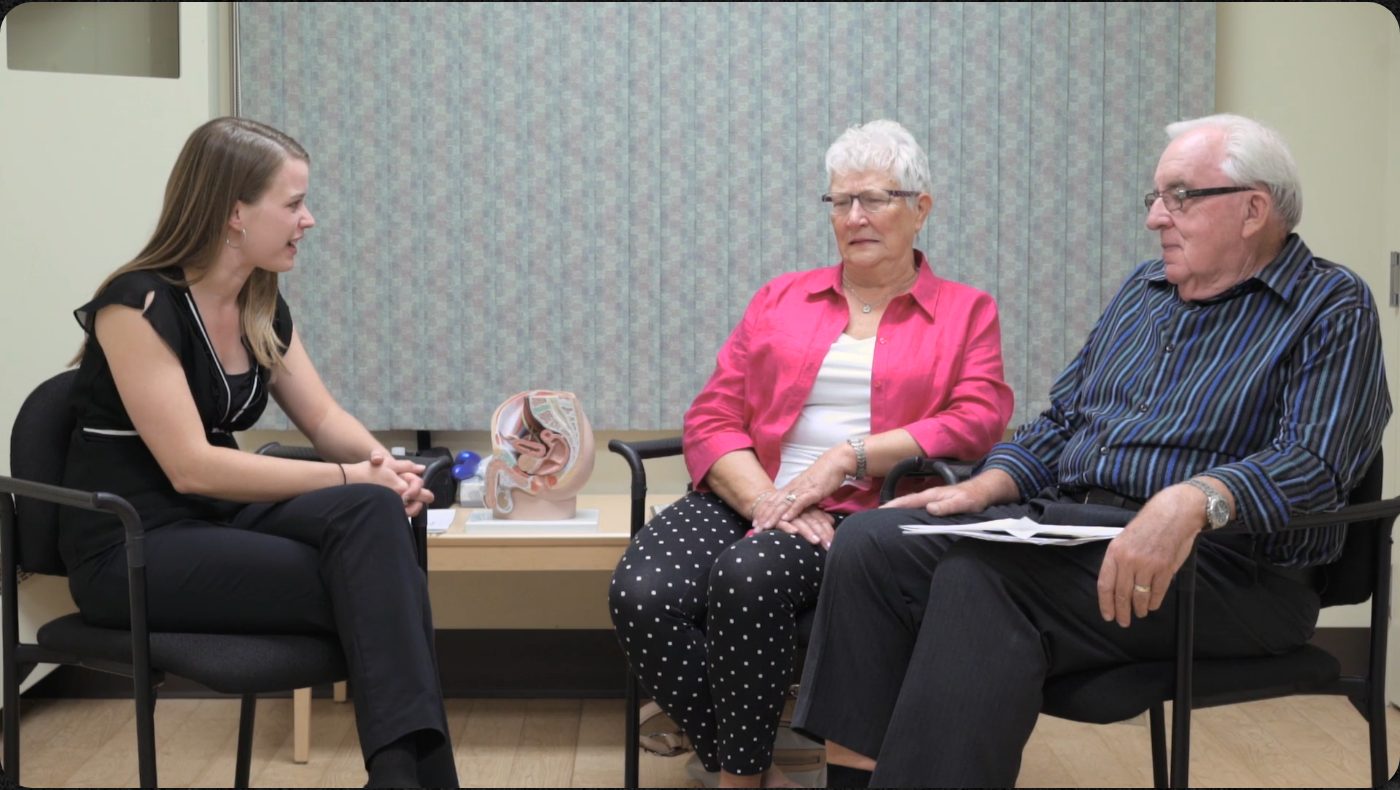
Doug and Jean sitting together opposite the clinician in her room, a pelvic model on the table between them.

You watched the opening of their session at the start of this module. Since then the clinician has taken them through the sexual response cycle, and through an exercise rating how much each of them values sex for physical pleasure and how much for closeness.

Doug came out high on both and higher on pleasure. Jean came out lower on pleasure and high on closeness. Neither of them was surprised.

Jean has just said that she does not want Doug to feel she needs penetrative sex every time, and that she does not want to put him under pressure.

Doug has not answered yet.

SCREEN 40 · content

2.3 Taking a sexual history

Pause and choose · Doug and Jean

How it works

  1. Press play. The clip runs for about 40 seconds, then stops.
  2. Choose what you would say next. You get one choice.
  3. Read the feedback on your choice. The session then carries on from where it stopped, so you see what the clinician actually said.

You can replay the clip as many times as you need, before or after you choose.

Jean has just said that she does not want Doug to feel she needs penetrative sex every time, and that she does not want to put him under pressure. Doug has not answered.

Press play. The session will stop where you have to choose.

Doug, Jean and the clinician

15:58We, we need to, we, we'd like to, uh, maintain, continue, uh, our regular intimacy as much as possible. Mm-hmm. That's a given. Yes.

16:08Mm-hmm. So you'd like to keep the recile function as good as you can mm-hmm. And keep intercourse mm-hmm. In your, your activities.

16:15I, I, I don't think that there's any problem, uh, that this being a danger to our marriage or anything like that. Okay.

16:22The, the other thing is I don't want to have him feel like I need to always have, uh, sexual

16:30or intercourse pen penetrative sex, let's put it that way. Okay. You know, there's other things maybe, so I don't wanna put dug under undue pressure.

16:40Right. Okay. Um, And, uh, So what do you think about that Response? Well, I mean, you, it's part of feeling as,

16:50as a man and able to a achieve, um, an erection and intercourse to, to have that inability, uh, diminishes you, um, in your role

17:05as a man, as as a husband. Okay. So that's how you're feeling about it. If you were to have a loss of your erectile function,

17:13you'd be wondering, how am I as a husband, how am I as a man? Yes. Mm-hmm. Okay. So important to know

17:20that you're both approaching this from a different perspective. You don't wanna put too much pressure on him. You want him to know that you're still okay

17:27with a lot of the other really good Things. That's right. That's Right. Of keeping you connected with each other. Yeah. Okay.

SCREEN 41 · content

2.3 Taking a sexual history

What that rehearsal was doing

Option B works because of what it leaves open.

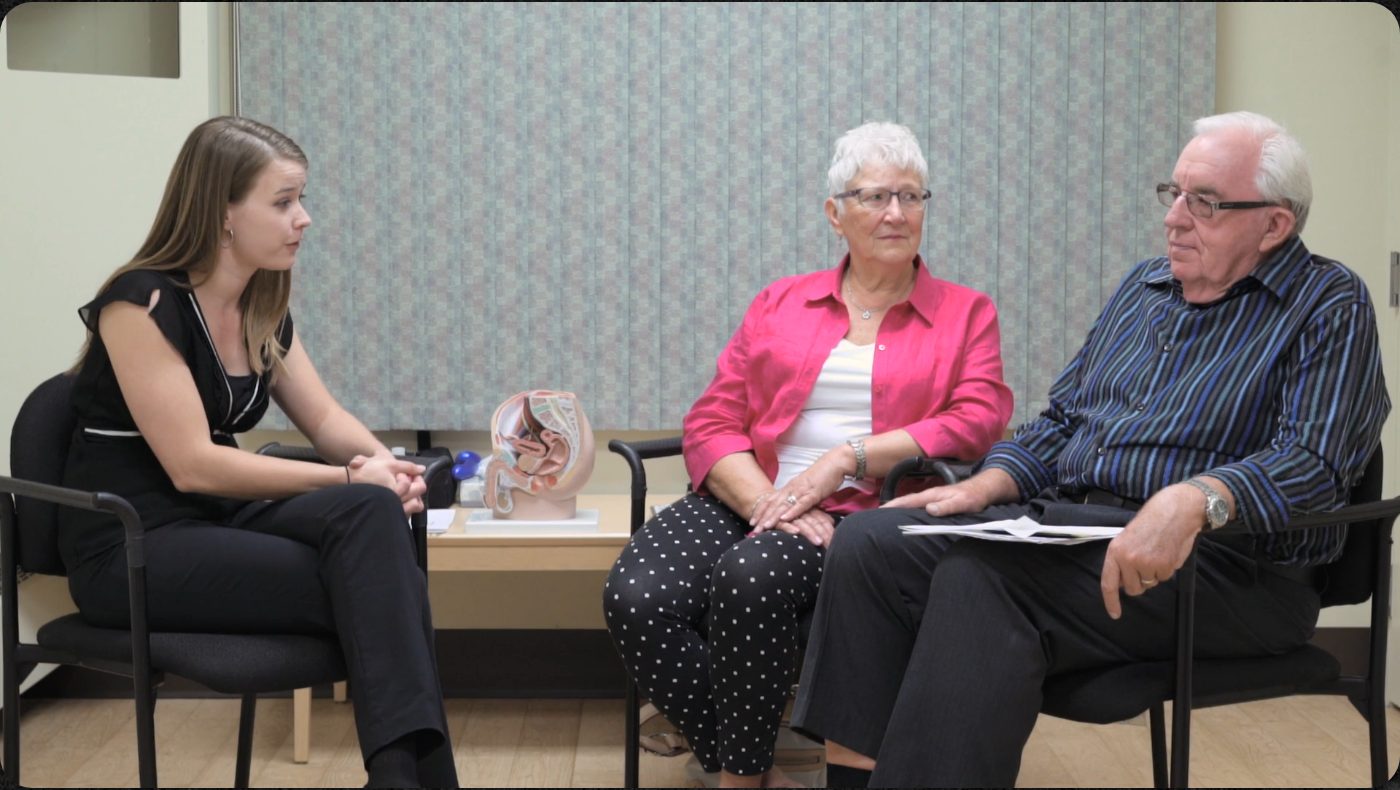
Doug and Jean sitting together opposite the clinician, Doug mid-answer.

When one person says something generous about the other, the pull is to endorse it. That's a lovely thing to say tells the second person what the correct reaction is, and they will produce it.

What do you think about that tells Doug nothing about how he is supposed to feel, so the answer he gives is his own. Doug is the second. His answer, that losing erections would diminish him as a man and as a husband, is the sentence the plan will be built on.

Ask the second person for their own view, in neutral words, so the answer you get is theirs.

SCREEN 42 · video

How a sexual health conversation starts in an appointment about something else

The history you have just built assumes a patient who came to talk about sex. Many arrive for something else, and the clinician opens the subject.

Andrew is 45. He had a nerve-sparing radical prostatectomy 12 months ago for a small tumour, so his chances of recovering sexual function are good without being assured.

He is sitting with a nurse counsellor who is going through a routine distress screening tool with him. He has marked himself a 4 for depression and nothing else.

Watch what she does with that score.

Press play to watch her follow the number.

Andrew and the nurse counsellor

0:01So Andrew, nice to see you. Um, I see that you filled out your screening tool today. Mm-hmm. And there may be a few things that you want

0:08to talk about today, but I did wanna spend a little bit of time talking about this. Yeah. So could we start there? Yeah, sure. Okay.

0:14So I, I didn't see anything that you checked off except really you checked off a four on the depressed scale.

0:20Yeah. Can you tell me a little bit about what's going on? I, um, I, I dunno, it, it's kind of hard in, in some ways

0:28to be, you know, so that's really specific or, or clear about it. But, um, like, I mean, when I, you know, when I was going

0:38through that, the thing that I, I kept thinking about was how these days, you know, I, I seem to just be all

0:44preoccupied about the, the issue that's been going on. And, you know, I just, things like concentration and getting into, you know, I, I can't concentrate on things

0:53that I used to really like, um, for one thing and the other is like, I don't enjoy anything anymore.

1:00You know, I just don't have fun, um, things that ordinarily would've made me smile or laugh. I, you know, I might, but that,

1:08that's about as far as it goes. And I, I just feel flat, um, okay. All the time. You know, I'm not, not crying and you know, all of that.

1:16But, um, I know just, you know, it's just, I, I feel like I'm just bubbling along and, and nothing

1:22Okay. Feels good anymore. Do you, do you actually think you are depressed? Like, do you think of that as a Um,

1:28Well, I suppose, I mean, I've read a little bit about it. I, yeah. Like there are some things that I don't have.

1:34Like, you know, I sleep fine. I probably sleep too much and maybe that's a, a sign but I don't, um, you know,

1:43my appetite's good. Um, okay. So what, what else is going on for you right now, um, in your life,

1:51Aside from the, The, the depressed Symptoms, the other problems that I've, Well, tell me a little bit about the other problems.

1:57Um, so I'm, well, I'm recovering from, um, prostate cancer. Right? Um, it's about a year ago that you had your

2:04Surgery, right? Yeah, that's right. Um, and so, and So how, how's that been for you, the, the recovery in that period of time?

2:14It's been, um, I don't know, kind of a mixed journey in some ways. You know, I mean, you know, being a year on the other side,

2:22it feels hopeful, you know, that, um, good. You know, certainly that's, you know, it seems to have gone away.

2:32Mm-hmm. Um, but, you know, it's, I guess it's left me with some physical issues. Mm-hmm. Um, the, I mean, well, basically I'm just, you know,

2:42I, I can't get an erection. Okay. Um, And is, is that something that's been really troubling for you? Y yeah. Okay.

2:50Um, it's been, well troubling for me, troubling for my partner. Um, How, how has it been affecting you and,

2:58and your relationship? Oh, where to start? Well, it's, I mean, the first thing we, we, we haven't had sex, um, a couple

3:08of failed attempts in the early, um Okay. Early days. Um, All right. And so from there it's just, I mean, basically everything I think has gone

3:20downhill in that, in that way. And, and the relationship is just, I think, a breaking point. Oh, really? Um, yeah. Okay. Um, which is really hard.

3:30Um, and I, you know, I don't dunno how to, to find my way out of it now. So What have you been trying to manage all of this?

3:41This sounds like a lot, uh, Avoidance, I guess. Okay. Um, you know, it's, it's, we, you know, we tried, um, and things just didn't work.

3:55Okay. Um, and I think I, I've reached a point where I reached a point a while ago where just

4:03to try was getting to be, you know, hu humiliating and embarrassing and mm-hmm. Um, Do, do you think there's any connection

4:13between what's happening for you sexually and in your relationship and your mood? Yeah, IW I'd have to say, yeah.

4:23I mean, it would be a strange for it not to be related in some way, you know? I mean, I can't, I can't think it through. Yeah.

4:31Um, but I don't, you know, I don't remember feeling this bad before the diagnosis. Um, and I know I certainly enjoyed things more

4:39before that. Um, yeah. Well, it sounds like it's been really difficult. Mm-hmm. It sounds really difficult for you. Oh, it's been difficult for both of us.

4:48I think it's, but it's been one of those situations where I, you know, I can't talk about it. It's, you know, how do you bring something like

4:55that up, um, With your partner? Yeah. Yeah. Yeah. And I, and I think for him it's, you know, it, it sort of affects

5:03how he feels about me and the relationship and, and himself too. And so, okay. I dunno where we can go from here.

5:12Okay. And so, um, it also sounds like you're not talking to anyone else about it. There isn't any health professional that you've talked to

5:21or found any help with this from mm-hmm. Anyone else in our system at, at this point? No. Um, Andrew, is that something that you would like,

5:29I mean, would you, would it be helpful to, um, see someone to talk about some of the sexual issues,

5:34your relationship issues, um, maybe have a little more assessment around your mood to see if there's anything needs to be done there?

5:42Yeah, I think, um, you know, if you'd asked me that question a couple of months ago, I probably would've maybe said no. You know?

5:50Yeah. Yeah. But it's got, I think I'm at a point now where I Okay. You know, I don't want it to go on and I,

5:55and I want things to get better and I, and I can't find my way Okay. Out of it. Yeah. So, sure. I'd, I'd, I'd give it a go

6:02Anyway. Okay. Yeah, so we do have a team with our program of, uh, various kinds of counselors. Mm-hmm. Um, and I can make a, a referral to,

She asks what sits underneath the score. The screening form only needed the number. What comes out is that the surgery and the erectile difficulty have done serious damage to his relationship with Jeff, who he has lived with for eight years. By the end of the conversation Andrew has agreed to a referral for proper assessment.


The tool asked about depression, the nurse asked one question behind the number, and a sexual health conversation followed.

SCREEN 43 · content

2.3 Taking a sexual history

How to record a sexual history in the notes

Record the history in the same appointment, in the patient's own words.

Tips

  • Write down the symptom, the goal, and anything he said about himself. To have that inability diminishes you in your role as a man, as a husband is clinical information. Write his words down, because they are what the next clinician can act on.
  • Record the goal in his words too, because it is what the plan will be measured against.
  • If you did not get through the whole sequence, write down where you stopped. The next clinician can pick it up from there.

Say what goes in the notes.

Try: Telling him what you are recording, and why, is part of taking the history.

SAY

  • I'm going to write that down so I don't ask you again next time.
SCREEN 44 · content

2.3 Taking a sexual history

Pause for a mo'

Think about the last sexual history you took, however brief.

How far down that sequence did you get? What stopped you: the time, the patient, or you?

✓ Saved
SCREEN 45 · content

2.3 Taking a sexual history

What the research says

What the research says

Open each one to read what the study found.

Robinson and Lounsberry set out a sexual function assessment organised by phase, with questions for desire, arousal, orgasm and resolution5. The functional questions in this lesson follow that structure.

Access the chapter

The same chapter gives the reason for taking a full history rather than treating the presenting complaint. A patient who reports lost desire may have dyspareunia behind it, and a suggestion aimed at desire will fail while the cause goes unaddressed.

Guideline statements 17 to 20 set out what to assess and when: screening before treatment and throughout follow-up, the specific effects this lesson lists, the partner's own sexual function, and validated measures where they exist.

Access the statements

The guidelines do not prescribe an order for the questions. The sequence in this lesson is the course's own, and it runs from what is easiest to say to what is hardest.

SCREEN 46 · part-divider

Module 2: Assessment and models of care

2.4 The words for the hard parts

SCREEN 47 · content

2.4 The words for the hard parts

Why the words matter

You know the sequence now. This lesson gives you the vocabulary to run it.

A clinician who is uncertain about a word will avoid it, approach it obliquely, or use a euphemism. Every one of those choices is audible, and you saw the finding in Module 1: awkwardness transmits, and a patient who hears it concludes the subject is unwelcome. Patients often have no words for it either. Some were never given the terms, and some use a word that means something else, so part of the job is offering the word and checking it is the one they meant.

Four of the five subjects in this lesson are clinical terms a patient has no everyday word for. One of them is not. Which one?

SCREEN 48 · content

2.4 The words for the hard parts

Dry orgasm

What it is. After a radical prostatectomy the prostate and seminal vesicles are gone, so there is no ejaculate. Orgasm can still occur and the sensation is usually preserved, though many men describe it as different rather than identical. After some radiation and after certain drug treatments, volume of ejaculate reduces rather than disappearing.

Why you should ask. Pre-treatment counselling rarely mentions it. For many men ejaculation is the evidence that orgasm occurred, and its absence reads as a further loss of something that defined their sexuality or masculinity. Some men describe the first dry orgasm as more distressing than the erectile difficulty.

Saying it.

SAY

  • After this surgery, orgasm can occur without any fluid. It's called a dry orgasm. The feeling is usually still there, though a lot of men say it's changed. Has that happened for you yet?

Explain it, name it, normalise it, then ask. That order matters: a man who has already had one and thought something had gone wrong needs the explanation before the question.

SCREEN 49 · content

2.4 The words for the hard parts

Penile shortening

What it is. Loss of penile length can occur after radical prostatectomy. It is attributed to a combination of the urethra being shortened at anastomosis and to structural change in the erectile tissue in the period without regular erections. Length is often partly recovered as erectile function returns, which is one of the arguments for penile rehabilitation.

Why you should ask. Men frequently believe they have imagined it, because pre-treatment counselling rarely covers it and some men were told it would not happen.

Saying it.

SAY

  • Some men notice their penis seems shorter after this operation. That's a real thing, not something you're imagining, and there are reasons for it. Have you noticed any change?

The phrase not something you're imagining is doing most of the work in that sentence. Say it even if he has not raised it.

SCREEN 50 · content

2.4 The words for the hard parts

Climacturia

What it is. Leaking urine at orgasm. It is common after radical prostatectomy, it is frequently temporary or improvable, and it can be managed with pelvic floor work, emptying beforehand, position, and a condom where that suits the couple.

Why you should ask. Men rarely raise it unprompted.

Saying it.

You wrote this one yourself in Module 1. Here are the versions that work.

SAY

  • Some people find they leak a little urine during sex, or when they orgasm. Has that happened to you?
  • One thing I ask everyone after this surgery: any leaking during sex?
  • Climacturia is leaking urine at orgasm. It's common after this operation and there are things that help. Is it something you've noticed?

Notice that the third one says there are things that help before it asks the question, so the patient is answering a question that already has an answer attached.

SCREEN 51 · content

2.4 The words for the hard parts

Anal sex

What it is. Receptive anal sex after radiation can be painful for a period, and the guidelines have a word for that pain: anodyspareunia. After surgery, the prostate that provided sensation is gone. For men who have receptive anal sex, this is a specific loss. Similarly, for men who have penetrative anal sex, erections after treatment aren't always hard enough to achieve this.

The question also identifies the men for whom this is not relevant, which matters because the alternative is assuming either way.

Why you should ask. For the clinician rather than the patient, most of the time. This is the question most often skipped, and it is skipped on an assumption. You met a clinician's account of that assumption in the last lesson.

Saying it.

SAY

  • I ask everyone this because treatment affects this and it often gets missed. Do you have anal sex, either receptive or penetrative? And has treatment changed that?

Ask it of everyone, in the same tone as the others, regardless of what you have assumed about the person in front of you.

SCREEN 52 · content

2.4 The words for the hard parts

Telling a new partner

What it is. A man who is single after treatment has to decide when to tell a new partner about erectile difficulty, about leaking, and about a body that has changed.

Why you should ask. The advice most often offered is just be honest, which is a value rather than a plan. What this patient needs is a rehearsal of the actual conversation.

Saying it.

SAY

  • If you start seeing someone, you'll have to decide what to tell them, how much and when. Most men find that hard and there's no single right answer. Would it help to run through some different options?

What you are offering is rehearsal. Anthony works through this in Module 3, and you will watch him do it.

SCREEN 53 · content

2.4 The words for the hard parts

Say it out loud

This rehearsal asks you to say two questions aloud. Say both.

You are with a 61-year-old man four months after a radical prostatectomy. You have asked about erections and he has answered. You now need to ask whether he has had a dry orgasm, and whether anyone explained it to him beforehand.

Say the question out loud, now, in whatever room you happen to be in.

Then say this one, in the same tone as the first:

Ask him whether he has anal sex, receptive or insertive, and whether treatment has changed it.

Say it out loud first, then open this to see how others phrase it.

Phrasings that work

After this surgery orgasm happens without any fluid, which we call a dry orgasm. Did anyone explain that before your operation?
I ask everyone this because treatment affects it and it gets missed. Do you have anal sex, receptive or penetrative? Has treatment changed that?

Notice whether the two questions came out of your mouth in the same tone of voice.

A patient hears the difference between the two tones. Practise until both questions sound the same.

SCREEN 54 · content

2.4 The words for the hard parts

What the phrasings have in common

Every form of words in this lesson does the same four things.

Before you look: the five phrasings in this lesson all do the same four things. What were they?

Write something first.

You can build your own version of any question in this course from those four parts. The phrasing that works is the one that sounds like you.

SCREEN 55 · content

2.4 The words for the hard parts

What the research says

What the research says

Open each one to read what the study found.

Clinician discomfort is one of the more consistently reported barriers to patients raising sexual concerns after prostate cancer. Charlick and colleagues reviewed help-seeking in this population and found perceived clinician discomfort acting as a deterrent2.

Access the review

McCaughan and colleagues evaluated a brief e-learning resource for clinicians working in prostate cancer care and found improvement both in confidence discussing sexual wellbeing and in feeling equipped with the language to start the conversation3. It is the closest thing in the literature to a test of this lesson's design.

Access the study
SCREEN 56 · image-quote
A clinician alone in a consulting room after an appointment, looking past the camera, thinking.

I made an assumption that I didn't need to talk to him about that. And I also felt bad about it after he left, and I just thought, you're just a big chicken, you should have just gone there.

A clinician working in prostate cancer care

SCREEN 57 · content

2.4 The words for the hard parts

How to recover when you get it wrong

It is perfectly human to make a wrong assumption, or hear an answer and visibly react. Everyone does.

The recovery is one sentence, said in the same tone as everything before it.

SAY

  • Sorry, I assumed something there I shouldn't have. Tell me how it actually is for you.

Then carry on with the next question. Dwelling on the mistake tells the patient that the subject needs careful handling.

Being corrected in front of a patient, and carrying on, is what normalises the subject.

SCREEN 58 · content

2.4 The words for the hard parts

Knowledge check

A 64-year-old man, five months after a radical prostatectomy, tells you that orgasm isn't the same and that he thinks something has gone wrong with the operation.

What is the most useful first response?

Choose one option.

SCREEN 59 · content
SCREEN 60 · part-divider

Module 2: Assessment and models of care

2.5 From assessment to plan

SCREEN 61 · content

2.5 From assessment to plan

How to turn a full history into a plan

The history has given you 40 minutes of assessment. You know what stopped working and when, what they have tried, what has happened between them, and what they want.

A clinician sitting with a notebook, listening, the hand of the person opposite raised mid-sentence in the foreground.

The Integrated Model of Sexual Health Framework takes you from that assessment to a plan1.

Of everything I have just heard, what needs addressing, and what has to change first?

The rest of this lesson is practice rather than reading. You will fill the framework in twice, first for Doug and Jean and then for Andrew, put a plan in order, and read a finished grid back to a patient.

SCREEN 62 · content

2.5 From assessment to plan

What the framework asks you to fill in

This is the Integrated Model of Sexual Health Framework, named on the previous screen. It takes the model you met in lesson 2.1 and turns it into a grid you fill in during the appointment.

Three columns.

  • Impacts and effects. What the illness and the treatment have done.
  • Needs. What this patient and this partner say they want addressed.
  • Tie to intervention plan. What you will do about it, and in what order.

Five rows run across those columns. Three of them are the biopsychosocial model from lesson 2.1 under different names. Two are new here: practical and information, which is what he was told about his treatment and what he took from it, and spiritual, which is what the loss means to him.

The menu will bring you straight back here.

Select each row to see what goes in it.

Nerve status, vascular supply, hormone levels, continence, pain, medication, comorbidity, fatigue. What the body can currently do.

What he was told before treatment, what he understood from it, and where he is still working from.

What he believes has happened to him, what he expects, what he is afraid of, and what the loss has done to how he sees himself.

What happens between two people: who initiates, what has been said, and what each believes the other thinks.

What sex means to him beyond function, and what he was raised to believe it was for.

Fill all three columns.

SCREEN 63 · content

2.5 From assessment to plan

How the grid maps to the model you assessed with

The biopsychosocial model you assessed with has three domains. This grid has five rows. They cover the same territory at two different points in the appointment: the three domains are how you assess, and the five rows are how you plan.

Start with the physical row, because nerve status, continence and medication are already on record. The other four rows come from what the patient told you when you took the history.

Each row of the grid belongs to one of the three domains you assessed with, except one. Put each row where it belongs.

Biological domain
Psychological domain
Social domain
Not in the three domains

Physical is the biological domain.

Psychological and emotional is the psychological domain.

Social and relational and Spiritual both sit inside the social domain. They are separated here because they lead to different interventions: couples work for one, and a conversation about meaning and values for the other.

Practical and information is the row the triad does not cover.

SCREEN 64 · content

2.5 From assessment to plan

Applying the framework to Doug and Jean

A clinician at a laptop in a consulting room, writing up a consultation.

Each of these is something you learned about Doug and Jean. Put each one in the row it belongs to.

Physical
Practical and information
Psychological and emotional
Social and relational
Spiritual

Fill the grid before treatment as well as after it. Before treatment the impacts column records what is about to happen, and the plan column records what to correct.

SCREEN 65 · content

2.5 From assessment to plan

Applying the framework to Andrew

Andrew is 45, 12 months after a nerve-sparing prostatectomy, and he came in to complete a distress screening form. He scored himself 4 for depression. He and Jeff have been together eight years.

Each of these is something you learned about Andrew. Put each one in the row it belongs to.

Physical
Practical and information
Psychological and emotional
Social and relational
Spiritual

The same five rows produce a different plan. Doug's impacts column is a prediction, and Andrew's records a pattern that is already running.

SCREEN 66 · content

2.5 From assessment to plan

How to decide what to treat first

The third column usually holds four or five things, and deciding their order is a clinical judgement. Apply these three tests in order.

Select each test to read it.

SCREEN 67 · content

2.5 From assessment to plan

Put the plan in order

A 66-year-old man comes in ten months after a radical prostatectomy. He has no erections, he has stopped initiating sex, and his wife has assumed he has lost interest in her. Late in the appointment he mentions one attempt at intercourse six months ago that went badly, and that neither of them has referred to it since.

Five things are worth doing. The order they happen in is what decides whether he comes back.

Select the five steps in the order you would do them. The number shows where you have put each one.

B. First. He believes his wife has given up on him, that belief sits between him and everything else on the list, and correcting it comes first.

A. Second. Neither of them knows what recovery looks like at ten months, so tell them both at the same time.

C. Fourth. Hand over a device while intercourse is still the measure of success, and the next attempt fails the same way as the last one.

D. Third. Sensate focus removes the performance demand that made the attempt six months ago go badly. The therapy is usable once that demand is gone.

E. Last. Book it for both of them before they leave.

The order is B, A, D, C, E. Every item was clinically reasonable. The order is what decides whether he comes back.

SCREEN 68 · content

2.5 From assessment to plan

What that drill was doing

Every item in that list was clinically reasonable. An intervention can be right and still fail, because the situation cannot receive it yet.

Seen from above: a clinician writing in a notebook, the patient sitting opposite across a low table.
  • Sequence is the intervention. Changing the order changes which of the five actions the patient is able to use when it arrives.
  • Fill the third column before you choose. It gives you a basis for choosing between options that are all reasonable.
SCREEN 69 · content

2.5 From assessment to plan

How to read the grid back to the patient and partner

Read the grid out loud so the patient and the partner can correct it.

  • Say what you think is going on, in the room, to both of them.

TRY

  • Can I tell you what I think is going on? You both want to keep this, and you're each measuring it by something different. Doug, you're measuring it by erections and intercourse, and you've told me that's tied to how you see yourself as a husband. Jean, you're measuring it by whether the two of you still feel close. After the surgery those measures are going to disagree for a while, and I'd rather tell you both now than have you work it out separately.

Doug can then hear that what frightens him is a question about identity, and Jean can hear why her reassurance has not reached him.

  • Check it before you write it down.

TRY

  • Does that sound right to you?

If they correct you, change the grid. Their correction is better information than your reading of it.

  • Write it in the notes in the words you said it in. The next clinician who sees them will need it, and so will you.
SCREEN 70 · content

2.5 From assessment to plan

Knowledge check

A 70-year-old man comes in three years after brachytherapy and describes erections that have worsened gradually over 18 months. He takes a beta blocker for hypertension, he retired last year, and he tells you his wife has been through enough already with her own health.

More than one of these belongs in the physical row. Tick every one that does, then check your answer.

SCREEN 71 · content

2.5 From assessment to plan

Pause for a mo'

Think of a patient whose sexual difficulty you treated and who did not improve.

Which row of the grid was empty?

✓ Saved
SCREEN 72 · part-divider

Module 2: Assessment and models of care

2.6 Scope, and referring well

SCREEN 73 · content

2.6 Scope, and referring well

What you can treat without referring

Most of what arrives in a sexual history after prostate cancer is within the scope of a competent generalist in this field.

You can give permission, correct a misconception, and explain what treatment did and what recovery usually looks like. You can teach a pro-erectile therapy, name what is happening between two people and ask them to say it out loud, and hand the patient a plan with an order to it.

Schover and colleagues looked at where sexual concerns actually get managed. What proportion do you think are handled at the first two PLISSIT levels, permission and limited information?

Drag the slider, then lock it in. Nothing is scored.

50%
SCREEN 74 · content

2.6 Scope, and referring well

How to decide what needs referral and to whom

Referring is a clinical decision, and these are the four situations that call for it.

Lesson 2.2 set out the four levels of PLISSIT. The first two are permission and limited information. What are the other two?

SCREEN 75 · content

2.6 Scope, and referring well

How to refer so the patient comes back

Select each move to open it.

Inside each one, select What the patient hears to read the comparison.

Compare

I'll send you to someone who deals with this.

You are still their clinician. Say which problems you will go on treating yourself.

Compare

I'll let the psychologist take it from here.

Make it a date that stands whatever happens with the referral.

Compare

Come back and see me if you need to.

If they hesitate about the referral: book the follow-up anyway, and say the referral can wait until after it.

SCREEN 76 · content

2.6 Scope, and referring well

Rewrite it

Here is a referral.

I think this is a bit beyond what I can help with, so I'm going to refer you on to someone who specialises in this area. They'll be in touch.

Rewrite it: Say what the referral is for, say what you are keeping, and put a date on seeing them again.

Write your version before you reveal the model answer.

Your version
✓ Saved
I want to get you in with Dr Nguyen, who works with couples where cancer treatment has changed things. She can give you the time to do the couple work properly.
I'm going to keep managing the erectile side with you, and we'll keep reviewing how the tadalafil is going.
I'll see you in six weeks either way. Let's book it now.

Compare it with yours, then use your own wording. The three moves are what matter.

SCREEN 77 · content

2.6 Scope, and referring well

What that drill was doing

The original referral was clinically correct and would read as entirely appropriate in the notes of any service. Your rewrite tells the patient what the referral is for, which part of the care stays with you, and when they will see you next.

Say the referral out loud before you make it, and listen for whether it sounds like being sent away.

Name one thing you will do differently, and the appointment you will do it in.

When
I will
SCREEN 78 · summary

What now?

You have reached the end of Module 2. Well done.

Two people in a long, unhurried conversation in a comfortable consulting room, both leaning towards each other.

You have got the integrated model of sexual health and a framework for deciding how far to take a conversation. You can take a full sexual history without notes, you have the words for dry orgasm, penile shortening, climacturia, anal sex and telling a new partner, and you have the grid that turns all of it into a plan with an order to it.

In Module 3: Intervention, you will do something with the method. Couple work, the treatments themselves, and what to say when a treatment does not work. Doug and Jean carry on into Module 3, Andrew and Jeff join them in the lessons on couple work, and Anthony takes you through the treatment lessons.

Before you go: how confident do you feel about taking a sexual history after prostate cancer treatment, in your next clinic?

Not at allCompletely50%

Your toolkit so far

  • Conversation guide: Modules 1 and 2, with every phrasing and the pre-treatment discussion prompt

  • My phrasing for the hardest question

  • My referral, in my words

SCREEN 79 · resources

Resources from this module

Tick the resources you would like to keep, then email them to yourself. The conversation guide is ticked for you.

    Tick at least one resource to email.

    Your reflections

    Everything you wrote during this module is still here, on this device. Open it to read it back, print it or email it to yourself.

    CHANGELOG

    Changelog

    Current version: v0.01

    • The films play, and they play the right seconds. PLACEHOLDER_VIDEO was true, so the engine treated every play press as a watched video and never built a player: no film in this module had ever played. Vimeo embedding is open as of 1 October 2026, so the three film screens are now driven by a new shared component, _components/rtl-film-player.js, which the engine has no equivalent of — its own playVideo builds an iframe from second zero and waits for ended, with no concept of an in or out point. Screen 6 plays 0:00–3:57, screen 42 plays 0:00–6:03, and screen 40 plays 15:58–17:32 with a hold at 16:40. Clip points come from the deck’s own VIDEO_SCREENS notes and the build asserts every number against them, because a wrong hold is not a visible defect: the film just stops on the wrong line.
    • Screen 40 is the pause-and-choose rehearsal the deck has always described. It holds at 16:40, shows the four options, and carries on to 17:32 once the answer is finished — which is what its own copy, “The session will play, and then it will stop”, has been promising a screen that had no film on it. The options are hidden until the hold, and every failure path reveals them anyway with a line saying the film could not be played, because ACTIVITY_GATE sits on this screen and is released by answering: a question behind a film that will not load is a locked module. Scrubbing past the hold seeks back to it, because the question is the screen.
    • Two faults the test run found, both of which would have reached learners. Seeking back after a scrub reported a seek at the hold, which was read as past the hold again — an infinite loop and a dead tab the first time anyone dragged the scrubber. And audit.js had an unguarded click on .quiz-option: one option that is present but hidden threw an uncaught error that killed the audit of all six modules, not just the screen. The audit now starts film screens before looking for their question, and its quiz clicks are visibility-guarded and non-fatal, like the loop beneath them already was.
    • The whole module: 79 screens across seven lessons, built from storyboard v5.0 (sign-off) via build_module.py → module-generate.js, so every screen number derives from its position in the data document. Deck screens 1–80 render as 79 because deck 2 folds into the hero.
    • Chrome and interactions carried over from Module 1 v6 unedited — header, footer, contents menu, settings panel, the rehearsal reveal, the per-option multiple choice, the cards, the ordering drill and the end-of-module celebration. One copy of each, so the two modules cannot drift.
    • Three rehearsal gates were locking the module shut, and now do not. The rehearsal script reads data-screen off the markup and tells the engine that screen is finished; the generator writes the DECK number there, while ACTIVITY_GATE is keyed on BUILT POSITIONS. The two are identical in Module 1 and differ by one here, so screens 53, 67 and 76 each marked a screen one further on and Continue never unlocked. A learner would have stopped at screen 53 of 79. Every data-screen is now rewritten to its built position and the build asserts all of them match before it writes the file.
    • Deck 71’s knowledge check is a multiple select, which is what it asks for — “select every entry that belongs in the physical row”, three of four correct. The generator renders every knowledge check as single-answer, so it had flagged one option right and would have marked a learner wrong for choosing another correct one. Tickboxes, one submit, and the deck’s own explanation for all four. Interaction needs sign-off.
    • Deck 68 is an ordering drill — press the five steps in the order you would do them — which is what its own title (“Put the plan in order”) and its own feedback (“The order is B, A, D, C, E”) ask for. The mechanic is Module 1 screen 43’s, carried over rather than rebuilt. One storyboard sentence changed, authorised 1 October 2026: the stem “Which one comes first?” became “The order they happen in is what decides whether he comes back”, because the drill asks for the whole order and the old stem asked for one step.
    • Deck 77 gives the learner somewhere to write. It instructs them to “write your version before you reveal the model answer” and there was no field. It is the engine’s own reflection box, so what they write is autosaved, restored when they come back, and included in “View my reflections” and the print and email export.
    • The resources screen does what its own copy says. It promised tickboxes, an email and “anything you saved as you went along is already ticked for you”, and had none of those. Now: 18 rows built from the deck’s own four groups, select-all, both email controls, and the reflections export. Module 1’s version of this script is deliberately NOT carried over — its bibliography is baked into it, so it would have put Module 1’s reading list here.
    • Saved phrasings now come back. Sixteen screens have been telling learners that saved phrasings “go to your resources, where you can print them or email them to yourself at the end of the module”. The store held ids and nothing could turn an id back into words, so the end of that promise did not exist. The module now ships the lookup, and saved phrasings head the resources list, already ticked.
    • Twenty-four phrasings could not be saved at all. The first sweep finds phrase cards; three screens still had clinician lines as italic runs inside a paragraph, including ten on the relationship-questions screen and the nurse’s five on the Ex-PLISSIT example, and two more screens had a control that did not cover their prose lines. 57 savable phrasings before, 78 now. Quoted PATIENT speech is excluded by name, not by pattern — Rakesh’s “the sex side of things is finished anyway” is the one line on deck 19 that should never reach a toolkit of things to say.
    • Six screens ask the learner to do something instead of reading. Anu, 1 October 2026: “it gets a bit monotonous with the teaching. We need to break it up where learners are actually doing something like the slider example in Module 1. It wasn’t testing anything but it was asking learners to engage.” Measured first: 37 of 79 screens had something to act on and 31 of the rest ran over 80 words with nothing. Added, all from the RTL activity library, which this module was loading and not using: three estimate sliders (the 41 per cent on deck 5, the 2 per cent on deck 17, Schover’s 80 per cent on deck 74), a free recall on deck 55, and a sort of the five grid rows into the three domains on deck 64. Nothing is scored. In each case the deck’s own sentence MOVES behind the commit rather than being rewritten, because an estimate whose answer is printed above it is not a question. The sort needs sign-off: it is select-then-place, which Anu rejected for ranking in Module 1.
    • The summary screen carries the kit’s rays rather than a placeholder, and its toolkit list is seven tiles instead of seven lines run together. Deck 79 briefs “MiM Rays graphic”, and a JPEG placeholder flattens the transparency that IS the artwork, so the kit PNG is referenced directly. Module 1 screen 61 still has the placeholder and could take the same treatment.
    • Deck 20’s level match is six independent one-question groups rather than the drag-and-drop the deck replaced at v3.0. The answer key is read out of deck 19 and the per-option feedback is deck 18’s own level definitions. Interaction needs sign-off.
    • Six diagrams drawn rather than placeheld: the three domains (the same drawing as Module 1’s, which deck 9 refers back to), the PLISSIT levels, Ex-PLISSIT, the 5A’s, the order of the history, and deck 63’s 3×5 framework grid. Marked decorative, because each states what the list beside it states; no figcaption carries a production brief.
    • Generator fixes, all of which affected Module 1 too: consecutive numbered blocks merge into one list; a knowledge check with no options fails loudly instead of rendering an empty one; a pull-quote line with more than one italic span keeps its emphasis; a divider’s trailing line is a sub-line, not body copy.
    • Known, and not this module’s to fix: qa-quiz.js and qa-resources.js both report failures here and report the identical ones against Module 1 v6. The first wants data-quiz on every option, which the per-option mechanic replaced with data-fb; the second asserts MIM Pro’s own wording (“Additional resources”, its research panel name, a completion note). Two of qa-quiz’s failures count zero things and still fail. Neither gate gives a signal on either SHAReT module.