

Module 4
Inclusive care and your professional practice
3 hours · five lessons
What you have covered so far
The first module made the case for having the conversation. The second gave you the method, and the third aligned interventions to the sexual health guidelines.
This module turns to two groups of patients whose sexual health needs differ from the ones you have met so far, and then to your own practice.
The first lesson returns to Andrew, and teaches what changes for gay and bisexual men and for men who have sex with men. The second covers transgender women and gender non-conforming people, who appear for the first time in this course.
The last three lessons cover the boundary decisions this work generates, why sexual health gets left out of cancer care, and how to become the clinician other services refer patients to.








Learning outcomes
By the end of this module you will be able to:
- Adapt assessment and intervention for gay and bisexual men, and for men who have sex with men
- Adapt assessment and intervention for transgender women and gender non-conforming people
- Apply professional boundaries, scope and ethics to situations arising in sexual health care
- Explain why sexual health gets left out of cancer care, and what changes it
- Establish yourself as a referral destination, and plan how sexual health care is embedded in your service
You will practise three times in this module. Once you will pause a consultation and choose what to say, once you will say a line out loud, and once you will rewrite one. There are also knowledge checks throughout the module.
Module 4: Inclusive care and your professional practice
4.1 Gay and bisexual men, and men who have sex with men
50 minutes
4.1 Gay and bisexual men, and men who have sex with men
What changes when the patient is a gay or bisexual man
In Module 3 you learned to build a sexual rehabilitation plan with a couple: returning to sexual activity, treating erectile difficulties, and supporting the partner's own needs. You worked through that plan with Andrew and Jeff as well as with Doug and Jean. For gay and bisexual men, seven parts of it change:
What changes in sexual function
Anal penetration needs greater rigidity and durability of the penis than vaginal intercourse.
Losing a preferred role, insertive or receptive, can affect sexual identity and a sense of belonging in the gay community.
Losing ejaculate is often distressing, because seeing ejaculation is valued as erotic. Ejaculate carries meaning beyond fertility, and losing it is a larger loss for many gay and bisexual men.
It can be affected by rectal discomfort, changes to the sphincter and reduced sensation.
What changes around the patient
A male partner's own sexual function often continues unchanged, where a woman after menopause can have changes of her own1. Gay and bisexual men are also more likely to have new or multiple partners, as well as sex in casual or anonymous settings, so they may have to disclose sexual changes more often.
Penile shortening, incontinence and erectile difficulties can affect confidence in dating, on apps and in community spaces.
Many report that no clinician discussed anal sex, their sexual practices or rehabilitation suited to them2.
The lesson works through the first six one at a time, in the order above. Gaps in care is the exception: it is covered first, under 'Why this matters, and how to ask' and 'Creating an inclusive care environment'.
Guideline statement 25 offers two recommendations1. Give these patients and their partners information relevant to their sexual experience and guide them towards support that suits them.
The guidelines name gay men, bisexual men and men who have sex with men separately. The last group describes what a man does rather than how he identifies, and it includes men who would not call themselves gay or bisexual.
Before you plan treatment, ask the patient what their sexual preferences are and what they hope to continue to have.
4.1 Gay and bisexual men, and men who have sex with men
Why this matters, and how to ask

Many LGBTQIA+ people have had reason to expect discrimination. In an Australian study of 430 LGBTQI people with cancer and 132 carers, 84% had experienced discrimination in their lives because of being LGBTQI, and a third had experienced it in cancer care3.
Most sexual health care assumes a heterosexual patient, and that can alienate people with different sexual identities and preferences. Gay and bisexual men have historically experienced discrimination in health care, and many do not feel comfortable disclosing their sexual orientation. Where that happens, the support that would have been relevant is not offered4. Many gay and bisexual men report that no clinician ever discussed anal sex, their sexual practices or rehabilitation suited to them2. When LGBTQIA+ people can discuss their sexuality openly, their outcomes are better.
You can only adjust the plan for a gay or bisexual man if you know he has sex with men. Ask every patient two questions:
ASK
- Is sex and sexuality important to you?
- What are your sexual preferences?
The second question lets a patient tell you without having to come out, and it includes anyone whose preferences differ from what you might assume.
4.1 Gay and bisexual men, and men who have sex with men
Creating an inclusive care environment
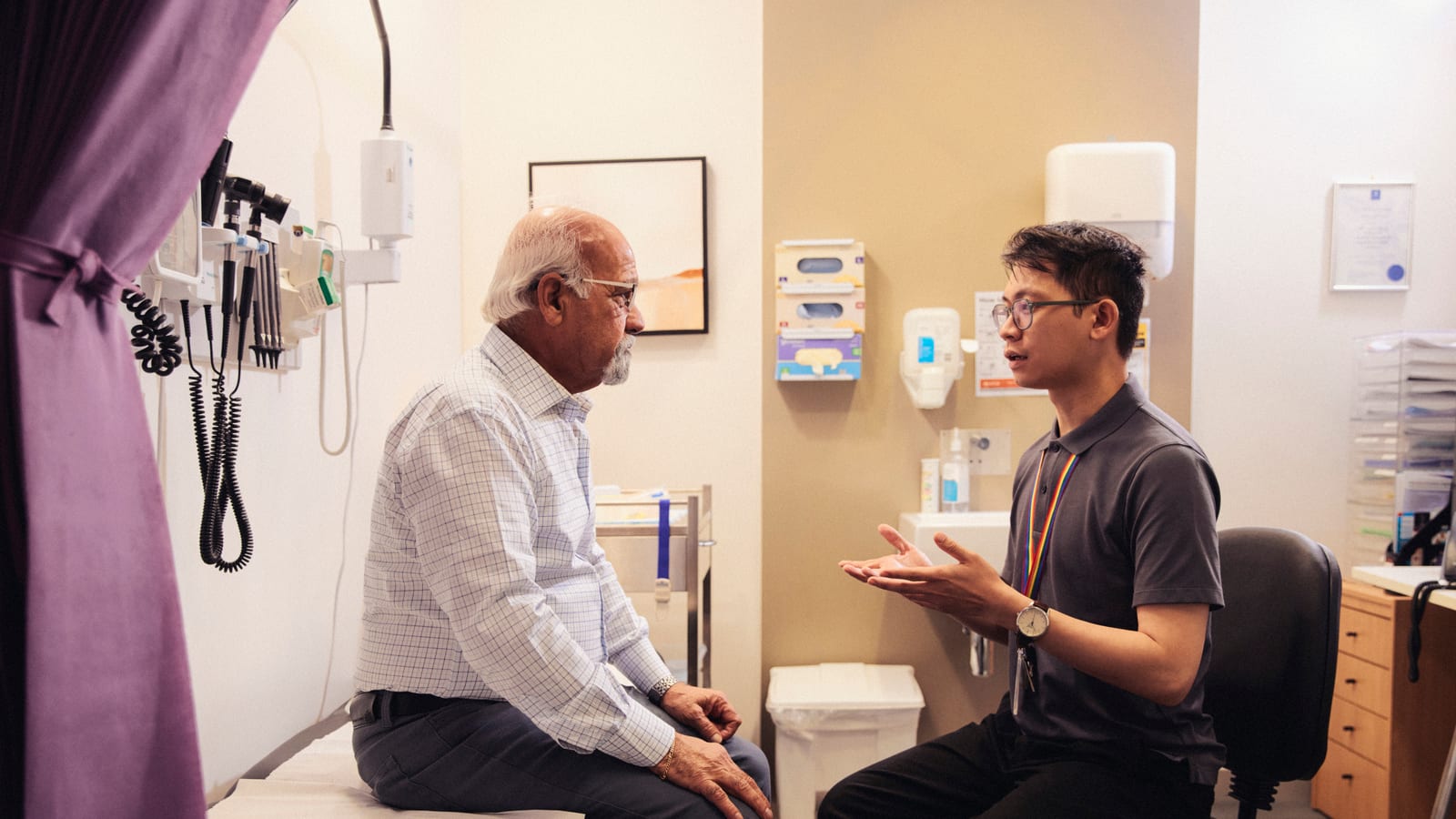
The guidelines recommend making the clinic welcoming before any question is asked5. It takes the confrontation out of asking about sexuality.
- Show allyship. Share your pronouns, wear a rainbow lanyard. It can seem tokenistic, but it can help create an inclusive environment with LGBTQIA+ patients.
- Normalise diverse relationships. Include male couples in clinic brochures, and inclusive art on the walls.
- Use the intake form. Ask every patient about their gender, sexual orientation, culture and ethnicity. A patient who can disclose on a form does not have to repeat it to every clinician they see5.
- Take accountability. You will sometimes get it wrong. Say so, and carry on with the appointment:
SAY
- Sorry, I assumed.
- Sorry, I used the wrong pronoun.
None of these steps replaces asking the question. They make it easier for your patient to answer when you ask.
4.1 Gay and bisexual men, and men who have sex with men
Why men who have sex with men may need a firmer erection

Once a patient has told you he has sex with men, or engaged in anal intercourse, the first change to the plan is the firmness of erection he needs. Erections for anal penetration require greater firmness than erections for vaginal intercourse4. Two men can recover the same erectile function and still have different needs, because the firmness a man needs depends on the sex he has.
A survey of gay and bisexual men after prostate cancer treatment asked about sexual function and sexual roles. Two-thirds rated their sexual functioning as fair to poor, and 22% had erections adequate for insertive anal sex. Among men taking the receptive role, one-third experienced pain on penetration1.
The same study found difficulty with erections given as a reason for not using condoms, and three participants acquired HIV after prostate cancer treatment.
The firmness a man needs depends on whether he penetrates his partner, is penetrated, or both, so the sexual history has to establish his role. In the next film, Andrew's clinician asks him what he and Jeff did together.
Watch a clinician ask Andrew about his sexual role
Andrew, 14 months after surgery
This appointment comes after the sensate focus sessions you watched with Andrew and Jeff in Module 3. Jeff is away, so Andrew has come alone. His clinician is taking him through what he and Jeff used to do together.
Andrew and the clinician
12:31I've never been a premature ejaculator. Yeah. Yeah. Been a problem. Um, and, and what kinds of, what kinds of sex did you enjoy?
12:41Did you, were you both, um, comfortable with oral sex? Did you use mutual masturbation? Were you both comfortable being top or bottom,
12:49or Yeah. How did you work that out? Well, I mean, there was, I mean, I think the, I mean,
12:55Jeff will, will probably, um, corroborate this, but I mean, but I would probably be more active, you know, more of a,
13:03in the top role, um, in terms of penetrative sex. Mm-hmm. Um, and I'm dancing around the issue here. I don't like to be penetrated. Um, yeah.
13:12You know, it's not my favorite thing, um, at all. Uh, and you know, we, we'd both sort of, um,
13:22give and receive oral sex and Yeah. You know, mutual masturbation and, and touching and stuff, you know, it was always, yeah.
13:30You know, we, we did that kind of interchangeably. But in terms of penetrative sex, I was Okay. The one who was, who would be on top.
13:39Um, and so of course this has been a, I Can see How, you know, it's made it a huge,
13:43um, a huge difference. And, um, that's probably something that's harder to talk about. 'cause the one thing that Jeff really wants to do is
13:54to be able to penetrate me. Like, you know, he's been saying actually even before the surgery Mm. That he wanted to, to try that. And I've never liked it,
14:04Never wanted him to. Yeah. Um, and I did, um, actually let him, you know, um, when we were having sex a few weeks ago,
14:15and it was for him, I think I enjoyable and for me, Deeply Unpleasant. And I haven't found a way yet to talk to him about that.
Listen for the point where Andrew says what he has not been able to say to Jeff.
You are watching the extract from 12:37 to 14:25. The full session runs for 29 minutes and is available in the resources at the end of this module.
Pause and choose · Andrew
The film stopped before the clinician speaks again.
Andrew has told you he was the one penetrating, that he has never liked being penetrated, and that he let Jeff do it a few weeks ago. He has said it was deeply unpleasant, and that he has not found a way to tell him.
What do you say first? Choose one. There is a best answer here, and it is what the clinician actually said. The feedback explains what each of the other three would do.
Choose one option.
4.1 Gay and bisexual men, and men who have sex with men
How losing erectile firmness affects sexual roles

The second change is the role a man holds during sex. Taking the penetrating role (top) or the receptive role (bottom) can be part of a gay man's sexual identity. Losing a firm erection disrupts familiar sexual activity and upends the role a man takes in a sexual encounter4.
Losing a preferred role can also affect how a man sees himself sexually, and his sense of belonging in the gay community6.
Some men and some couples adapt to new roles. Others do not find the adaptation acceptable, and the guidelines ask you to recognise that when you counsel a man about pro-erectile aids.
Men describe both outcomes. One man who switched said he had reinvented himself as a bottom, and his partner was happy with it. Another man said he could still take the receptive role without an erection, but he did not find it very pleasurable7.
Whether a couple can switch roles often depends on the partner. A partner who takes both roles makes the switch possible, and a partner with a fixed preference does not. Ask about both partners' roles.
Andrew has always taken the top role, and being penetrated hurts him. His clinician offers him a strap-on, so he can keep the role he has.
Watch the top role kept without an erection
Andrew, at the appointment about treatment options
His clinician shows him a strap-on dildo and a harness.
Andrew and the clinician
5:46uh, useful option. Um, and the last thing that we've been using a little bit, I don't know if you and Jeff have used d****s at all, um,
5:54or if you would consider it? Well, We once, I think we, we, you know, we kind of tried to
5:59Play around with it, play Around. Well, I mean, it wasn't that successful. No. Well, you may not be interested,
6:05but I'll just show you the, um, this is one that I just, uh, just found in the market. I haven't seen quite this model before.
6:12Um, but, you know, basically, have you, have you seen these devices? Wow. I know. It's huge, isn't it? It's, yeah, I know.
6:18Um, they come in all different sizes, so you can pick your Own own Size. I know, I know. I'm not sure who makes these, um,
6:26porn stars maybe, I don't know. But they're all similar and they come with, you know, a harness and this, this particular one has a rigid base
6:35and, um, it actually has a, a piece that inserts into the d***o down to boat here. So it actually keeps it a bit more stable. Okay.
6:42Um, this is not the best, uh, harness. Um, and one of the things about these is if the harness
6:48doesn't fit well, it's not snug. And if it doesn't hold the d***o, uh, against your body in a really stable way, um, then it won't,
6:57um, you know, it, it won't work for you. Um, but there are tons of different models sizes, different kinds of harnesses.
7:06Um, and there's more that I can tell you about that if it's something that you're interested in. Do you know the problem? I mean, to be honest, I mean,
7:14this might be effective and, and that certainly would possibly, you know, be okay for, for penetrating Jeff, but Right.
7:25There's something about the, the degree of preparation, right. You know, again, is that sort of, there's that introducing that artificial element to the moment mm-hmm.
7:37That I, that I kind of, I'm not quite sure about. And the thing that would worry me about using the,
7:45the d***o is that there's no sensation in it. And I think one of the things that's really important, certainly for, I, I think for,
7:54for most guys if you're having penetrative sex, is to be able to interpret how far to push how mm-hmm.
8:03Whether to ease off, you know? Mm-hmm. And, and part of that is in response to the sensation that you mm-hmm.
8:08You get. And there's none in that. And, and potentially you could end up hurting someone going too far mm-hmm.
8:14Or too hard, you know? Mm-hmm. Um, I don't know. Mm-hmm. Well, there, there are some, you know, there are some challenges like
8:20you're describing in something like this. Yeah. But in fact, we have had some reports, um, from heterosexual men that, um,
8:28when they use a strap on d***o, if their partner is also stimulating their, their penis with a, uh, lubricated hand, that
8:36because the position of the body is pretty natural and because the penis is being, being stimulated, um, also with something that's wet
8:45and warm, um, that the sensation is actually much more familiar to, to them than you would ever imagine. Um, one particular case
Listen for Andrew's objection, and for what she suggests in reply.
You are watching the extract from 05:48 to 08:55. The full session runs 16 minutes and is available in the resources at the end of Module 3.
4.1 Gay and bisexual men, and men who have sex with men
Ejaculate, and the prostate as a sexual organ

The third change is what treatment does to ejaculate and to the prostate. Gay and bisexual men value ejaculate beyond its reproductive role and beyond the sensation of orgasm. It can be part of erotic play and exchange between partners. The guidelines therefore consider it extremely important that the effect of each treatment on ejaculate is discussed while the patient is still choosing one4.
What to tell him: the initial loss of semen is greater after surgery than after radiation therapy for localised disease. Over time, semen is also diminished after radiation and after hormonal therapy.
The prostate is a sexual organ, and prostatectomy takes away a source of sexual sensation. For many gay and bisexual men that is a larger loss than it is for heterosexual men, because the prostate plays a part in erotic stimulation and sensation. Radiation also reduces prostate sensitivity.
Raise the loss of ejaculate and the loss of prostate sensation while the patient is still choosing a treatment.
4.1 Gay and bisexual men, and men who have sex with men
Anal sex after treatment, and what each treatment does to it
The fourth change is receptive sex. For a man who takes the receptive role, what matters most is how treatment affects the anus and rectum. After prostatectomy, anal penetration is unavailable for six to eight weeks. The prostate lies directly in front of the rectum, so the surgical site is close to the anal canal. It has to heal before the tissue can take the stretching of the anal canal8.
Two treatments affect receptive sex in different ways. Which one causes the longer-lasting difficulty?
External beam radiotherapy causes longer-lasting difficulty. The guidelines list five effects: narrowing of the anal walls, reduced tone and flexibility, faecal frequency or urgency, bowel incontinence, and scarring that causes anal discomfort and pain.
The guidelines ask that patients understand these consequences as they make decisions about treatment options.
Raising any of this starts with a sexual history. The next film goes back to Andrew's appointment, to the moment before his clinician begins it.
Watch a clinician name her own limit
Andrew, earlier in the appointment about roles
Before the clinician asks him anything about his sexual history, she asks whether she may, and she tells him why she wants to.
Andrew and the clinician
3:13Uh, you know, there, there has to be something happening for it, to, to occur. Okay. Okay. Um, I wonder if it would be helpful,
3:20I was thinking it might be helpful, uh, to you as well as to me, uh, to understand, uh, a little bit more fully than we've had a chance
3:28to talk about in the last couple sessions. Just how your body normally, uh, functions sexually. Mm-hmm. Um, and, and what's different now.
3:35And I just thought it would be helpful to go through that a little bit, um, in part because there's perhaps some things
3:42that you may not be aware of, um, in relation to what's happened to your surgery and what's likely to happen from here.
3:49Oh. Would you be okay if I just asked you a few questions around that? Yeah, if you, you ask, I'll Okay. I'll try not to.
3:56Okay. And so, um, I'll, I'll just say Jeff, um, uh, with Jeff, uh, not here. I mean, if he were here, I would do this with him as well.
4:05Mm-hmm. And so I may get a chance to do that, um, in, in the future. Yeah. Um, when he comes back, uh, I haven't worked a lot
4:12with gay guys in this area. And so as I'm going through these questions, if you think of things that, you know, maybe I should know about,
4:19or even if I language things a little differently than fits for you mm-hmm. Just would you just let me know? Yeah.
4:26And that would be really helpful to me. I would, uh, you know, not wanna miss anything or misunderstand anything.
Listen for what she says about her experience with gay men, and how she asks Andrew to correct her.
You are watching the extract from 03:19 to 04:32.
4.1 Gay and bisexual men, and men who have sex with men
How to ask, and what to say

- Ask what he does, rather than what he is.
- Ask about role and firmness in the same question.
- Tell him why you are asking.
Try:
ASK
- Are you having sex with anyone at the moment? What do you usually do together?
- When you have anal sex, are you usually the one penetrating, the one being penetrated, or both?
- How firm does your erection need to be for what you want to do?
- Some men miss ejaculating more than they expected to. Has that been true for you?
- Some men keep the top role with a strap-on. Is that something you and your partner would want to talk about?
If a patient has not told you he has sex with men:
ASK
- I ask everyone these questions, and I ask because the answers change what I can offer you.
If he says he would feel nothing through a strap-on:
ASK
- Some men find it feels more familiar if their partner strokes their penis with a lubricated hand at the same time. That might be worth trying.
If you get something wrong:
ASK
- If I use a word that doesn't fit for you, tell me, and I'll use yours instead.
4.1 Gay and bisexual men, and men who have sex with men
How a partner's unchanged sexual function can affect the patient

The fifth change is the partner.
Both men are recovering from prostate cancer treatment. Whose situation is more likely to leave him holding back?
A man with a female partner after menopause may find she has sexual changes of her own.
A gay or bisexual man is more likely to have a male partner whose sexual function continues unchanged1.
You saw this with Andrew and Jeff in Module 3: Jeff's attraction to Andrew had not changed, and Andrew held back because he could not act on his own desire.
Sexuality can be a core part of identity for gay and bisexual men and for men who have sex with men. Where discrimination and lack of acceptance have made that identity something to keep quiet, sexual encounters also become a way of belonging. Being seen as sexually potent is highly valued in the gay community, as it is in the wider community4.
The guidelines draw the conclusion directly.
Heterosexual men struggle with what prostate cancer does to their sense of masculinity, and gay and bisexual men may have a harder time of it.
Some experience the loss of libido as a loss of social energy. Gay men report that they feel sexually disqualified. One man put it as having lost all confidence that he could be in a relationship with anyone. He gave his reasons as being older, heavier and less attractive7.
In the next film, Andrew's clinician works with a thought like this. She asks him to write the thought down and helps him put together a response in his own words. Then she checks whether he believes it. It builds on the sensate focus work in Module 3, where you offered Andrew a replacement for the thought 'why bother'.
Watch a clinician help Andrew respond to an unhelpful thought
Andrew, at his next appointment
The thought that interrupts Andrew during sex is that Jeff is missing out because of him. His clinician does not tell him the thought is wrong. She helps him write a response to it in his own words.
Andrew and the clinician
8:17until I can have an erection again. Mm-hmm. So once all the thoughts are written down, um, then the idea is to go back to one or two of them at a time
8:28and just really try and challenge yourself. Try and imagine, for example, sometimes it helps if you can imagine you've got a friend Yeah.
8:37And your friend is saying to you, no, I just can't even engage in this because I just feel like, you know,
8:41my partner is being let down. Mm-hmm. You know, what might you say to the partner that, to that friend rather that, you know,
8:48might make them feel a little bit better. Yeah. Yeah. And so how would you counter or argue that point?
8:54So just to give you an idea, thinking about that thought that you had about Jeff, um, you know, feeling like you were letting him down.
9:03Um, what, what in what way might you counter that argument if you were to say, okay, it's out there.
9:09I see that, but the other side of this coin is I think he wants to stay. Okay. So there's more to the relationship than
9:28the sexual troubles that he's, he values, I guess. Yeah. He and, and he values you. Yeah. Would you say that?
9:37Yeah. Yeah. Yeah. Okay. So, so that's a really, actually a good example of a ca Jeff values me. Mm-hmm. Not my erections necessarily, though.
9:50He might like those, but, um, he, val it's me, he values. Yeah. Now, when you say that to yourself,
9:58does it resonate as a strong, um, message, not necessarily one that's gonna overcome the other one, but does it feel strong to you?
10:06Do you, is it believable? Um, yeah, I think so. Okay. Yeah. So the work, the thinking work around this is
Listen for the sentence Andrew comes up with, and how she checks whether he believes it.
You are watching the extract from 08:19 to 10:13. The full session runs 14 minutes and is available in the resources at the end of this module.
4.1 Gay and bisexual men, and men who have sex with men
Single, dating, and the friendships at risk

Anxiety about starting a new relationship and having to disclose a sexual difficulty can be debilitating. The guidelines name avoidance, loneliness and depression as consequences1. The disclosure rehearsal you watched with Anthony applies to these patients as well.
It can apply more often. Gay and bisexual men are more likely than heterosexual men of the same age to be single, and to have casual or new partners, so a man may have to disclose a sexual change repeatedly, to people he has only just met9.
For some gay men, withdrawing from sex after treatment costs them something beyond the sexual relationship itself. What does it cost them?
For some gay men there is a second loss. Sexual encounters were how friendships got made, and men describe withdrawing from acquaintances after treatment and having to learn another way of making friends7.
On average, gay men have less social support available. Some lost family connections when they came out. Friends and the gay community often act as family. A man who withdraws from sexual encounters can lose contact with those friends as well.
Ask whether he has stepped back from sex or dating since treatment. Ask who he has lost contact with as a result and include that in the plan.
4.1 Gay and bisexual men, and men who have sex with men
Body image and confidence

The sixth change is body image. Treatment can change how a man's body looks and behaves: a shorter penis, leaking urine, an erection that does not hold. For a single man, those changes go with him onto dating apps and into community spaces.
Men who are single or in open relationships report losing confidence and finding it harder to meet other men after treatment9. He is unlikely to raise it himself, so ask:
- Ask how he feels about his body since treatment.
- Ask whether it has changed how he dates or where he goes.
- Offer help with the changes you can treat, such as continence, alongside the conversation.
Try:
ASK
- Some men tell me they feel differently about their body since treatment. Has that been true for you?
- Has it changed how you go about meeting people?
If he says it no longer matters to him:
ASK
- That's fine. Tell me if that changes.
4.1 Gay and bisexual men, and men who have sex with men
Finding support resources for gay and bisexual men

Gay and bisexual men may need a different kind of support. The guidelines say general support groups may not suit them, and point to online support instead1.
What suits them may be online or run by an LGBTQIA+ health organisation rather than a cancer service. Some places to start:
- malecare.com, a United States organisation named in the guidelines, with online support for gay and bisexual men. Open malecare.org
- Guy's Cancer Academy, which has a learning module for clinicians on supporting gay and bisexual men with prostate cancer, and information for patients. Open the module for clinicians
- LGBTIQ+ Health Australia, the national peak body for LGBTIQ+ health and wellbeing. Open LGBTIQ+ Health Australia
- Rainbow Health Australia, at La Trobe University, which trains organisations. Open Rainbow Health Australia
- Out with Cancer, a Western Sydney University research program on LGBTQI people with cancer. Open the Out with Cancer project
Which of these suit your patients depends on where you work.
Make your own list, of local services and online groups, before a patient asks you for one.
4.1 Gay and bisexual men, and men who have sex with men
Knowledge check
A gay man two years after external beam radiotherapy tells you his erections have improved and are now good enough for sex. He is single and has started dating again. He asks whether he can go back to how he used to have sex.
Tick every option that belongs, then check.
Tick at least one before checking.
4.1 Gay and bisexual men, and men who have sex with men
What you can do now
Which two will you use in your next appointment?
Choose, then make a note.
Choose up to two, and a space to write a note opens underneath. All of these are saved to your conversation guide either way.
Before the appointment
What to ask
What to explain and offer
Marked for your next appointment.
Name when you will use what you chose. A time and a place beats a good intention.
These are saved for you, with the phrasings from this lesson, in the conversation guide on the resources screen at the end of this module.
References
- Clinical Guidelines for Sexual Health Care in Prostate Cancer (2022), p. 73.
- Rose, D., Ussher, J.M., & Perz, J. (2017). Let's talk about gay sex: Gay and bisexual men's sexual communication with healthcare professionals after prostate cancer. European Journal of Cancer Care. https://doi.org/10.1111/ecc.12469
- Power, J., Ussher, J.M., Perz, J., Allison, K., Hawkey, A.J., & the Out with Cancer Study Team (2022). 'Surviving discrimination by pulling together': LGBTQI cancer patient and carer experiences of minority stress and social support. Frontiers in Oncology, 12, 918016. https://doi.org/10.3389/fonc.2022.918016
- Clinical Guidelines for Sexual Health Care in Prostate Cancer (2022), p. 69.
- Clinical Guidelines for Sexual Health Care in Prostate Cancer (2022), p. 70.
- Hart, T.L., Coon, D.W., Kowalkowski, M.A., et al. (2014). Changes in sexual roles and quality of life for gay men after prostate cancer: Challenges for sexual health providers. The Journal of Sexual Medicine, 11(9), 2308-2317. https://doi.org/10.1111/jsm.12598
- Wassersug, R., et al. Unique considerations for gay relationships. Chapter 8, Androgen Deprivation Therapy, 2nd edition.
- Clinical Guidelines for Sexual Health Care in Prostate Cancer (2022), pp. 69 and 70.
- Martin-Tuite, P., & Shindel, A.W. (2021). Prostate cancer and sexual consequences among men who have sex with men. International Journal of Impotence Research, 33, 473-479. https://doi.org/10.1038/s41443-020-00392-6
Also drawn on in this lesson
- Ussher, J.M., Perz, J., Rose, D., Dowsett, G.W., Chambers, S., Williams, S., Davis, I., & Latini, D. (2017). Threat of sexual disqualification: The consequences of erectile dysfunction and other sexual changes for gay and bisexual men with prostate cancer. Archives of Sexual Behavior, 46(7), 2043-2057. https://doi.org/10.1007/s10508-016-0728-0
- Ussher, J.M., Perz, J., Kellett, A., et al. (2016). Health-related quality of life, psychological distress, and sexual changes following prostate cancer: A comparison of gay and bisexual men with heterosexual men. The Journal of Sexual Medicine, 13(3), 425-434. https://doi.org/10.1016/j.jsxm.2015.12.026
- Lee, T.K., Breau, R.H., & Eapen, L. (2013). Pilot study on quality of life and sexual function in men-who-have-sex-with-men treated for prostate cancer. The Journal of Sexual Medicine, 10(8), 2094-2100. https://doi.org/10.1111/jsm.12208
Module 4: Inclusive care and your professional practice
4.2 Transgender women and gender non-conforming people
40 minutes
4.2 Transgender women and gender non-conforming people
Who this lesson is about
A transgender woman who has had gender affirming surgery usually still has a prostate. So does a gender non-conforming person who has had hormone therapy and no surgery. Anyone with a prostate can develop prostate cancer.
Research on prostate cancer in this population is still developing, and the guidelines note that these patients' needs are not yet fully understood1. This lesson draws on the guidelines and on an interview with a urologist who provides gender affirming surgery.
With these patients, as with every patient, say what is known and where the evidence is still developing. The next film starts with the most basic fact: whether the prostate is still there.
Watch a urologist explain why the prostate usually remains after surgery
This clip comes from an interview with Dr Marissa Kent, a reconstructive urologist at Beth Israel Deaconess Medical Center.
The interviewer suggests that a transgender woman sitting in a urology clinic may feel they should not be there.
The urologist and the interviewer
1:58blatant imagination uh but i would imagine that a transgender woman even though she's been told she might have prostate cancer or
2:07she should look into the possibility of that or prostatitis or bph or something related to the prostate she's sitting in your
2:15office thinking you know i'm a woman i should not be here you know how does that come part of the
2:22conversation how might that go yes so that's actually a very good point and i think a huge part when it comes to
2:31recognizing prostate cancer awareness anyone that has a prostate can have prostate cancer
2:39and when it comes to gender affirmation surgery it's actually most common to not remove the prostate so even if you've had a
2:48vaginoplasty it usually still means that you have a prostate and are at risk of having prostate cancer
2:56so so yes in this situation it can be a possibility and something that we would need to look into for her absolutely
Listen for what she says about what gender affirming surgery does and does not remove.
You are watching the extract from 01:58 to 03:04. The full interview runs 28 minutes and is available in the resources at the end of this module.
4.2 Transgender women and gender non-conforming people
What most gender affirming surgery leaves in place
Three treatments matter for prostate cancer care.
They are vaginoplasty, orchiectomy and hormone therapy. Before you read what each one leaves behind, test what you already assume.
A patient has had vaginoplasty. Is the prostate still there?
Vaginoplasty creates a vagina and usually removes the testicles, but most often leaves the prostate where it is. Orchiectomy removes the testicles only. Hormone therapy (oestrogen, usually with medication that blocks testosterone) involves no surgery, so the prostate and testicles remain.
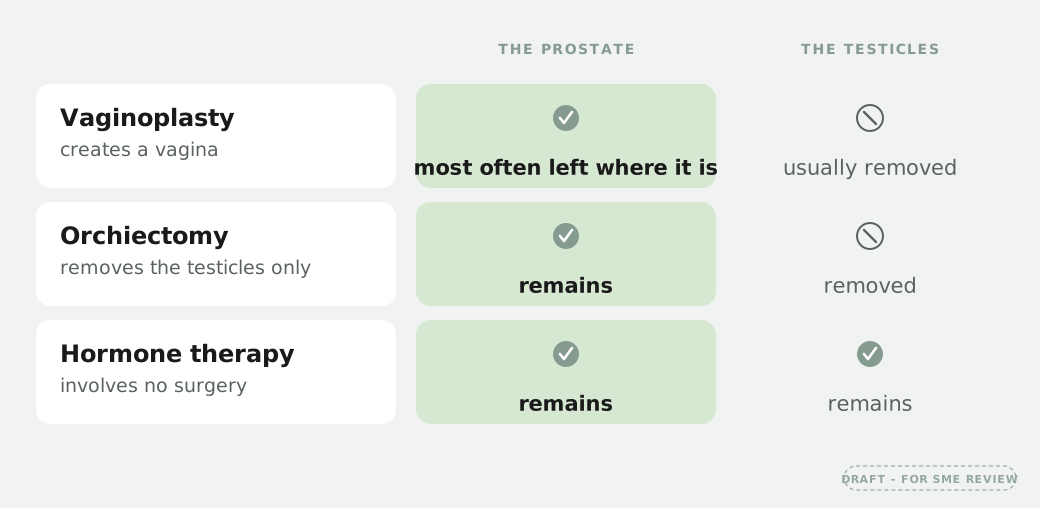
Some patients do not know this. The urologist interviewed for this lesson raises the prostate in every vaginoplasty consultation she does. It matters for urinary control and for sexual satisfaction. Patients should understand what is still part of their body.
4.2 Transgender women and gender non-conforming people
The impact of long-term hormone therapy on the prostate
Prostate cancer responds to hormones. Oestrogen with androgen blockade lowers testosterone, which is also how androgen deprivation therapy treats prostate cancer. An orchiectomy lowers testosterone in the same way.
After many years the prostate atrophies and shrinks, and the incidence of prostate cancer in this population is lower. The guidelines attribute that to the protective role of hormonal treatment as part of gender transition1.
Cancer still occurs despite that. When it does, it is more likely to be the aggressive, hormone-resistant kind, because hormone-sensitive disease has already been suppressed.
Surgery raises separate questions. In the next film, the urologist explains how prostate surgery and vaginoplasty each affect continence.
Watch a urologist explain how surgery affects continence
This clip comes from the same interview and covers continence after both operations.
Two sphincters hold urine in the bladder. Prostatectomy removes one of them, and vaginoplasty weakens the pelvic floor that supports the other.
The urologist and the interviewer
6:29so when we talk about surgery i think one of the key things to understand is the anatomy and how continents control the
6:38urine comes into play so there really are two sphincters two mechanisms to hold the urine in there is
6:45the internal sphincter which is above the prostate at the bladder neck and the external sphincter which is the muscle
6:53and that one really is in continuity with the pelvic floor the pelvic floor supports that sphincter is another way to freeze it
7:00so when the prostate is removed for for cancer prostatectomy you're really removing one of those
7:08sphincters the internal sphincter so what that means is your body is depending on that one and only external
7:17sphincter so most people after surgery have to do exercises kegel exercises to strengthen that pelvic floor and try to
7:25regain their continence where this comes into play is if you're having vaginoplasty
7:32the vaginal canal is created right behind so below the urethra prostate bladder so going
7:41through some of those muscles of the pelvic floor so in essence you're compromising some of those muscles
7:50so for most people you know after you have vaginoplasty you're not going to have continence because you have two sphincters and it's not going to have
7:58any significant effect but if you've now had the prostate removed and then are having a vaginoplasty where the only
8:06thing you're depending on is that pelvic floor and it's going to be compromised your rates of incontinence are going to be significantly higher
8:15than someone who hasn't had that procedure so it's it's going to be different your outcomes are going to be different
Listen for what happens to continence when a patient has had both operations.
You are watching the extract from 06:29 to 08:23.
4.2 Transgender women and gender non-conforming people
How the order of surgeries affects treatment
Two things follow from what you have just watched.
The first is the order the operations happen in.
A patient who has had vaginoplasty now needs a prostatectomy. How does their incontinence risk compare with the figures you would quote a cisgender patient?
If the patient has had vaginoplasty and now needs a prostatectomy, their incontinence risk is higher than the figures you would quote to cisgender patients.
Which way round the operations happen changes what you tell them.
Open each one to see what it changes.
The operation itself is also harder. An atrophied prostate has fewer clear landmarks, and scar tissue between the vagina and the prostate raises the complication rate.
If the patient has not yet had vaginoplasty and needs prostate cancer treatment, they are likely to ask whether that treatment will affect their chance of having vaginoplasty later. The urologist says this is one of the main questions she is asked by patients who have not had surgery.
4.2 Transgender women and gender non-conforming people
How radiation affects vaginoplasty in transgender women
Vaginoplasty creates a vaginal canal directly behind the urethra, prostate and bladder. Because it sits so close to the prostate, prostate cancer treatment can affect it.
Radiation for prostate cancer is given in different ways. It can be delivered externally, through small radioactive seeds placed in the prostate (brachytherapy), or as a combination of the two.
Hormone therapy shrinks the prostate over time. In studies of cisgender men, seeds placed in a smaller prostate had a greater effect on the tissue around it. After vaginoplasty, that surrounding tissue includes the vagina. The radiation can cause scar tissue that narrows the vagina, a condition called vaginal stenosis2.
It is also unknown whether radiation works as well for these patients. High-risk prostate cancer is usually treated with radiation and androgen deprivation therapy together. Patients on gender affirming hormone therapy are already taking androgen blockade, so it is not known whether adding radiation gives the same long-term survival.
When radiation is being considered, discuss the risk of vaginal stenosis and explain that survival evidence for this group is limited.
4.2 Transgender women and gender non-conforming people
How to read a PSA result in a patient on gender affirming hormone therapy
Prostate cancer screening uses a blood test for prostate-specific antigen (PSA). A raised PSA can be a sign of prostate cancer, and each result is compared against an action level that signals when to investigate further. In Australia, the action level for the general population aged 50 to 69 is 3.03 based on cisgendered men with no history of hormone therapy.
In a study of 210 transgender women taking oestrogen, the median PSA was far below that of cisgender men of the same age. How far below?
Gender affirming hormone therapy lowers PSA considerably at a base level, which means any increases must be compared to the base, not the general population guidelines. In a study of 210 transgender women taking oestrogen, the median PSA was 0.02, about 50 times lower than in cisgender men of the same age. In that study, 95% had a PSA of 0.6 or lower, and the highest result was 2.24.
Reading a PSA result on hormone therapy
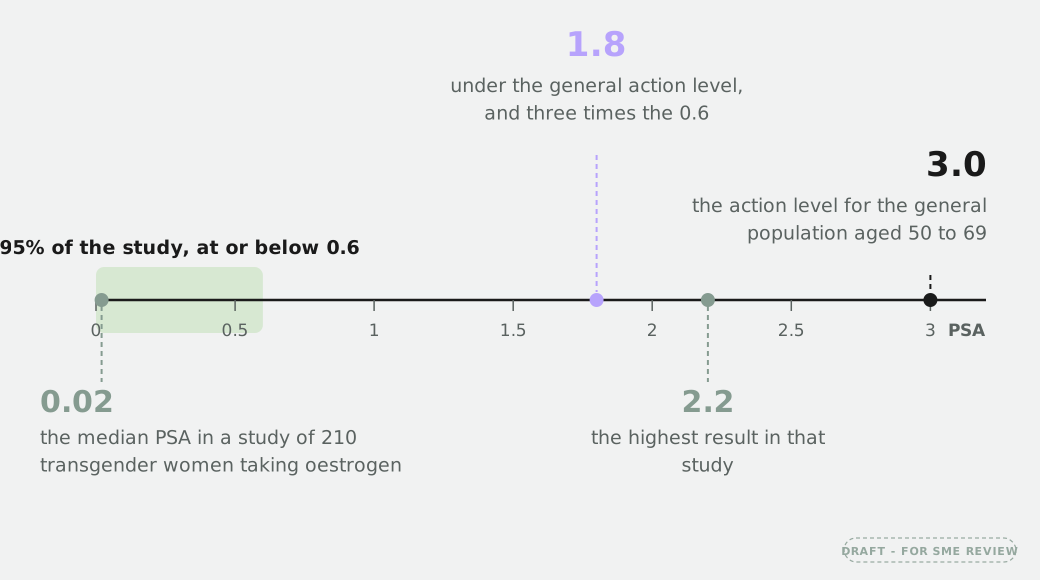
So a result under 3.0 can still be unusually high for a patient on hormone therapy. A PSA of 1.8 is under the general action level, and it is three times the 0.6 that 95% of the women in that study stayed at or below.
No action level has been validated for this population. A systematic review found the available data cannot yet establish clinical reference intervals for this population5.
So the useful comparison is the patient's own history.
Compare the patient's result with their own earlier results and discuss it with a urologist.
4.2 Transgender women and gender non-conforming people
Why prostate cancer may be diagnosed later in this group
Four factors can delay diagnosis:
Clinicians may not know if the prostate is still there.
Patients do not always disclose.
Some expect to be discriminated against, so a surgical history goes unmentioned, particularly where no intimate examination is expected.
Prostate cancer is usually silent.
By the time it produces symptoms it is generally advanced.
There is no agreed screening threshold for transgender women.
No PSA action level has been validated for this group, and there is no agreed schedule for how often to screen after hormone therapy or surgery.
The research on this population is largely case reports, and the cases reported are the patients who already had problems.
4.2 Transgender women and gender non-conforming people
How to ask, and what to say
- Ask what surgery the patient has had and say why you are asking.
- Tell them the prostate is still there.
- Explain how the order of their surgeries affects their options.
- Explain what their PSA result means for them.
Try:
SAY
- I need to ask what surgery you've had, because it changes which treatments are open to you and what the risks of each one would be. It's a clinical question rather than a personal one.
- Most gender affirming surgery leaves the prostate in place, so you're in a urology clinic for the same reason anyone else would be.
- Because you've had the vaginoplasty already, the continence risk from prostate surgery is higher for you than the figures quoted for most patients. I'd rather you heard that from me.
- The range on your report is based on men who aren't on hormones. Hormone therapy lowers PSA a lot, so your result is higher than I'd expect for someone on your treatment, even though it's under that range.
- There's no tested range for women in your position, so I'd like to compare this with your earlier results and ask a urologist to look at it with me.
If they ask whether the hormones protected them:
SAY
- They lower the risk and they don't remove it. Cancer that does develop tends to be the more aggressive kind, which is why I want to look at this properly.
4.2 Transgender women and gender non-conforming people
Say it out loud
This rehearsal asks you to say two things aloud. Say both.
You are with a 58-year-old transgender woman who has been on hormone therapy for 20 years and had vaginoplasty 12 years ago. Their PSA has come back at 1.8, which is inside the reference range printed on the result.
First, tell them they still have a prostate, and that a urology clinic is the right place for their care.
Say it out loud, now, in whatever room you happen to be in.
Then tell them that their result cannot be read against the range on the report, and that there is no tested range for them. Say it in the same tone as the first.
Phrasings that work
SAY
- Most gender affirming surgery leaves the prostate where it is, and yours did. That's why a urology clinic is the right place for your care.
- The range on your report is based on men who aren't on hormones. There isn't a tested range for women in your position, so I'm not going to call this normal. I'd like to compare it with your earlier results and ask a urologist to look at it with me.
Notice whether the second one came out more slowly than the first.
Saying there is no tested range for this patient can feel uncomfortable, and clinicians often slow down or hesitate when they say it. A patient can read that hesitation as bad news being held back. Practise until you can say the second line as calmly as the first.
Watch a urologist explain why she offers every patient the same appointment times
This clip comes from the same interview and covers appointment times.
Some arrangements are offered with the best of intentions and still set the patient apart. The most common is a quiet appointment at the end of the day, away from a full waiting room.
In this video, the interviewer describes a doctor who offered a transgender woman a 6 pm appointment and presented it as convenient for her work and her child. It also meant the waiting room would be empty. The interviewer then asks the urologist whether separate appointment times are a good idea.
The urologist and the interviewer
20:50the case anywhere good uh the idea that um some doctors may and i've heard this over the years i
20:58don't not in the last four or five years perhaps but uh some time ago uh a doctor asked a transgender or offer said to a
21:06trans i've got an appointment for you it's that i forget what the time was but let's say six o'clock and it the it was presented as like
21:16convenient so you could attend to work and uh that woman had a child so you could you know pick him up from school whatever but
21:25really the idea was uh the waiting room would be empty uh and it wasn't clear what and to me it certainly wasn't clear
21:32whether the physician didn't want the transgender woman in the waiting room or was somehow being innocently
21:39protective of her of her what are the concerns of i mean do you think well actually do you think that's
21:47a good strategy or you know to have special times for transgender women to present
21:55so in my practice that'd be virtually impossible just because the amount of individuals i see but i'm very fortunate because that's
22:03the work i do so i have a very supportive staff and and all of that um i personally
22:11hate that idea i i don't think there should be separate times i i think in many ways that works
22:18against what many many people are advocating and trying for and want for themselves generally speaking when you go to a
22:25doctor's office the best time is in the morning because of those tends to be the you know shortest wait times
22:32and i would want the best for for all my patients and yeah no i wouldn't i wouldn't recommend that yeah i mean these are almost common
22:41sense things but i think these things are offered you know out of innocence and slash ignorance but really
22:48returning to innocence somebody means well but hasn't figured out how to navigate anything you know and i'm sure 20 years
22:58ago i you know people could have said found something about my practice as well so um
23:05you know i feel more forgiving about things from the past but uh it's still for the patient presenting today for i
23:13mean you know you you're anxious and you want to the best care and you don't have to deal with any sort of perception of barriers or perception of
23:22discrimination or bigotry or anything like that um you know there there's a practice in new york city um and i guess we shouldn't
23:31mention but i think you're familiar with it from uh your time here where they have something called a man
23:38cave in the waiting room uh and you know it's it's sort of like you know sort of like a
23:45you know it's it's this 1950s style living room with a big screen tv and they have sports memorabilia and everything i mean it's basically where
23:54every one of my bullies grew up and it's so triggering and quite awful we have to get past that as well meaning as maybe
Listen for her answer: the best appointment is the earliest one, and she wants that for every patient. The conversation then turns to a waiting room designed for men.
You are watching the extract from 20:50 to 24:03. The full interview runs 28 minutes and is available in the resources at the end of this module.
4.2 Transgender women and gender non-conforming people
What the guidelines ask of you
The guidelines make four recommendations for this group1.
Screen and diagnose anyone who still has a prostate
in an environment that is inclusive and welcoming.
Ask about sexual concerns and rehabilitation needs based on the patient's anatomy and priorities
rather than on an assumed anatomy.
Acknowledge that the patient's sexual concerns relate to their identity
to their history of hormonal and surgical treatment, and to their own goals, across the whole of survivorship care.
When you look for support resources
follow the same approach as for gay and bisexual men, because the usual resources may not suit this patient6.
4.2 Transgender women and gender non-conforming people
Questions patients ask, and what the evidence can answer
The urologist names the three questions patients ask her most. Patients who have not had surgery ask how prostate cancer treatment would affect their options for surgery later. Patients who have had surgery ask how prostate cancer treatment would affect them, given the surgery they have had. Both groups ask about continence and sexual function, which the urologist describes as the areas urology knows best.
You can answer the first two from the patient's surgical history and the treatment options. You can answer questions about continence and sexual function as you would for any patient.
The evidence cannot yet show whether prostate cancer treatments work as well for this group. Beyond hormones, the evidence is single case reports, so no firm conclusion is possible. The guidelines also say it is uncertain what sexual distress these patients experience and which losses will matter to them1.
No centre specialises in this care. The urologist recommends a multidisciplinary opinion instead, with the surgeon and the radiation oncologist working together. Prostate cancer treatment is individualised for every patient.
Sort what patients ask by whether you can answer it today.
Establish what the surgery did and did not remove before you plan anything.
4.2 Transgender women and gender non-conforming people
Knowledge check
A 57-year-old transgender woman had vaginoplasty eight years ago and has been diagnosed with localised prostate cancer. They are choosing between prostatectomy and radiation therapy.
Tick every option that belongs, then check.
Tick at least one before checking.
4.2 Transgender women and gender non-conforming people
What you can do now
Which two will you use in your next appointment?
Choose, then make a note.
Choose up to two, and a space to write a note opens underneath. All of these are saved to your conversation guide either way.
What to establish and explain
What to raise and check
How to run the appointment
Marked for your next appointment.
Name when you will use what you chose. A time and a place beats a good intention.
These are saved for you, with the phrasings from this lesson, in the conversation guide on the resources screen at the end of this module.
References
- Clinical Guidelines for Sexual Health Care in Prostate Cancer (2022), p. 70.
- Kent, M.A. (2022). Real world treatment choices for transgender women with prostate cancer [Interview by D. Mitteldorf]. Malecare. https://www.youtube.com/watch?v=opLbM_NohBI
- 2026 Guidelines for the Early Detection of Prostate Cancer in Australia. Prostate Cancer Foundation of Australia. https://www.prostate.org.au/wp-content/uploads/2026/08/2026-Guidelines-for-the-Early-Detection-of-Prostate-Cancer-Summary-of-Recommendations.pdf
- Nik-Ahd, F., De Hoedt, A.M., Butler, C., et al. (2024). Prostate-specific antigen values in transgender women receiving estrogen. JAMA, 332(4), 335-337. https://doi.org/10.1001/jama.2024.9997
- Hall, R., Ball, R., Bancroft, E., Eeles, R., & Berner, A.M. (2025). Systematic review of PSA reference intervals in the gender diverse population with prostates. BJU International, 136(4), 568-577. https://doi.org/10.1111/bju.16825
- Clinical Guidelines for Sexual Health Care in Prostate Cancer (2022), p. 73.
Module 4: Inclusive care and your professional practice
4.3 Boundaries, scope and ethics
30 minutes
4.3 Boundaries, scope and ethics
The four situations this lesson puts to you

Sexual health appointments can raise boundary questions that other clinical work raises less often. You talk with patients in detail about sex and intimacy, often over longer or repeated appointments. Patients may share things they have never told anyone else. That closeness helps the work, and it can also make the line between a professional and a personal relationship harder to see.
This lesson covers four common situations:
Select each one to read it.
Each situation involves a decision.
Thinking it through now makes it easier to respond well when it happens.
4.3 Boundaries, scope and ethics
When you notice a change in how you treat a patient
You have been seeing a patient several times about the sexual effects of their treatment. You notice that you look forward to the appointments. You are more conscious of how you dress on the days you are seeing them. The sessions run over. You make more social conversation than you would with another patient.
Four things have changed. Three of them are changes in what you do. Which one is not?
Three of these are changes in what you do: how you dress, how long the sessions run, and how much you talk socially. You can check them against your appointment schedule and against how you work with other patients.
Noticing these changes is how you recognise that something needs attention.
4.3 Boundaries, scope and ethics
What to do once you have noticed
- Tell one colleague before you decide anything.
- Put the appointment back to its scheduled length.
- Decide whether to continue with the patient and decide it with someone else.
Try, to a supervisor or a peer:
SAY
- I've noticed my appointments with one patient are running long, and I want to talk it through before I do anything about it.
- I'm not sure whether I'm the right person to keep seeing them. Can you help me work that out?
Try, to the patient:
SAY
- We're going to keep to the 45 minutes from now on, so we get through everything you came for.
If you decide to hand the patient on:
SAY
- I want to get you in with a colleague who can give this the time it needs. I'll tell them where we've got to, so you can pick up from there.
4.3 Boundaries, scope and ethics
When a patient touches you
You have been seeing a couple about the sexual effects of prostate cancer. One of them reaches out to hug you every time they leave. You return the hug briefly, and you are uncomfortable about it every time.
The hug is meant kindly, and the patient has no idea you are uncomfortable. Is that a reason to leave it as it is?
Even if the hug is a way of saying thank you, your discomfort is a reason to change what happens. The patient does not know you feel uncomfortable, so it is up to you to change it.
Two things are happening at once. A patient is thanking you as they would thank anyone who had helped them. At the same time, you are repeatedly accepting physical contact you are not comfortable with, in appointments about sex, without saying anything.
4.3 Boundaries, scope and ethics
How to change what happens at the door
- Change your own position before you say anything.
- Say it warmly and once, rather than each time.
- Name what you are keeping, so the change does not read as a withdrawal.
Try, offering a hand as you stand:
SAY
- It's been good working with you both.
Try, if you would rather say it:
SAY
- I'm not much of a hugger, so you'll have to make do with a handshake. It's been good working with you.
If they ask whether something is wrong:
SAY
- Nothing's wrong at all. It's just me.
4.3 Boundaries, scope and ethics
When a patient asks about your own sex life

You are working with a couple. One of them has decreased sexual interest and difficulty reaching orgasm. The other turns to you and asks what you do to spice up your own sex life.
The question follows from the appointment. You have spent an hour asking them about their sex life, and they have answered every question. Asking you back is what makes the exchange feel even.
If you answer, you share personal information that changes your professional relationship with them. If you refuse abruptly, they may feel embarrassed for asking after sharing so much themselves.
4.3 Boundaries, scope and ethics
How to decline a personal question respectfully
A good answer has three parts. Put them in the order the clinician uses, then read the wording for each.
- Say why the question makes sense.
SAY
- That's a fair question to ask someone who's been asking you about yours.
- Give your reason for not answering, rather than a rule.
SAY
- I don't talk about my own, because what works for me tells you nothing about what would work for the two of you.
- Replace it with what you can offer instead.
SAY
- What I can do is take you through what other couples have found useful. Where would you like to start?
If the question keeps coming back:
SAY
- I'm going to keep ducking that one. Let's stay with what the two of you are working out.
4.3 Boundaries, scope and ethics
When one of them asks to see you alone
You have seen a couple together several times. One of them rings and asks for an appointment on their own.
A private appointment can help, because people sometimes say things alone that they would not say in front of their partner. Andrew waited until Jeff was away to tell his clinician that being penetrated had hurt him, and the rest of that appointment built on it.
The risk is that one partner tells you something the other does not know you have heard. In later joint appointments, you are holding information that one of them has not shared.
One of them rings and asks to see you on their own. What do you do?
Agree to the appointment. At the start, before they tell you anything, agree with them whether what they say will stay between you or can be raised when you see them together.
4.3 Boundaries, scope and ethics
Patient or partner, and what you settle first
It matters whether the person asking to see you alone is the patient or the partner, because your responsibilities to each of them are different.
The patient is yours. A private appointment with the patient is ordinary care, and the partner has no claim on what is said in it.
Services differ on whether the partner is a patient. In some, a partner can be seen in their own right. In others, the partner is not your patient, and a private appointment with them is a different thing. Check how your own service works before you agree to see a partner alone.
Either way, they may want help with their own sexual health, which the guidelines support and Module 3 taught you to ask about, or they may want to tell you something about the patient.
Settle the same thing either way, before the appointment starts:
SAY
- Anything you tell me stays with me unless you and I agree otherwise. I won't bring it into the joint sessions on your behalf.
- If it's something the two of you need to talk about, I'll help you work out how to say it. I won't say it for you.
4.3 Boundaries, scope and ethics
Rewrite it
A man you have seen three times since his prostatectomy has been describing how hard it has been to have sex without an erection. He stops and asks whether you have ever had problems with sex yourself.
Here is what a lot of us would say.
- I'm not going to answer that. Let's keep the focus on you.
Rewrite it: say why the question makes sense, give your reason for not answering rather than a rule, and replace it with what you can offer instead.
Write your version before you reveal the model answer.
SAY
- That's a fair thing to wonder, after everything you've told me.
- I keep my own life out of these appointments, because my experience wouldn't tell you much about yours.
- What I can tell you is what other men in your position have found helpful. Would that be useful?
Compare it with yours, then use your own wording.
4.3 Boundaries, scope and ethics
Knowing where your expertise ends

Clinicians come to this work from different starting points. Sexual health is not yet a standard part of medical or health professional education1, so a urologist or oncology nurse may know prostate cancer treatment well and have less training in sexual health. A sexual health specialist or psychosexual therapist may know sexual health well and have less experience with cancer treatment.
Wherever your expertise sits, it has limits and recognising them is part of good practice. Knowing where your expertise ends lets you decide what to manage yourself and when to involve a colleague.
As patients come to trust you, they may raise issues that go beyond what you are trained to manage.
Decide what you will treat and what you will refer while the patient is still with you, so they get the right care when they need it.
4.3 Boundaries, scope and ethics
Coping with boundaries being tested

Guideline statement 44 asks clinicians to undergo sexual health education in interprofessional groups, using case-based and reflective learning, and it is a strong recommendation1.
That is a statement about education, and it also describes what you need when a boundary has been tested: a case, discussed with people from other disciplines who are willing to examine their own part in it.
All four situations in this lesson have the same first step. Find the group, or the supervisor, or the one colleague, and have the conversation there.
If your service has no such group, supervisor or colleague, setting one up is a change worth making. The last lesson in this module covers how to make changes like this in your service.
4.3 Boundaries, scope and ethics
Knowledge check
You have seen a patient six times about the sexual effects of his treatment. You realise you have moved his appointments to the end of the day, and last week you gave him your personal mobile number so he could text you between appointments.
Tick every option that belongs, then check.
Tick at least one before checking.
4.3 Boundaries, scope and ethics
What you can do now
Which two will you use in your next appointment?
Choose, then make a note.
Choose up to two, and a space to write a note opens underneath. All of these are saved to your conversation guide either way.
Before it happens
When it happens
Marked for your next appointment.
Name when you will use what you chose. A time and a place beats a good intention.
These are saved for you, with the phrasings from this lesson, in the conversation guide on the resources screen at the end of this module.
Module 4: Inclusive care and your professional practice
4.4 Why sexual health gets left out of care
20 minutes
4.4 Why sexual health gets left out of care
Why sexual health support is often missing from cancer care

The previous lesson covered decisions about your own practice. This lesson looks at the wider system: why sexual health care is often missing from cancer care, and what changes that.
Many patients see sexual health as a very important part of their care, but the support available to them is limited. The guidelines set out several reasons for this1.
Clinicians can feel uncomfortable discussing sex. They may lack knowledge, resources, or a sexual health provider to refer a patient to. Some believe that a person with cancer is more concerned with survival than with sexuality.
Cancer patients report a high need for sexual health information, and that need is rarely met. Men with prostate cancer have better access to sexual health support than people with other cancers. Even so, many of their needs are not met.
These barriers come from how services are organised, which means services can change them.
4.4 Why sexual health gets left out of care
What stops clinicians raising sexual health
In a hospital-based study, clinicians named their two most common barriers to discussing sexuality.
One of the common barriers named was lack of training. What percentage do you think named this?
Lack of training came first at 38%. The topic being difficult to discuss came second at 27%2.
The guidelines note that sexual health is not yet a standard part of medical or health professional education, and that further education for clinicians is limited. The programs that do exist have often not been evaluated, have shown limited effect, or have not been found useful by the people who took them1.
One health professional described how the topic gets missed:
"I don't think as a topic it's something which is brought up as early as perhaps it could and should be in the pathway… and I suppose the risk with that is it sort of becomes a bit of a taboo thing that's never talked about."
4.4 Why sexual health gets left out of care
The belief that sexual health belongs to another discipline
Training is only part of the picture. One study of nurses and one review of 18 studies found the same two things3,4: significant gaps in education and confidence, and a belief among nurses that sexual health was not primarily their responsibility.
The second finding matters because training alone may not change that belief. Clinicians who see sexual health as part of their own role can raise it with patients, even when another discipline also provides care.
This belief is not limited to nursing. Robinson and Lounsberry describe health professionals across disciplines who believe the responsibility lies with another discipline5. When every discipline assumes another will ask, the patient may never be asked at all.
When your service agrees whose role it is to ask, the question becomes part of routine care and every patient is asked.
4.4 Why sexual health gets left out of care
Why patients do not raise sexual health themselves

Patients also wait to be asked. O'Brien and colleagues interviewed 35 men after treatment for prostate cancer, with partners present in 18 of the interviews6. The men said their clinicians rarely invited them to discuss sexual health concerns.
The older men in that study gave a second reason for not raising sexual health themselves. Can you guess what it was?
Their age. They were embarrassed to bring up sexual health with a professional because of how old they were.
Clinicians can make the same assumption about age. One reason clinicians give for not starting the conversation is the belief that sexuality is not a concern for patients who are very young or old5.
This means an older patient may be waiting for the clinician to ask, while the clinician assumes the topic does not matter at his age.
Raise the topic yourself, whatever the patient's age.
4.4 Why sexual health gets left out of care
Why patient handouts can fall short

Asking patients about sexual health is the first step. The written information you give them afterwards also needs to be easy to use. An observational study of patient resources on the sexual side effects of prostate cancer found them often inadequate. More than 50% of the materials reviewed were written above a high school reading level. Another 16% scored unacceptably for the cultural sensitivity of their visual messaging7.
So, a patient who wants to know more may be given material that is too hard to read, or with images and examples that do not reflect their culture or their life.
This is the easiest barrier in this lesson to check. Read the handouts your service gives out and consider whether your patients could understand them and whether the images and examples reflect the patients you see.
4.4 Why sexual health gets left out of care
Patients who have even less access to expertise
The guidelines note that every barrier in this lesson is greater for lesbian, gay, bisexual, transgender and intersex patients, because even less expertise is available to them1.
Earlier in this module you learned what changes clinically for gay and bisexual men and for transgender women. There are also fewer specialists to refer these patients to.
The American Society of Clinical Oncology has called for more education and competency training, so that providers can work effectively with sexual and gender minorities. The guidelines agree it should be part of any sexual health education, which is the approach described on the next screen.
4.4 Why sexual health gets left out of care
Three changes you can start with
- Add a sexual health question to the standard follow-up form.
- Take one real case to a group that includes other disciplines.
- Read your own handouts before you give another one out.
Try, to whoever owns your follow-up template:
SAY
- Can we add one sexual health question to the standard template? At the moment only a few of us ask it, so many patients aren't asked.
Try, at a team meeting:
SAY
- I'd like to bring a case to the next one. It's a sexual health case and I want more than my own discipline looking at it.
Try, with the patient:
SAY
- I ask everyone I see about sexual health, so it's a normal part of your appointment.
4.4 Why sexual health gets left out of care
Think of the last patient you saw who had been treated for prostate cancer.
Was that person asked about their sexual health, and who asked?
Write down one thing about your service that decided the answer.
4.4 Why sexual health gets left out of care
Knowledge check
An audit of your service finds that patients treated for prostate cancer are asked about their sexual health in about one appointment in ten, and that only a small number of clinicians ever ask.
Tick every option that belongs, then check.
Tick at least one before checking.
4.4 Why sexual health gets left out of care
What you can do now
Which two will you use in your next appointment?
Choose, then make a note.
Choose up to two, and a space to write a note opens underneath. All of these are saved to your conversation guide either way.
How to see the gaps
What to change in your service
Marked for your next appointment.
Name when you will use what you chose. A time and a place beats a good intention.
These are saved for you, with the phrasings from this lesson, in the conversation guide on the resources screen at the end of this module.
References
- Clinical Guidelines for Sexual Health Care in Prostate Cancer (2022), p. 99.
- Jonsdottir, J.I., Zoega, S., Saevarsdottir, T., et al. (2016). Changes in attitudes, practices and barriers among oncology health care professionals regarding sexual health care: Outcomes from a 2-year educational intervention at a University Hospital. European Journal of Oncology Nursing, 21, 24-30. https://doi.org/10.1016/j.ejon.2015.12.004
- Julien, J.O., Thom, B., & Kline, N.E. (2010). Identification of barriers to sexual health assessment in oncology nursing practice. Oncology Nursing Forum, 37(3), E186-E190. https://doi.org/10.1188/10.onf.e186-e190
- Kotronoulas, G., Papadopoulou, C., & Patiraki, E. (2009). Nurses' knowledge, attitudes, and practices regarding provision of sexual health care in patients with cancer: Critical review of the evidence. Supportive Care in Cancer, 17(5), 479-501. https://doi.org/10.1007/s00520-008-0563-5
- Robinson, J.W., & Lounsberry, J.J. (2011). Communicating about sexuality in cancer care. Chapter 35. https://doi.org/10.1093/acprof:oso/9780199238361.003.0035
- O'Brien, R., Rose, P.W., Campbell, C., et al. (2010). Experiences of follow-up after treatment in patients with prostate cancer: A qualitative study. BJU International, 106(7), 998-1003. https://doi.org/10.1111/j.1464-410x.2010.09292.x
- Choi, S.K., Seel, J.S., Yelton, B., et al. (2018). Prostate cancer information available in health-care provider offices: An analysis of content, readability, and cultural sensitivity. American Journal of Men's Health, 12(4), 1160-1167. https://doi.org/10.1177/1557988318768599
Module 4: Inclusive care and your professional practice
4.5 Being the destination
30 minutes
4.5 Being the destination
Why sexual health care belongs in your service

Most of this course has focused on what happens within appointments. This lesson looks at the service around them, and at becoming the clinician other services refer patients to.
The guidelines note that cost is usually the reason given for not including a psychosexual specialist in a cancer service. Leaving that role out tells patients and partners that sexual health is not an essential part of prostate cancer care1.
When sexual health care is part of the service, it reduces the stigma of asking for help and gets people into rehabilitation sooner.
The next film shows what ongoing care makes possible. It returns to a couple you have followed since before surgery.
Watch a couple review their priorities a year after surgery
Doug and Jean, at their fifth appointment
In Module 2, you watched Doug and Jean, before his surgery, rate how much they each valued physical pleasure and how much they valued closeness with each other. A year after his surgery, their clinician asks them to rate it again.
Doug, Jean and the clinician
8:11as when you engage in non penetrative strategies. Mm-hmm. Mm-hmm. Okay. So one of the things I thought we could touch on was.
8:18if you remember back to the very first time mm-hmm. You came in to see me mm-hmm. I had you fill out, uh, a grid, right? Yes.
8:26Where you rated how much you valued sexual activity for pleasure or for relational closeness mm-hmm. Or connection. Mm-hmm. And I'm curious to determine whether
8:36or not using the injections has changed that experience at all for you. What would you say, Gina? Remember you saying you're pretty high on the
8:45relational aspect? Mm-hmm. Mm-hmm. Um, hmm. Using the injection Well, I guess, uh, I, I would think that we probably adjusted
8:57and learned to appreciate the re relational aspect more. Okay. And, um, the physical pleasure, um, has probably become less important.
9:12It's probably a product of our experience and, uh mm-hmm. Of our own maturity. Mm-hmm. Okay. So you've, you've adapted mm-hmm. Right.
9:23You've changed over the course of the last year, and in fact, the reasons that you value sex have maybe changed.
9:29If I gave you that form again, you might rate it a little bit differently, it sounds like. Mm-hmm. That's, that's quite possible. Mm-hmm. Okay.
9:36Now, whether I would or not, I, I'm honest, I think intimate relationships are still, um, uh, important. Mm-hmm. Yep. But the degree
9:46to which sex is the way you connect with your partner. Yeah. Yeah. Okay. So I think that, uh, the physical part is, uh,
9:53maybe it is a little different. I, I may have had to adapt more than she has had to adapt.
9:59That's possible. Mm-hmm. Okay. So you talked about the clinical nature of using these interventions. Mm-hmm. So using an injection, it's like you have to stop
Listen for how their ratings have changed, and the reasons they give.
You are watching the extract from 08:15 to 10:01. The full session runs 17 minutes and is available in the resources at the end of this module.
4.5 Being the destination
Why follow-up appointments matter

Doug and Jean have been seen five times across a year. Between the first appointment and the fifth, what they wanted from sex changed, and they say so themselves.
Couples usually work out what they want over several appointments, by trying things, finding that some do not work, and adjusting the plan.
Module 3 followed couples across several appointments. From the service's side, this means building follow-up into the plan at the first appointment, so the plan can be adjusted to what happened.
4.5 Being the destination
Deciding which referrals to take on
Becoming a referral destination means deciding what you will accept. You have already learned when to refer patients on, and this is the other side of that decision.
- Take on what your training covers and what you can see through. Passing a referral on after accepting it delays the patient's care.
- Take on the conversation even where the treatment is managed elsewhere. A man whose medication is managed by a urologist may still need a clinician to talk about what he wants from treatment.
A referral arrives for something that needs a different discipline. What happens to your involvement with the patient?
Refer on what needs a different discipline and stay involved. You can refer a treatment and keep seeing the patient.
Decide what you will accept before referrals arrive.
4.5 Being the destination
Other disciplines involved in the patient's care

A patient treated for prostate cancer is seen by several disciplines. Each can contribute something different to their sexual health care.
- Urology. The prostate, the nerves and the pro-erectile treatments. Medication doses, devices and surgical options sit here.
- Radiation oncology. What the radiation did and what recovery to expect, including side effects that can develop months after treatment ends.
- Nursing. Nurses often have the most contact with the patient, which puts them in a good position to ask about sexual health.
- Psychology and psychosexual therapy. Specialist couple and psychosexual therapy when education and support in your appointments are not enough (guideline statement 26).
- Physiotherapy. The pelvic floor, which affects both continence and arousal.
- General practice. Prescriptions between appointments, and ongoing care for the rest of the patient's life.
You are unlikely to be the only one of these clinicians your patient sees, and some of them see him more often than you do. Find out who they are, so you can work with them on his sexual health between your appointments.
4.5 Being the destination
What referrers need from you
Some clinicians hold back from raising sexual health because they are not sure where to send the patient next. One health professional described it:
"If I was to talk to them about it, what am I saying to them? Where am I signposting them to?"
When you accept referrals, you give colleagues like this an answer. They are more likely to keep referring when they learn what happened, can tell the next patient what you will do, and can see the referral was worth making.
Timely feedback shows referrers that the referral was worth making. Send it soon after you see the patient, while the referrer still remembers them.
4.5 Being the destination
How to respond to a referral
- Acknowledge it the same week, even where the appointment is months away.
- Tell the referrer what you are going to do, in one line.
- Send something back after the first appointment.
A referral for Mr Halloran arrives this morning and you can see him on the 14th. Write the line you would send the referrer today.
After receiving the referral
SAY
- Got your referral for Mr Halloran. I'll see him on the 14th. Thanks for asking him about it.
After the first appointment
SAY
- Saw Mr Halloran today. He and his wife hadn't talked about it at all, so we've started there. I'll keep you posted, and I've left the tadalafil with you.
If the referral is outside what you take on
SAY
- This one needs a urologist more than me, so I've sent it across to the clinic. Happy to see him afterwards for the couple side, and keep sending me these.
4.5 Being the destination
Making it easy for colleagues to refer to you

Colleagues can only refer patients to you if they know about your service and how to reach you.
A referrer needs four things: your name, what you take on, how to send a patient, and how long the wait is. Write these down and send them to the services that should be referring to you, so referring is simple.
The guidelines make a similar point about the whole system. There are too few experts in this area, which limits the education and resources available to support sexual recovery2. Making your service easy to find helps patients reach the expertise that does exist.
4.5 Being the destination
Making patient materials culturally appropriate
Guideline statement 45, a moderate recommendation, asks providers and healthcare systems to develop culturally appropriate materials for counselling about what prostate cancer treatment does to sexual health2.
The recommendation draws on the study of patient materials described in the previous lesson, which found many were hard to read or not culturally sensitive. The authors concluded that what is available in healthcare practices may not meet patient needs for content, cultural sensitivity or readability3.
The guidelines recommend asking patients, partners and other stakeholders to review materials before they are used.
4.5 Being the destination
How culture shapes what recovery means

The definition of sexuality varies with cultural, ethnic and racial understandings, and so does the value attached to each part of it. The guidelines ask for enough cultural awareness to define what the population you serve needs, and to use language they find acceptable2.
Two studies show what that means in practice. Among Black African and Black Caribbean men, support systems differed from those White men described. Cultural definitions of masculinity also shaped how these men understood their experience after treatment. Among Latino men, cultural taboos around sex and masculinity limited what they learned and delayed detection. Fathers were a valued source of information, and their roles affected whether sons intended to be screened.
The guidelines also note that some patients have unrealistic expectations of treatment and experience regret about its side effects2. When a patient and clinician understand recovery differently, misunderstandings about side effects are more likely and can go unnoticed by both of them.
4.5 Being the destination
Tailoring education to your local community
Guideline statement 46 is expert opinion. It asks that patient education programs about sexual recovery be tailored to local cultural influences, to the resources available in the region, and to how recovery and its priorities are understood there4.
The guidelines explain why local tailoring matters. Local understandings of sexual health shape what support men and partners receive, and how an institution applies guidelines like these.
The aim is for each patient to meet a clinician whose information is locally relevant, respectful and free of bias. Patients who get that are more likely to accept psychosexual care.
Design what you offer around the patients your service sees.
4.5 Being the destination
How cost affects access to treatment
Guideline statement 47 is a clinical principle. It asks that all insurance providers cover the treatment of sexual dysfunction caused by prostate cancer therapy, to recognise it as part of cancer care and to reduce differences in who can get it5.
The guidelines describe the current position plainly. Medications and devices cost a considerable amount. There is little data on what is available globally, and most men are unlikely to be able to access it. Even in wealthy countries, sexual rehabilitation after prostate cancer treatment is not part of usual health care.
In England the NHS limits patients to one tadalafil tablet a week, although two meta-analyses found daily tadalafil more effective. What share of patients preferred daily?
Two examples show how funding rules shape clinical practice. In the United States, Medicare, the national health insurer for people over 65, stopped covering erectile dysfunction medication in 2005 and vacuum devices in 2015. In England, the NHS limits patients to one tablet a week, although two meta-analyses found daily tadalafil more effective and 72% of patients preferred it.
4.5 Being the destination
Where the evidence is still developing
The guidelines close by naming the areas where more research is needed. Three of them relate directly to what this course has taught you6.
- Penile rehabilitation. There is not yet convincing evidence that rehabilitation protocols improve the recovery of erectile function. The guidelines see its current value in bringing the couple into recovery early and building confidence with erectile aids.
- Interventions for sexual and gender minorities. These are still being developed. The guidelines call for research into what these populations need, so interventions can be designed and tested.
- Culture and stigma. Where laws or religious prohibitions threaten particular sexual practices or relationships, men may avoid cancer treatment to preserve sexual function, which can lead to late diagnosis and early death. The guidelines call for research to guide action on this.
This course has taught both established practice and areas where research is still developing. When you offer care, tell patients which parts are well established and which are still being researched.
4.5 Being the destination
Think about the service you work in.
If a colleague wanted to send you a patient with a sexual health concern tomorrow, what would they have to already know, and how would they find out?
Write down the one thing that would be hardest for them.
4.5 Being the destination
Planning one change in your service
- Pick what you just wrote down.
- Make it small enough to do without a business case.
- Name the person who has to agree and go to them this month.
Most changes of this size need only one person's agreement. For example, you could add a line to the follow-up template, send a short description of what you take on to the services that should be referring to you, add a standing item to a team meeting agenda, or ask two patients to read a handout before it is reprinted.
Try, to whoever has to agree:
SAY
- I want to add one line to the follow-up template. It takes a minute in the appointment, and it means every patient gets asked.
- Can I have ten minutes at the next team meeting? I want to set up a standing slot for a sexual health case, because the guidelines ask for it to be worked across disciplines.
Name the change and when you will take it to the person who has to agree.
4.5 Being the destination
Knowledge check
A general practitioner refers a man 14 months after prostatectomy. He is using tadalafil, it works about half the time, and he and his wife have stopped trying to have sex on the nights the medication does not work. The referral letter asks you to review his medication.
Tick every option that belongs, then check.
Tick at least one before checking.
4.5 Being the destination
What you can do now
Which two will you use in your next appointment?
Choose, then make a note.
Choose up to two, and a space to write a note opens underneath. All of these are saved to your conversation guide either way.
Setting your service up
Working with referrers
Making it fit your patients
Marked for your next appointment.
Name when you will use what you chose. A time and a place beats a good intention.
Anything you mark appears here
Nothing marked yet. Anything you mark here or on an earlier lesson’s closer appears in this list.
These are saved for you, with the phrasings from this lesson, in the conversation guide on the resources screen at the end of this module.
4.5 Being the destination
You have completed the course
You began with the case for having the conversation. Since then, you have learned to assess and to plan and deliver interventions. You have also learned to adapt your practice for patients whose needs are less well covered by current research, such as gay and bisexual men and transgender women.
Your toolkit holds the reflections you wrote, the words you rehearsed and the one change you named.
Keep the guidelines you have been working from as your reference. No other document in this field covers all of this in one place: assessment, intervention, particular populations and the systems around them.
Your next step is to book the conversation with the person who has to agree to your one change.
Before you go: how confident do you feel about caring for a patient whose sexual health needs are less well covered by the research, in your next clinic?
References
- Clinical Guidelines for Sexual Health Care in Prostate Cancer (2022), p. 107.
- Clinical Guidelines for Sexual Health Care in Prostate Cancer (2022), p. 101.
- Choi, S.K., Seel, J.S., Yelton, B., et al. (2018). Prostate cancer information available in health-care provider offices: An analysis of content, readability, and cultural sensitivity. American Journal of Men's Health, 12(4), 1160-1167. https://doi.org/10.1177/1557988318768599
- Clinical Guidelines for Sexual Health Care in Prostate Cancer (2022), p. 102.
- Clinical Guidelines for Sexual Health Care in Prostate Cancer (2022), p. 103.
- Clinical Guidelines for Sexual Health Care in Prostate Cancer (2022), pp. 106 and 107.
Resources from this module
Tick the resources you would like to keep, then email them to yourself. Anything you saved as you went along is already ticked for you.
Your reflections
Everything you wrote during this module is still here, on this device. Open it to read it back, print it or email it to yourself.